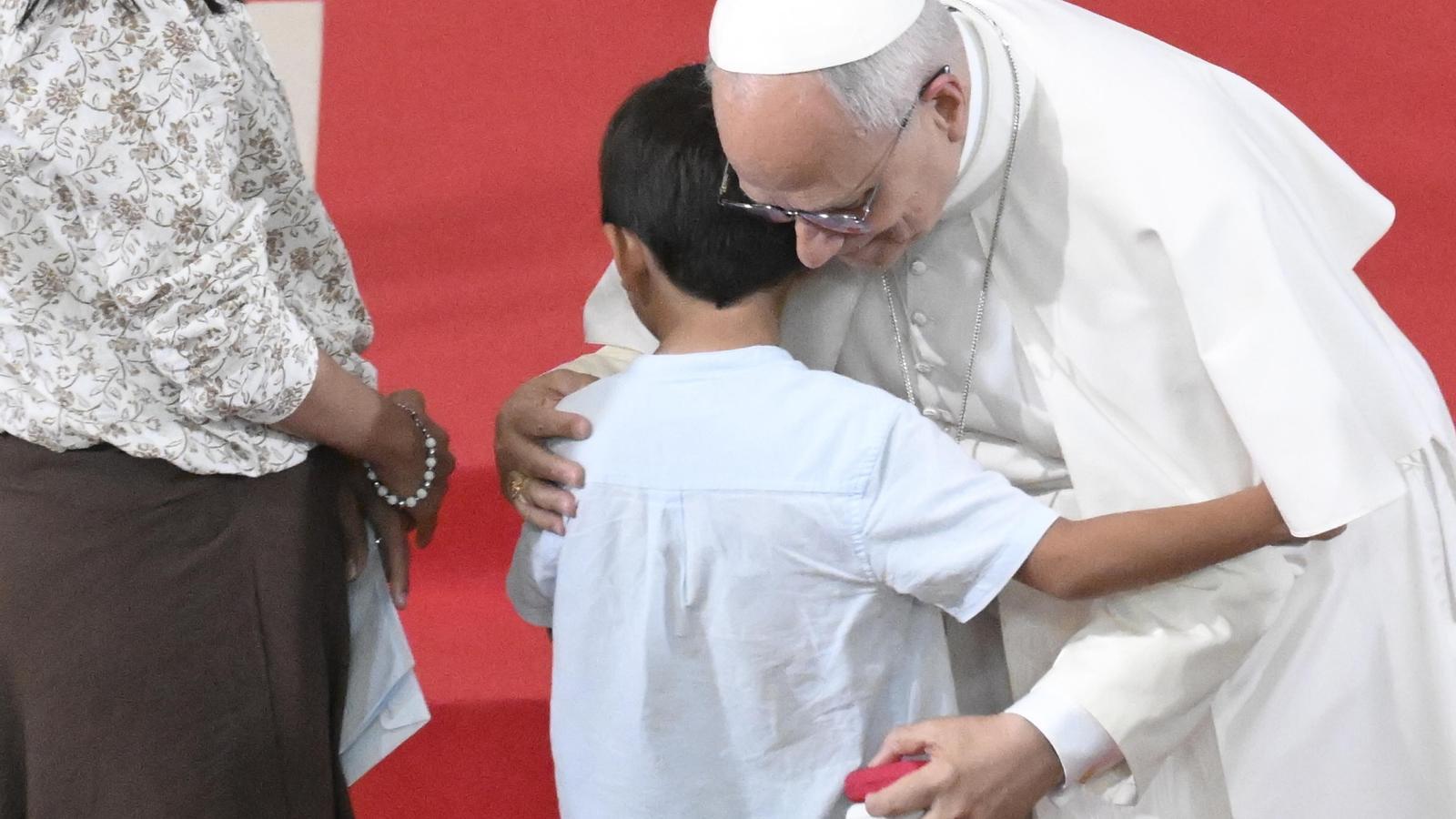
Leo XIV and the child Renzo: "Why do some people have good things happen to them and others don't?"
The Pope reserves the last day of his visit to Barcelona for two small-scale events at Brians prison and the parish of Sant Agustí del Raval

-
CAT -
CAST
Sant Esteve SesroviresThe Pope has reserved the two small-format, more intimate events for the second and last day of his visit to Barcelona to meet with vulnerable groups. In the morning, he met with about eighty inmates at the Brians 1 prison, in Sant Esteve Sesrovires, before heading to the monastery of Montserrat. In the afternoon, he chose the modest church of Sant Agustí, in the heart of Barcelona's Raval, on his way to the central event of the blessing of the Sagrada Família's tower of Jesus. It was, therefore, a day marked, on the one hand, by two great symbols of Catalan spirituality and, on the other, by two points where current social problems are felt.
Both in the prison and in the church, Leo XIV used Catalan to address a small audience, which included the highest Catalan civil and religious authorities and representatives of various entities that the head of the Vatican wanted to hear firsthand.
It was at Sant Agustí that the Pope was seen to be moved, paying attention to the words of Renzo, a six-year-old boy from an immigrant family who lives in the Nou Barris district and who, when he learned of the papal visit, sent a letter to the Vatican explaining that his family lives with the threat of being evicted for not being able to pay the rent.
The little one stole some of the pontiff's spotlight by raising his small voice to ask the Pope a series of questions. One after another, the child laid out the current problems faced by the most suffering population: "Hello, Pope. I want to ask you some questions. Do you like football? Did you want to be a pope when you were little? Why does my father have so many jobs? Why do some people have bad things happen to them and others don't? Whose fault is it? Why do some people live on the streets and no one helps them? Does God want there to be poor and rich people? Why are there so many lonely old people if they are so important? Should we always forgive?".
Leo XIV dedicated a large part of his words to answering the child, who was accompanied by his mother. He told him not to abandon his dreams, and using a football analogy, he praised the value of "teamwork" in comparison to players who, even if they are very good, "never pass the ball or let the rest in." He spoke of hope, of trust in Jesus Christ, and of the Christian value of knowing how to forgive, although he insisted that forgiving does not mean forgetting or turning bad things into good ones.
He has been very categorical in his response regarding the loneliness of the elderly. Leo XIV has defended that they are "important people" for society and that they should be given back the work done by helping to raise grandchildren to make them "good men and women". "We do not allow loneliness to be normalized. Let us have open hearts and, even if they are not our grandparents, let us not allow them to feel alone and unprotected," he said.
Sant Agustí's is a small and unfinished church in the square of the same name in Barcelona's Raval. Frequented by the Latin American and Filipino community of the neighborhood, it has no trace of opulence in statues or decoration. "I feel at home," proclaimed the Pope, belonging to the order of the Augustinians, who has shown his satisfaction that the temple is open, unlike how he found it in 1982 on a previous visit to the city.
Unprecedented visit
Inside the walls of Brians 1 prison, the Pope has achieved the milestone of being the first pontiff to visit a Spanish penitentiary center. Furthermore, as the event was concentrated in the small theater, a proximity was achieved almost as if it were a private audience. The visit broke the penitentiary routine for both the officials and the approximately eighty inmates present, who described the event as "historic." On the wall shone the words of Matthew: "I was in prison, and you came to see me." A welcome that the pontiff reciprocated in Catalan: "Thank you all for your reception so full of sympathy and cordiality."
The audience was then already moved by the words of Josefina and Montserrat Benavente, two inmates who could not hide their "emotion" at the fact that the pontiff had made time to visit such an "invisibilized" group. They explained complicated lives, mistakes for which they pay with the loss of freedom, but they also expressed to what extent "belief and faith" have reconnected them with life. "Thanks to faith, I am a better person," stated Benavente, who embraced the pontiff in a heartfelt hug, even though minutes before, while waiting for the event to begin, she said she knew that "you cannot touch the Pope."

Leo XIV has reminded the prisoners that they are "worthy" and assured them that "life's mistakes do not determine a person's identity." Prison is an earthly punishment, but "there is no situation that makes the Lord turn away his gaze," he said, adding that God's love is "merciful" even if we have "done wrong." "When the temptation comes to feel less than or you think it's not worth going on, lift your gaze," he said, addressing the prisoners, to whom he asked to continue "dreaming God's dream." Leo XIV assured that being a Christian "does not consist in not making mistakes," but in "the ability to convert, repent, amend, and, above all, reconcile and forgive" to "start anew."
Before the Virolai brought the meeting to an end, the Pope and the prisoners exchanged symbolic gifts. On behalf of the inmates, a painting and a ceramic plate made in the training workshops. On behalf of the pontiff, a portrait of the Virgin Mary. The Pope left the small theatre greeting the public, with some selfies and many handshakes. "It's historic, I never imagined I would have him so close," said two female officials.
To commemorate the visit, cannelloni will be served in all Catalan prison canteens, a meal reserved for special occasions. However, if the Pope is God's representative on earth, it has become clear that in Brians, earthly law reigns. Once Leo XIV had left, civil and ecclesiastical authorities left the hall, and the rest of mortals had to wait inside, without moving. "First, we have to count the prisoners." At the door, an official passed the detector over the prisoners' bodies. These are the prison rules.
