The laughing gas, the drug of young tourists that the police fight to sanction
The first time it was found in Barcelona was in 2016, but its origin dates back to the 18th century

-
CAT -
CAST
BarcelonaIt was the late 18th century and the English chemist Joseph Priestley made a discovery that revolutionized medicine. Specifically, he thought of a way to feel it less: he discovered a new gas, nitrous oxide, which had analgesic properties and could relieve pain. It was one of the first gases used to anesthetize a patient before surgery. In fact, it is still used in childbirth today. However, without knowing it, Priestley also revolutionized the parties of the time: the elites began to try nitrous oxide and discovered that, besides being a good analgesic, in small quantities it produced a feeling of euphoria. It became a fashion at high society parties. The laughing gas had just been born.
Young people consuming gas with a balloon in the center of Barcelona is a relatively new trend, but this gas, understood as a recreational substance, has more than two hundred years of history. On Sunday, June 28, a young man was consuming laughing gas inside a car, parked improperly at the doors of a hotel in the Sant Martí district. The hotel staff called the police and the young man fled, a chase that ended fatally on Carrer Pallars when, driving against traffic and at a speed far above the limit, he collided head-on with a vehicle stopped at a traffic light. Both drivers died.
One of the first times laughing gas was detected in Barcelona, explains the deputy inspector of the Guàrdia Urbana de Barcelona, Javier Peláez, was in 2016. Exactly 5,000 capsules were seized. However, consumption really began to grow after the pandemic, in the nightlife areas of the waterfront. It is a substance imported from Northern Europe, where it became popular due to the lack of milder drugs like marijuana. And, since then, the same trend has been repeating: "Throughout the year we don't detect a large presence of it, but in the summer it increases a lot," explains Peláez.
The effect in hospitals
The consumer has a fairly marked profile: young, in some cases minors, tourists, and who take it to go out partying. The head of toxicology at the Hospital Clínic, Emilio Salgado, describes that they have few hospitalizations per year for this substance, which often goes unnoticed in the emergency room, and he is "concerned" about its consumption. Although it seems less harmful, he specifies that it slows down the arrival of oxygen to the brain and that prolonged consumption can have neurological consequences, as it oxidizes vitamin B12. Mireia Ventura, director of the international drugs area of ABB-Energy Control, explains that at low doses this gas produces euphoria and has a momentary effect, lasting seconds. It is an ephemeral and risky happiness, as Ventura agrees that it is in prolonged consumption where pathologies arise. At the Clínic, Salgado has treated cases of young people who took 150 balloons of laughing gas in a single day.
In total, however, cases of nitrous oxide intoxication attended in the emergency area of the Hospital Clínic are residual compared to other drugs. In 2025, for example, laughing gas accounted for 0.64% of all attendances. There are few cases, but they are on the rise: in 2020 one case was attended, in 2021 there were already two, the same as in 2022, but in 2023 they rose to four and 2024 and 2025 have closed with nine attendances.
Difficult regulation
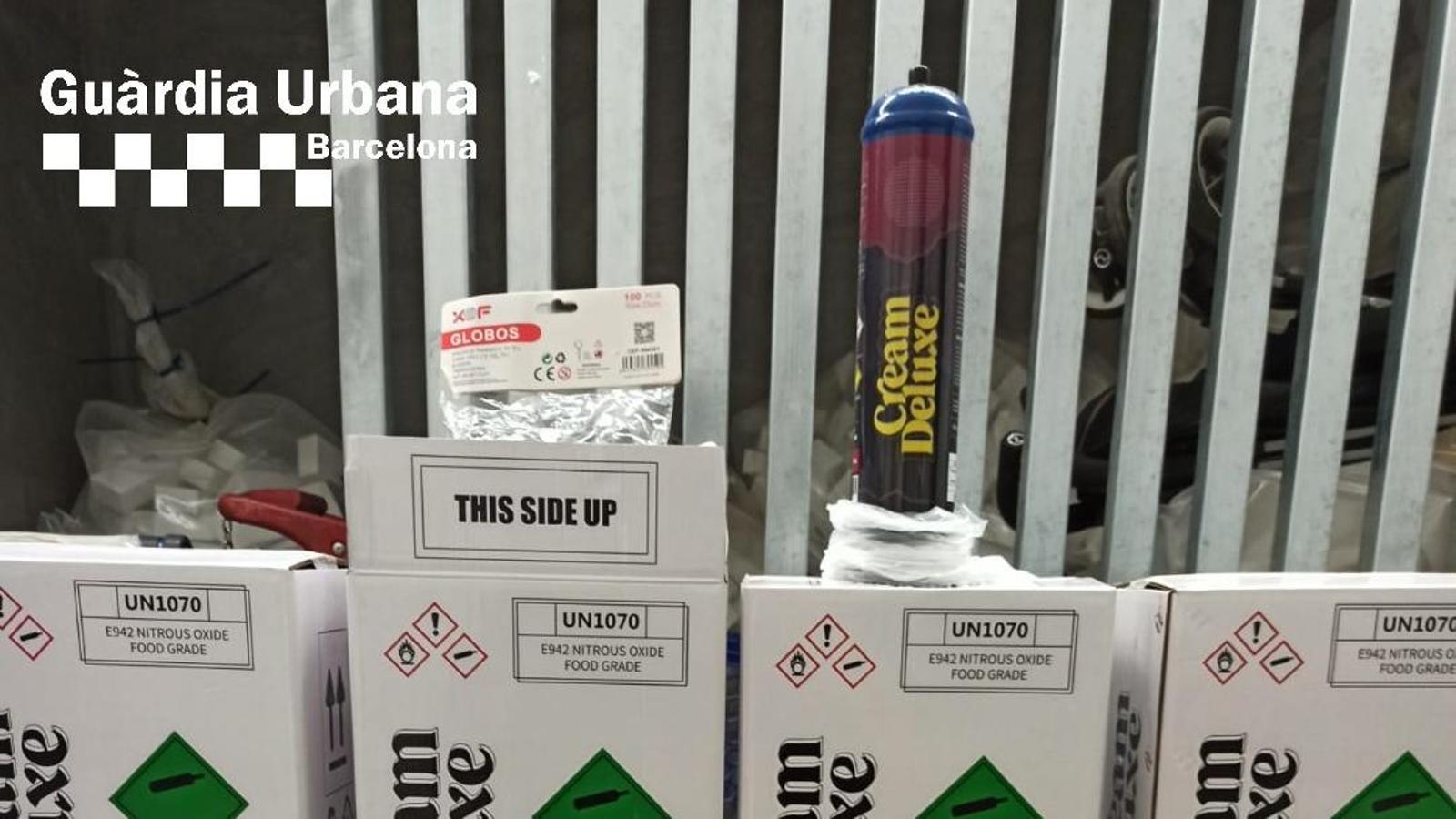
On Amazon, 50 doses of laughing gas can be bought for 40 euros. The package features a photograph of a strawberry on top of a bed of white cream. Nitrous oxide, in fact, is a gas used for whipping cream. This makes it very easy to find and not considered a narcotic substance. However, the police have been looking for alternatives to remove canisters from the market for years. Sub-inspector Javier Peláez explains that since 2021 they have had an internal procedure to regulate it, especially regarding consumption by minors.
One of the measures they take is that when this substance is being sold on the street, they consider it unlicensed street vending, which allows them to seize the canisters. They also consider the trafficking of large quantities to be punishable by law, as it is a substance harmful to health. Another action they take when they find young people consuming it in a nightlife area, for example, is to confiscate it because it can be considered a dangerous element, as it can lead to a fight or argument. Afterwards, the user can retrieve it from the police station, and a report is filed that is not a fine. In the case of minors, they also confiscate the canisters and even take the young person to their parents.
The Barcelona Urban Guard has noted an increase in nitrous oxide interventions, particularly concerning alleged street vending. On the street, a balloon full of laughing gas can be worth between three and five euros.
Other towns
Laughing gas, however, does not only affect the Catalan capital, but has also spread to various coastal towns, especially those with more tourism. From the Salou City Council, for example, they explain that a few years ago they experienced the irruption of this substance and that it generated "certain concern". "The preventive and control work promoted by the Local Police has contributed to a significant reduction in the presence of this product in the municipality," they add from the council. In fact, they conclude that the presence of laughing gas right now is "residual", a decrease that they also link to the reduction in the number of nightlife establishments.
In Platja d'Aro they find themselves in a similar situation. This year, the Local Police have seized 20 canisters of nitrous oxide. From the council, however, they state that years ago they used to intervene entire boxes and boxes, and that now its consumption has been declining. The ordinance on coexistence and civility is what foresees the intervention of these products.
Precisely, the Mataró City Council is reviewing the ordinance on civility and coexistence to regulate the use of uncivil conduct that was not contemplated, such as the consumption of nitrous oxide. This modification is in process and the forecast is to approve it and have it come into force before the end of the year, they point out from the council. In the capital of Maresme, they calculate the presence of laughing gas according to those canisters collected by the cleaning service and intervened by the Local Police. And the trend has been upwards since 2022. During 2025, municipal data has recorded nearly 2,100 canisters removed from public spaces. They are seized for health prevention, especially in the case of minors, but it is not a punitive action.
And in Castelldefels they find themselves in a similar scenario. Recently, a proposal has been incorporated into the modification of the municipal ordinance on coexistence to specifically regulate laughing gas. Right now, it is still in the process of being processed. In the meantime, from the council they clarify that when the Local Police detect these containers during their operations, they proceed to their confiscation for safety reasons.
