The Government will forgive debts for errors in dependency aid
Illa assumes that "it makes no sense" to demand families return money if it is the administration that has failed

-
CAT -
CAST
BarcelonaUp to 1,300 euros are being claimed by the Department of Social Rights from a young person with a high degree of dependency who has entered a special employment center and, therefore, should not have continued to receive the fixed economic benefit. But since bureaucracy is not prepared to automate changes, the order for the transfer of aid continues to arrive, accumulating an amount that for the family "is as if it didn't exist", it is not touched. This is one of the examples that explain what the Generalitat calls "undue payments" and which are mainly due to errors or the slowness of the administration; whether, as in the young person's case, due to incompatibilities, a downward revision of a dependency degree, or the death of the beneficiary. Last year alone, the ministry requested the repayment of 10,665 of these debts.
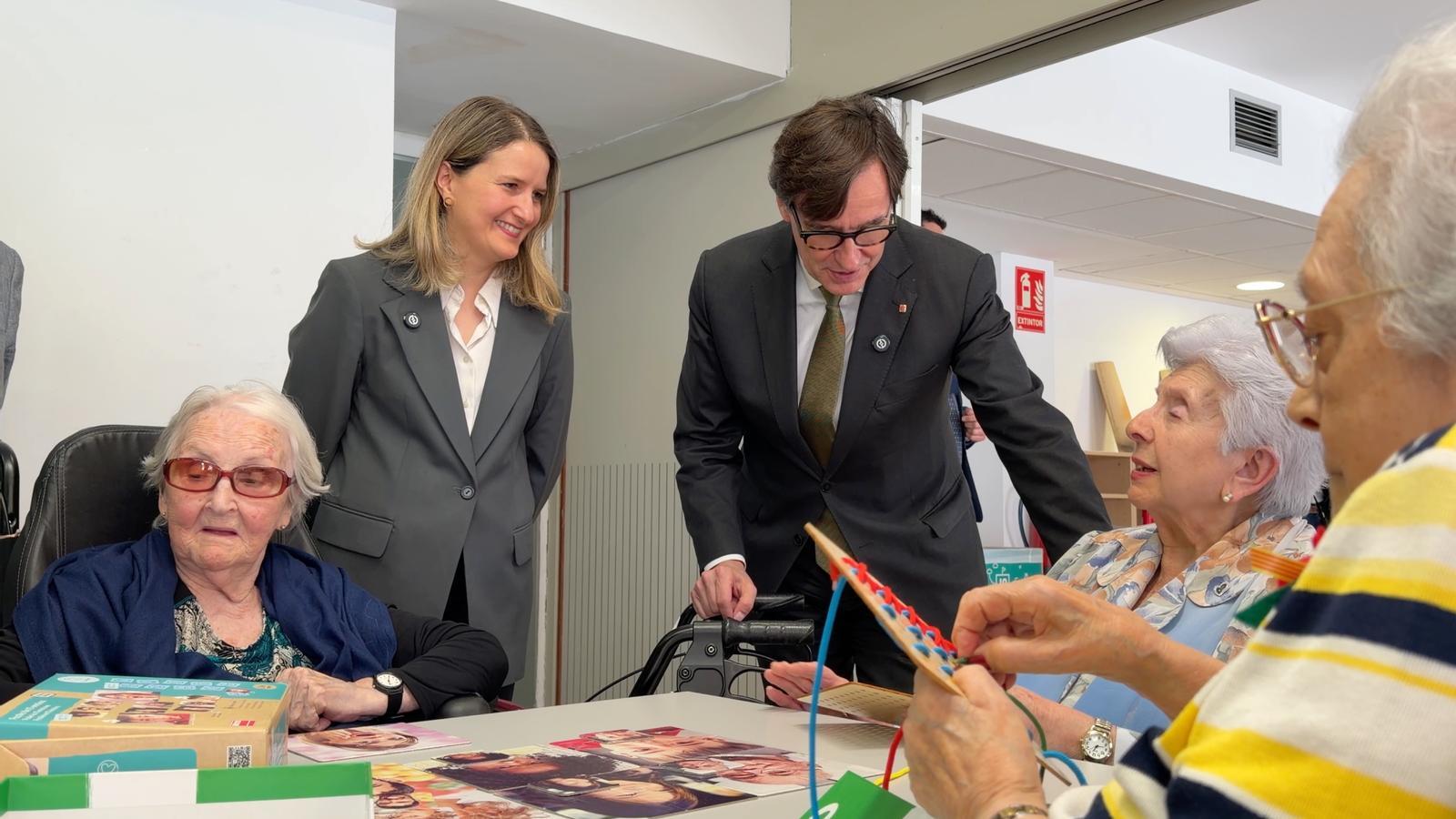
From now on, the Generalitat will forgive them. The announcement was made this Monday by the President of the Generalitat, Salvador Illa, who justified the action as "the remedy to a situation that should never have occurred: claiming money from a person who has died seems like a bad joke, but it had been happening for decades," he admitted during a visit to a residence in the Gràcia neighborhood of Barcelona.
Ana Mourelo knows well what it's like to receive one of these letters and a recognized degree III (the maximum) to demand that he return 362 euros for having received the full month's benefit when the child had died on the 2nd. Although the family had communicated this on several occasions before the end of the month to avoid this situation, they finally received the transfer and, subsequently, the claim.Illa indicated that this claim "makes no sense," especially in moments of pain and grief that "are not simple," but at the same time indicated that, according to the regulations, the Generalitat's obligation was to claim undue amounts. This is the third time the Government has waived debt for undue payments: the first was for beneficiaries of the
and the second, . In both cases, an amnesty was approved, except for cases where bad faith on the part of the beneficiary was proven.
The Minister of Social Rights, Mònica Martínez Bravo, then acknowledged that the administration's computer system had become obsolete and deficient for processing so many files. Thus, and to avoid new undue payments, the Generalitat has announced a modernization of administrative processes that will consist of redesigning benefits to be more precise when calculating amounts monthly and not accumulating debts, in addition to computerizing the department's systems. "It won't happen again," stated Illa, referring to the claim of undue payments, while indicating that "the reform of the administration is precisely for this purpose."
200 euros for the wait
On the other hand, and within the Cura Plan to speed up dependency aid, the president also announced that people waiting for a public place in a day center, residence, or home care service (SAD) will automatically receive between 100 and 200 euros, depending on the recognized degree, until their turn comes and they can access the service. On average, the wait for a geriatric center is 587 days (one year and seven months) and for one specialized in disability, 1,191 days (five years).
Mònica Maldonado's father has been on the waiting list for a residence for two and a half years and, in the meantime, is using his savings to pay for a caregiver at home because he has almost no mobility left and Alzheimer's has advanced very quickly during this time. "200 euros? It's better than nothing, but with that we can't even pay for the podiatrist. We want residences, not money," he complains.
