The cooperative that rescues neighbors who lose their homes
The UN awards the initiative of Les Juntes, which buys and transfers homes to fight social exclusion and speculation

-
CAT -
CAST
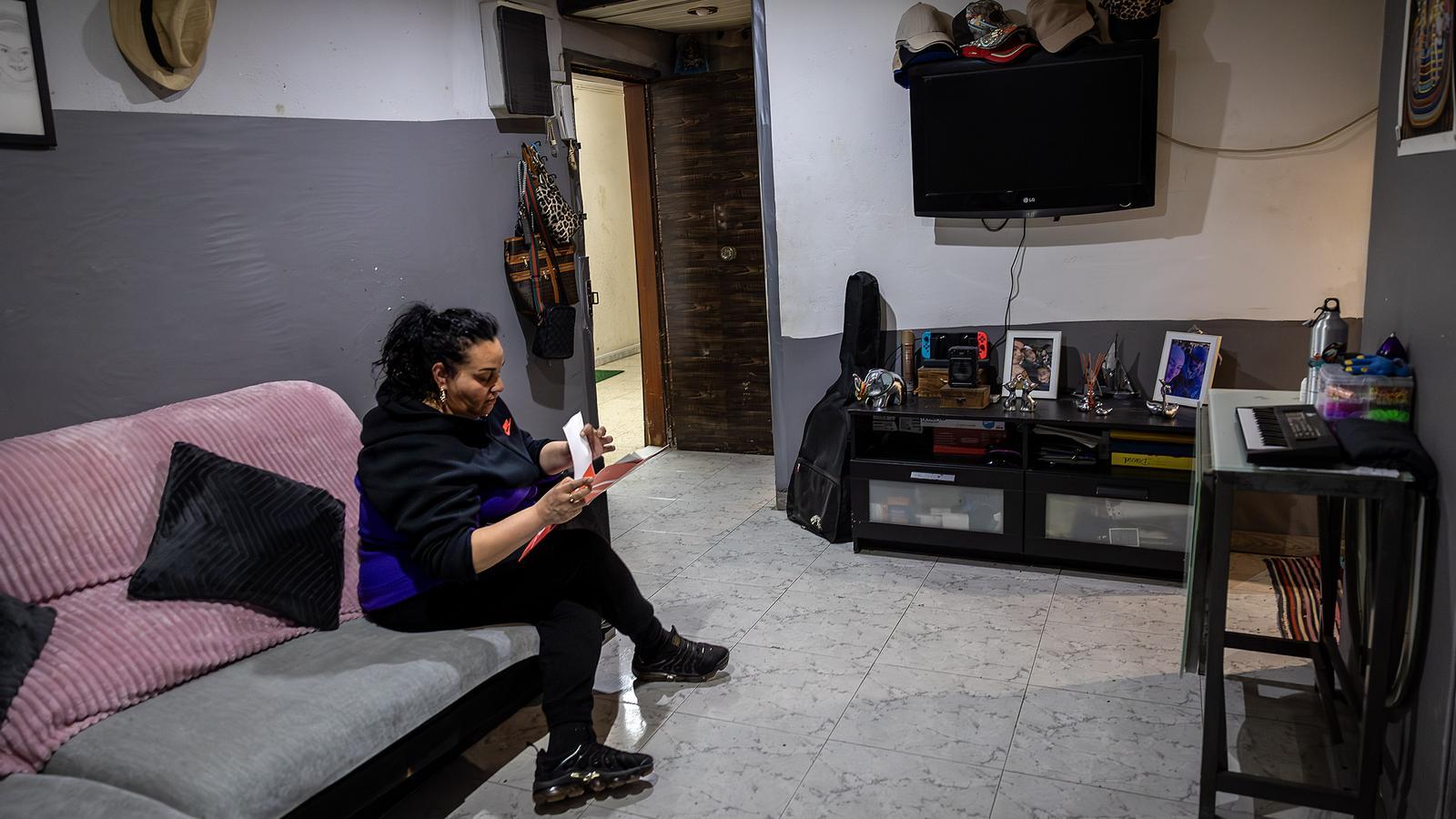
L'Hospitalet de LlobregatMaika Granados tried up to three times for a social rental for the ground floor of the Florida neighborhood in L'Hospitalet de Llobregat, where she has lived for years with her three children and husband. There was no way for the vulture fund that owned the property or the municipal social services, who had signed "all the vulnerability reports in the world" for her, to heed her pleas. Family income made it impossible to access an apartment on the open market, not even in this neighborhood with a very degraded housing stock: rents already exceed 1,000 euros, and a room, 700.
The fear of being evicted and ending up on the street sent her into a crisis of distress, anxiety, and depression, a condition that also emotionally affected one of the children. Until someone from the neighborhood told her about Les Juntes, and she approached them as a last resort. There she found a group of women who not only listened and understood her, but also took action, and today Granados's family is "calm" in a small apartment that, although they are not owners, they have the guarantee that they will not be thrown out.

La Florida is the densest neighborhood in Europe and one of the most socially problematic, partly because the mortgage crisis led to the entry of housing speculators. "Many people who are not wanted elsewhere due to racism or aporophobia come to live here," points out Mariló Fernández, an activist and the soul of the cooperative, who rejects the concept of "squatting" and uses "the right to have housing."
The constant trickle of evictions has strengthened activism for decent housing in the neighborhood. With each eviction, a call to try to stop it, sometimes successful, and many other times, not. At the end of 2023, a group of women realized that they had to take a further step if they didn't want to be "always back at square one," explains Fernández, who admits that fighting on the streets "is emotionally very draining."
They sought support from the neighborhood fabric and social economy (foundations and other cooperatives) and opted to form a cooperative with the aim of recovering housing in the hands of banks and speculative funds so that families could stay without problems. It is a cession of use, meaning that the housing becomes the collective property of the cooperative, not of the resident family, who can live there indefinitely by paying the monthly fee.
A neighborhood of protected housing
protected housing, and now in the hands of funds and speculatorsbronze medal of the World Habitat Awards 2026. "Les Juntes is the best thing that has happened to La Florida," proudly emphasizes the partner Khabdja ben Ali.
After fulfilling a feasibility plan, the entity signed a loan with Coop57 to start a pilot plan with which it set itself the almost utopian goal of acquiring four homes. On average, the purchase of each home is 50,000 euros. Doing the math, the partner families pay 450 euros per month to repay the debt. "It's an amount you can afford," points out Granados.

The first beneficiary was Hannan, a mother with three children who later left the apartment to the cooperative when they moved. After almost three years, Les Juntes has exceeded expectations and has already bought eight homes, they have just signed the down payments for two more and are in negotiations for another two. They will now debate whether to increase the fees to have more economic margin and increase the offer for one of the homes, given that the property does not yield on the asking price.
Rehabilitate the homes
At the last meeting, Enriqueta Pérez came with one of her two young sons, who keeps a watchful eye on everything happening around him. Pérez states that while she was living in the apartment owned by a fund without a contract, her life was one of little peace. "I have cried a lot," she summarizes to emphasize that the day Les Juntes bought the property to give to her – and even though "the apartment is destroyed" – she "got a weight off her shoulders."
The Florida blocks, and most of the buildings in the neighborhood, are quite degraded due to lack of maintenance. The cooperative's intention is to be able to rehabilitate the apartments, as many have major dampness, construction defects, or basic deficiencies. For now, they have been able to pay for the works of three homes, and in the rest of the cases, like Granados', families do what they can with more imaginative than efficient solutions.
The profile of cooperative families is varied, like the neighborhood, but most have in common high social vulnerability, whether because they are irregular immigrants, have no fixed income, are beneficiaries of social benefits, or work in the informal economy. For this reason, Mariló Fernández values that Les Juntes fights against "the paternalism" that the administration exercises against those who cannot buy housing on the free market, to the point of "blaming them" and "naturalizing" unfair situations.
Estela Alais is a "expectant" cooperative member. She is in her twenties and cannot and does not want to move out so as not to leave her mother to take care of a rent all alone, but she considers that Les Juntes is
This risk led Araceli Brito to check out the Les Juntes premises. After 16 years of "paying the rent every month" for her apartment, one day she was informed that the property had passed into the hands of a "vulture fund" and that her recently signed five-year contract was little more than a wet paper. She has suffered harassment to leave the apartment in exchange for 5,000 euros or to buy it for 70,000 euros.

