The teaching conflict is experiencing a similar moment in Catalonia and Galicia, although the latter territory has accumulated up to five strike calls since the beginning of the school year. The common point is that both educational systems have seen how in recent months a part of the unions (CCOO and UGT in both communities, adding ANPE and CSIF in Galicia) have agreed to an agreement to improve conditions with the government. An agreement, however, that the majority union forces have not supported. Faced with this scenario, a new strike has been called in Galicia – the sixth of this course – for April 28, while in Catalonia USTEC has already announced that next week it will put new mobilizations on the table "to force the Government to sit down and negotiate".
Teacher unrest spreads throughout the State: "They have stretched us like gum"
In the last year twelve autonomous communities have registered strikes in the education sector
-
CAT -
CAST
Barcelona/ Valencia/ PalmaConsecutive strike calls, follow-ups of more than 30%, teacher closures in institutes, massive demonstrations and even some resignations. But, also, several agreements and pre-agreements. This is the scenario that the education sector in Spain has experienced in the last year. In fact, since the beginning of the school year, up to twelve autonomous communities have registered some teacher strike call, with more or less adherence. The last one was this very week in Madrid, where early childhood education teachers have called an indefinite strike that has already lasted four days.
"They have stretched us like chewing gum," criticizes Héctor Adsuar, secretary of public school teachers for CCOO at the state level. He assures that the discontent is similar throughout Spain and that the teacher protests that have spread through the different communities are the result of a situation that has been escalating: "It is not a recent change. They have been asking us for more and more because they know we cannot say no, but you cannot ask for everything without providing the necessary resources," Adsuar describes. He denounces that, according to CCOO's calculation, in recent years student needs have increased by 75%
and, on the other hand, investment to meet them at the state level has grown "only" by 26%.
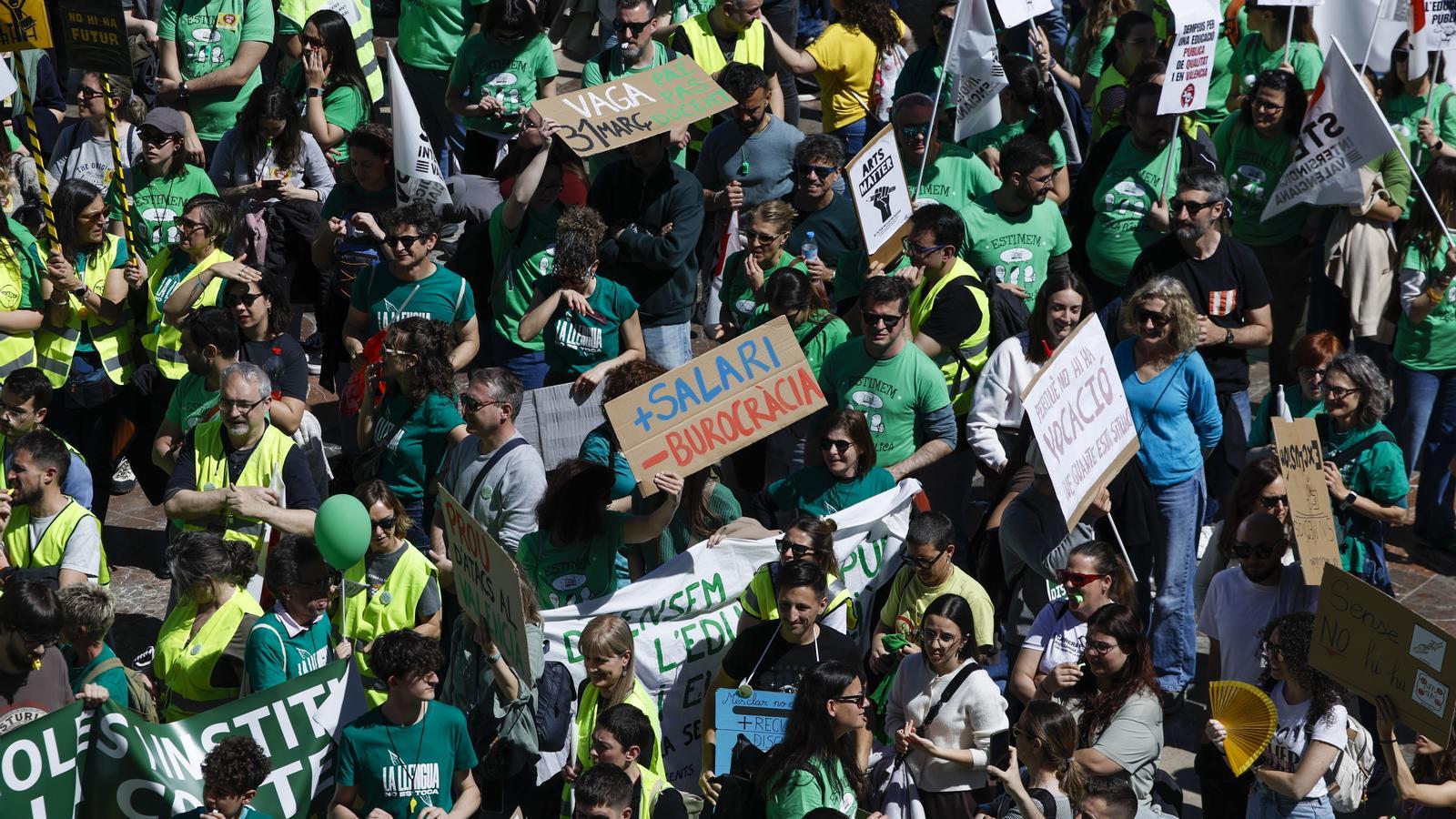
In fact, one only needs to look at the strike calls from unions and the banners or slogans of the demonstrations to see that, in general, the reasons for teachers' stoppages throughout Spain are almost the same: reduction of class sizes, more resources to deal with classroom complexity, and tools to alleviate workload. And, also, salary. "It is not the only factor, but it is very relevant and it is also one of the reasons why more and more teachers are missing," admits Adsuar. "It is a matter of recognition and attractiveness for the profession, but also a legitimate and necessary struggle in any labor sector," insists the union leader.
Despite these common complaints, the monitoring of mobilizations –and triumphs– is quite uneven. While in Catalonia, Valencian Country, Galicia, or Asturias adherence to strikes has been notable, with participation rates close to 40%, in other communities the scenario has been radically different. In Navarra, the follow-up to the last teacher strike did not reach 5%; in Castilla y León, mobilizations were called off after a pre-agreement with the Leonese government, and territories such as the Balearic Islands, Castilla-La Mancha, or the Canary Islands have not registered any recent strike calls.
However, the situation in these latter communities may change, partly due to a possible ripple effect after the success of mobilizations in other parts of the State. For example, in Castilla-La Mancha, unions are surveying teachers to decide whether to call a strike to demand a salary increase, taking as a reference the salary increments –more or less satisfactory– achieved in Catalonia, the Basque Country, and Cantabria after several protests. "Education is an autonomous competence, therefore, mobilizations are not usually directed against the central government. What does happen is that if it is seen that a mobilization works in a certain territory, it is easier for it to be repeated in other places. There is a certain contagion effect and a tendency to think: if it is working there, it should also be able to work here," describes Jordi Mir, doctor in humanities and professor at Pompeu Fabra University (UPF) and the Autonomous University of Barcelona (UAB).

The PP-VOX effect and concern for the language
An example of contagion could be the massive follow-up of the strikes in the Valencian Country, a few weeks after the stoppages by Catalan teachers. Both mobilizations were close to 40% follow-up in a very short period of time, even though the reasons for protest vary. This year, Valencian teachers have carried out two strikes that add to the protests already initiated in 2024 against "the cuts and the sidelining of Valencian" implemented by the PP and Vox following their arrival in the Valencian government. At this time, the conflict could lead to an indefinite strike at the end of May if negotiations between unions and the administration, scheduled from April 16, do not prevent it.
The current period is the moment of greatest educational mobilization since 2012 when the Generalitat – then led by the PP – approved a trilingual education model that reduced teaching in Catalan. After a 2025 highly dominated by the defense of teaching in Valencian – following the consultation on the vehicular language promoted by the PP and Vox –, teachers have now focused on labor demands.The attacks on the language and the policies of the PP and VOX are also what have ignited, even more, the teacher discontent in the Balearic Islands, despite being one of the few communities where no strikes have been called recently. The teachers of the islands face a permanent political eye watching them. Issues such as "indoctrination" or attempts to question teaching in Catalan are constant in Vox's interventions in Parliament, while the popular Education Minister, Antoni Vera, tries to maintain a balance between the defense of educational policies and political pressures.
However, to cope with the shortage of teachers – the lists of interim staff for many specialties are empty, which means that in some centers all positions remain unfilled –, the Ministry of Education has announced that it will allow teachers without Catalan requirements to access the civil service, which has generated alarm among sectors that defend education in their own language. Center projects in Catalan are at risk and, moreover, the Balearic educational community has been denouncing the deterioration of school infrastructure, which they attribute to a “historically insufficient investment” by the administration. Furthermore, it is also worrying that violence is on the rise, both among students and in relation to teaching staff. Recent cases, such as the homophobic assault suffered by a teacher from IES Baltasar Porcel in Andratx, have highlighted the tension experienced by many professionals.
A more mobilized collective?
In recent months, comments such as "teachers always go on strike" have been commonplace, but Mir warns that "historically, teachers would not be among the most mobilized groups" and that, in general, it is not a group that is "constantly" protesting. He also warns: "We always have the impression that there are more mobilizations than there are". Nevertheless, the professor explains that it is a sector that can easily mobilize due to the unifying effect of unions and the fact that they have shared spaces to discuss their concerns and organize. "In schools this can happen, but, on the other hand, among Glovo or Las Kellys delivery workers it is more difficult for them to find common moments and spaces to share demands," he exemplifies.
On the other hand, Mir also brings up the factor that a teachers' strike has a direct impact on society's daily life, while "perhaps a strike in the metal sector does not directly affect the general population". And regarding whether one group demonstrates more than another because it has or does not have worse conditions, the doctor offers a further reflection. "Social mobilization on many occasions is associated not so much with who needs to mobilize, but with who has the possibility to mobilize," he concludes.
