A second tunnel boring machine will drill Barcelona starting in October
The bulk of the L8 tunnel between Plaça Espanya and Gràcia will be done from February and for almost a year

-
CAT -
CAST
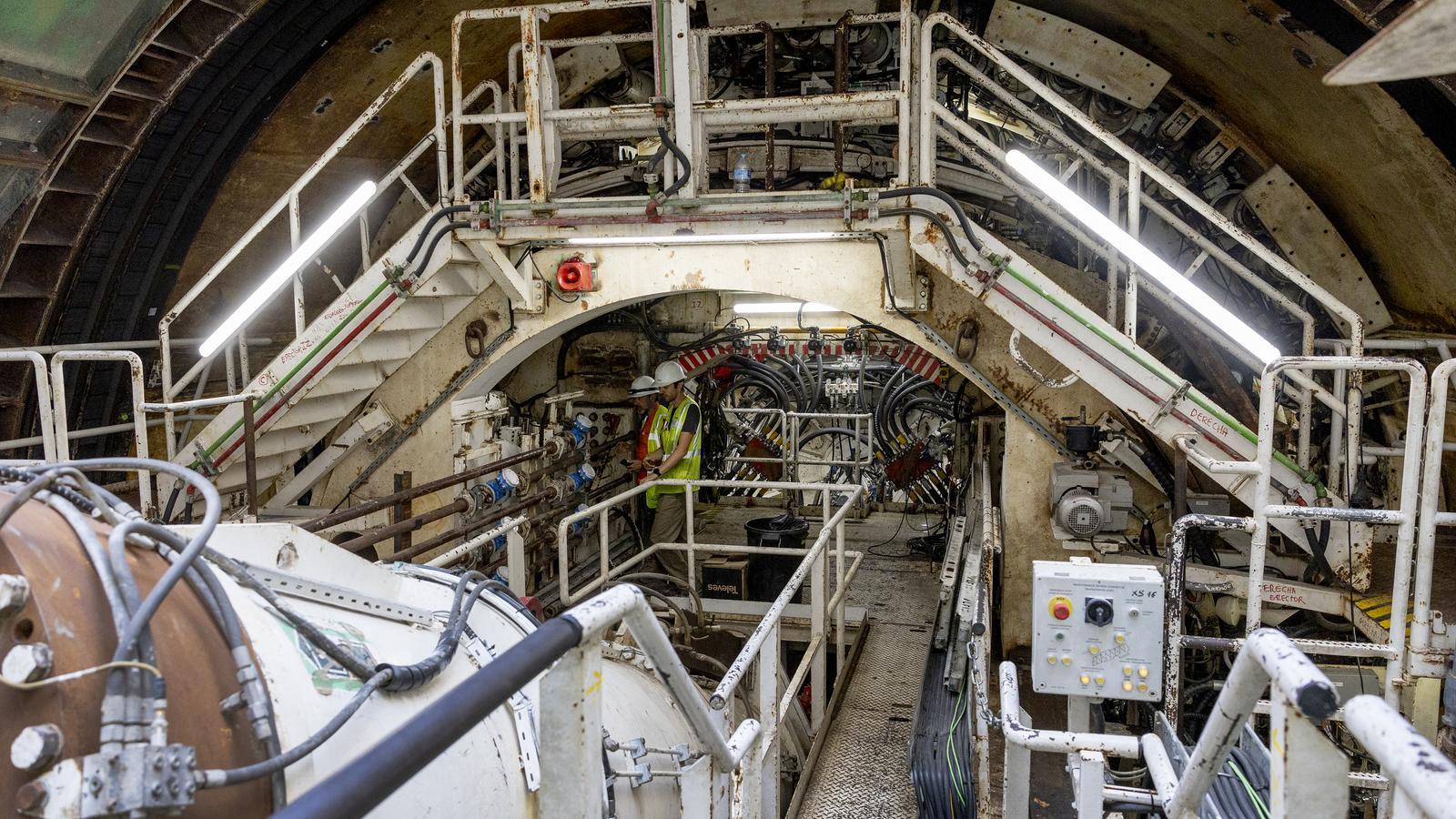
BarcelonaThe L9 tunnel boring machine is no longer the only one inhabiting the subsoil of Barcelona. The great machine that is to build the L8 tunnel for the Ferrocarrils de la Generalitat is already assembled and ready to start operating, starting next week. This was confirmed today by the Minister of Territory, Sílvia Paneque, during a site visit to the attack shaft of this infrastructure, which is located on the Gran Via de les Corts Catalanes, next to Plaça Espanya. The new tunnel boring machine, however, will not face the longest section of the tunnel, from Plaça Espanya to Gràcia, until February.
During the month of October, this new tunnel boring machine –which has been in assembly for months, piece by piece– will begin to drill the section that goes from Carrer Llança to Vilamarí. These are a scant 60 initial meters that must be advanced to make space for the tail and finish assembling two more tugs at the final part of the machine. But once this first advance is made, the machine will stop its engines again, while the work progresses in finalizing the details of the tunnel that must extract the earth to the surface.
The main part of the drilling will, therefore, be from next year, when the tunnel boring machine is expected to begin its long journey to the Gràcia station. First, it will travel along the Gran Via to Urgell, where it will head upwards, towards Plaça Francesc Macià, and, finally, it will make a turn to reach the Gràcia station. This tunnel, of about four kilometers, is expected to be finished in a period of thirteen months, that is, already in 2028. Once finished, it will connect the Vallès railway line with the Anoia line, crossing Barcelona, with new stops at Hospital Clínic, Francesc Macià and, finally, Gràcia. The start-up date for this infrastructure is 2032 and its cost is now estimated to exceed 500 million euros, when it was initially estimated at 412 million.

The tunnel boring machine is very similar to the one that is drilling the L9 and is currently stopped at Putxet following the sinkhole that appeared there a few months ago. It is slightly smaller –the cutter head has a 10.6-meter diameter instead of 12 like the metro's– and it will drill through terrain that technicians define as "sand and clay" and "much more homogeneous and predictable than the Putxet terrain." At its deepest point, it will pass about 50 meters underground.

Message of calm to the neighbors
Regarding the "unease" that this new infrastructure may generate among the residents in the area affected by the route, Minister Paneque wanted to send a message of calm and remarked that the latest technology is being used. "There is a permanent citizen service office where residents can go to ask for information and also to resolve any doubts," she clarified. Paneque also qualified that "each project has specific works, specific geology, and infrastructure that condition the work." "These are complex works, but we are doing it with determination and an excellent team," she stressed.
The Director General of Infrastructure, Ramón Ramírez, also specified that the L9 has provided the teams with a lot of experience. "We already have 33 kilometers of drilling experience behind us and we have been incorporating all the new technological changes," he added.
Regarding the rest of the works related to this line, the technical teams specified today that the holes for all the new stations are already made, as well as the emergency exits (located on the streets of Consell de Cent, Muntaner, and Gran Via). They also confirmed that the delay in the startup – the tunnel boring machine was supposed to start drilling in the summer – is due to the fact that during assembly they found underground anchor cables from other adjacent buildings that were not foreseen.
Minister Paneque insisted that, once finished, the L8 will facilitate travel, will connect the tram and the Vallès network with the metro, and will improve the mobility of millions of people each year to travel to work, university, or medical centers without the need to use a private vehicle. "We are making more investments and carrying out more works than ever. Whoever says that this government is not promoting public transport either does not know what we are doing or is simply playing politics," she concluded.
