We are on the verge of a health crisis in Ceuta
The Spanish government raises the number of registered unaccompanied minors to 1,898 and calculates that around 5,000 migrants remain in Ceuta

-
CAT -
CAST
MadridThe situation in Ceuta is far from normalizing. This is a message that social organizations and entities in the autonomous city, as well as its population, have been repeating for days. Fifteen days after tens of thousands of people entered swimming from Morocco, triggering a humanitarian emergency, the Elín Association of Ceuta is focusing on people's health and their care: "We are on the verge of a health crisis," warns Ramsés Mohamed, a social educator and spokesperson for Elín, in statements to ARA. "We are talking about people with illnesses and infections that cannot be treated," he adds. Many of the migrants who arrived in Ceuta did so with significant trauma after the sea crossing.
Precisely this Wednesday, the Official College of Physicians (OMC) moved to the autonomous city and warned that the situation "is not only putting healthcare professionals under pressure, but also the system's capacity to maintain safe assistance and guarantee public health protection," stated the president of the OMC, Tomás Cobo, at a press conference. The OMC has demanded three measures: increase staffing, protect ordinary healthcare assistance, and reinforce resources in prevention and epidemiological surveillance. "The solidarity and vocation of our doctors are not an unlimited resource," they have warned. The Minister of Health, Mónica García, has rejected that "collapse" can be spoken of and has announced a visit to Ceuta soon.
"Administrative silence"
"We are moving heaven and earth so that our needs are met," adds Ramsés, who attends ARA by phone, in the midst of the whirlwind. He denounces that they are encountering "administrative silence" that "is killing." "The rights of many people who do not have access to protected places, nor sufficient food are being violated [...]. We cannot talk about voluntary returns given the gravity of the situation," he reiterates. Between Tuesday and Thursday, about 600 migrants have left Ceuta "voluntarily," according to police sources told ARA, who emphasize that a trickle of these returns is occurring.
The fluctuation of figures of migrants who fled Morocco and remain in Ceuta is a constant. While the local government says there are still about 10,000 people in the city, the Minister of the Interior, Fernando Grande-Marlaska, says there are about 5,000. "We have already said that we have an approximate number and it is 5,000 people," the minister assured this Thursday from Ceuta. Police sources also share this second estimate. In turn, it is known that there are 1,898 registered minors, but from Elín and other organizations in Ceuta they warn that there are many more.
Regarding adults, the Spanish government wants to prioritize their expulsion and in fact, police presence has been reinforced to do so. Also to give "tranquility" to the population of Ceuta, indicate police sources and Marlaska himself has acknowledged. "When the food or the little money they have runs out, tension may increase," add the same sources. From the organizations, it is also warned that asylum applications from people fleeing wars and conflicts are not being processed. Marlaska detailed this Thursday that more than 500 international protection applications have been processed and that "the vast majority" have been dismissed.
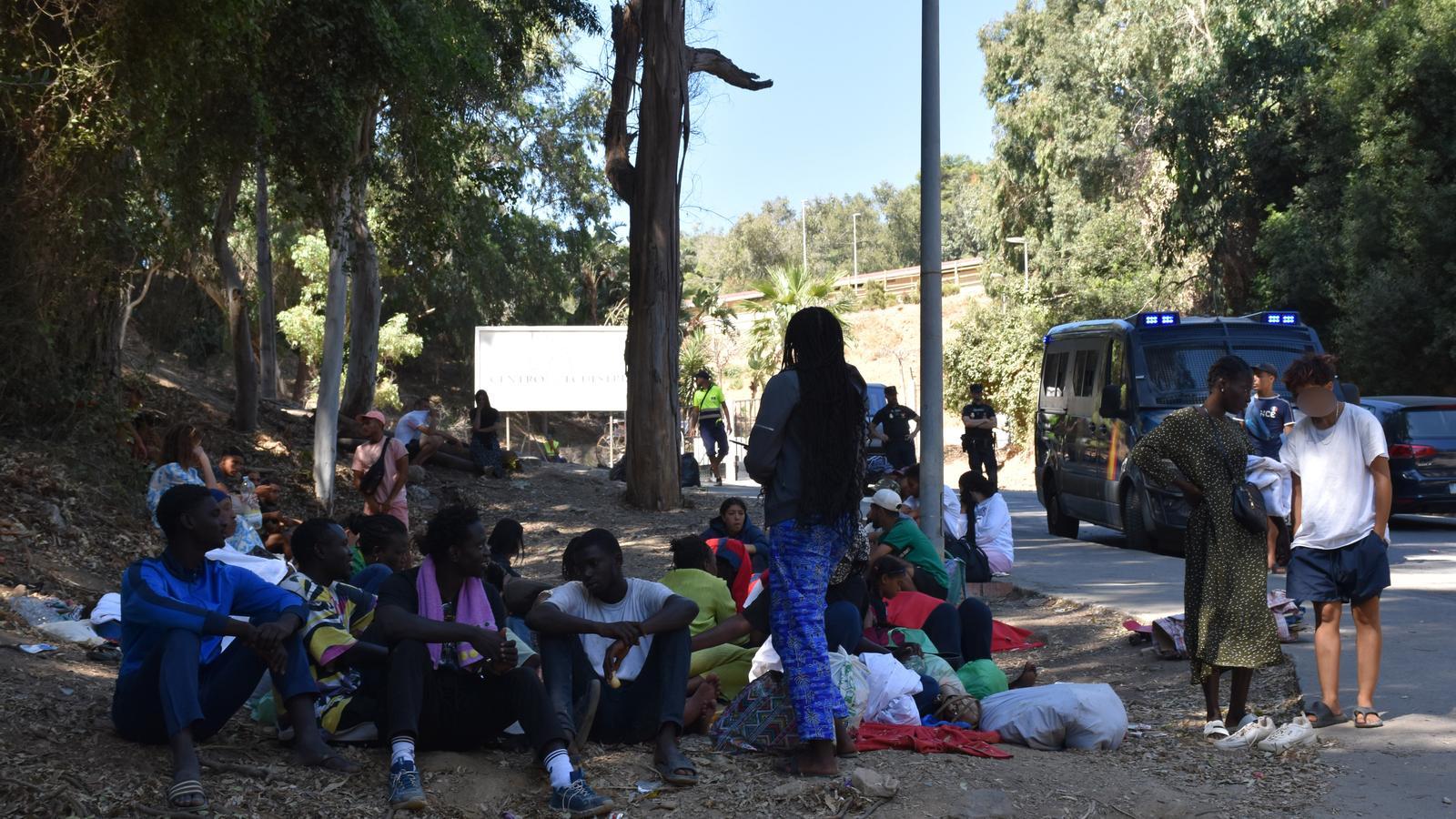
Elín is one of the entities organizing the meal distribution, but also the provision of spaces for people who, facing the collapse of institutional centers, are sleeping outdoors. In fact, in the peripheral neighborhoods of Ceuta, they continue to expand the improvised places to accommodate more people, such as sports centers, especially for women and girls. In the case of the La Reina neighborhood alone, we are talking about 300 women and girls; in the El Príncipe neighborhood, another 250, according to estimates from the entities. Meanwhile, in the El Tarajal warehouses, near the border with Morocco, around 800 people continue to be settled there this Thursday, especially young Moroccan boys, according to the head of the NGO Luna Blanca Mustafa Mohamed, who distributes breakfast and lunch to them.

