Killing 30,000 pigs a day: working in Osona but not finding a place to live
The region is becoming a powder keg due to the huge growth of meat processing plants, with no provision for housing or services for the immigrants who work there.


-
CAT -
CAST
VicFifty-year-old Sylvie remembers almost vomiting on her first day working in a slaughterhouse. She had to cut the pigs' tongues and hearts with a knife in a room so cold her hands nearly froze. They were enormous pigs, weighing between 80 and 100 kilos, unlike anything she'd ever seen. "In my country, pigs are small. Here, they're as big as cows." And endlessly, one pig after another. Like on an assembly line.
Now she still works in a slaughterhouse, but she's in charge of examining the animals' lungs. The smell of blood is intense. Her gloves, apron, and mask also get stained with blood, and she has to keep her arms raised constantly to palpate the lungs of the pigs hanging upside down, one by one. "When I go home, my whole body aches," she confesses. But she says she's gotten used to it. She is a single mother, lives in Vic with her three children, aged 13, 16, and 26, and earns around €1,200 net per month.
Sylvie was born in Senegal and is one of the thousands of immigrants who work in the meat processing plants in the Osona region. They are immigrants with legal status, with work and residence permits, who have contributed to the Osona is one of the economic engines of CataloniaThis is confirmed by the Osona Socioeconomic Observatory.

The region has a rich industrial base, but it stands out above all for its powerful food industry, which has grown at a faster rate than other sectors. "While overall hiring in Osona grew by 16% between 2015 and 2024, in the food industry it grew by 67%, and in cleaning services, closely linked to this industry, by 119%," explains Sandra Álamo, the technician in charge of the Osona Socioeconomic Observatory. This growth, she adds, would have been impossible without low-skilled foreign labor. In 2015, three out of every ten workers in the food industry were immigrants. By 2024, six out of ten were. The majority are from sub-Saharan Africa, but there are also Indians and Latin Americans. In industrial cleaning services, the presence of foreigners has grown even more: from four out of ten to almost eight out of ten, especially from North Africa. Locals no longer want to do that work.
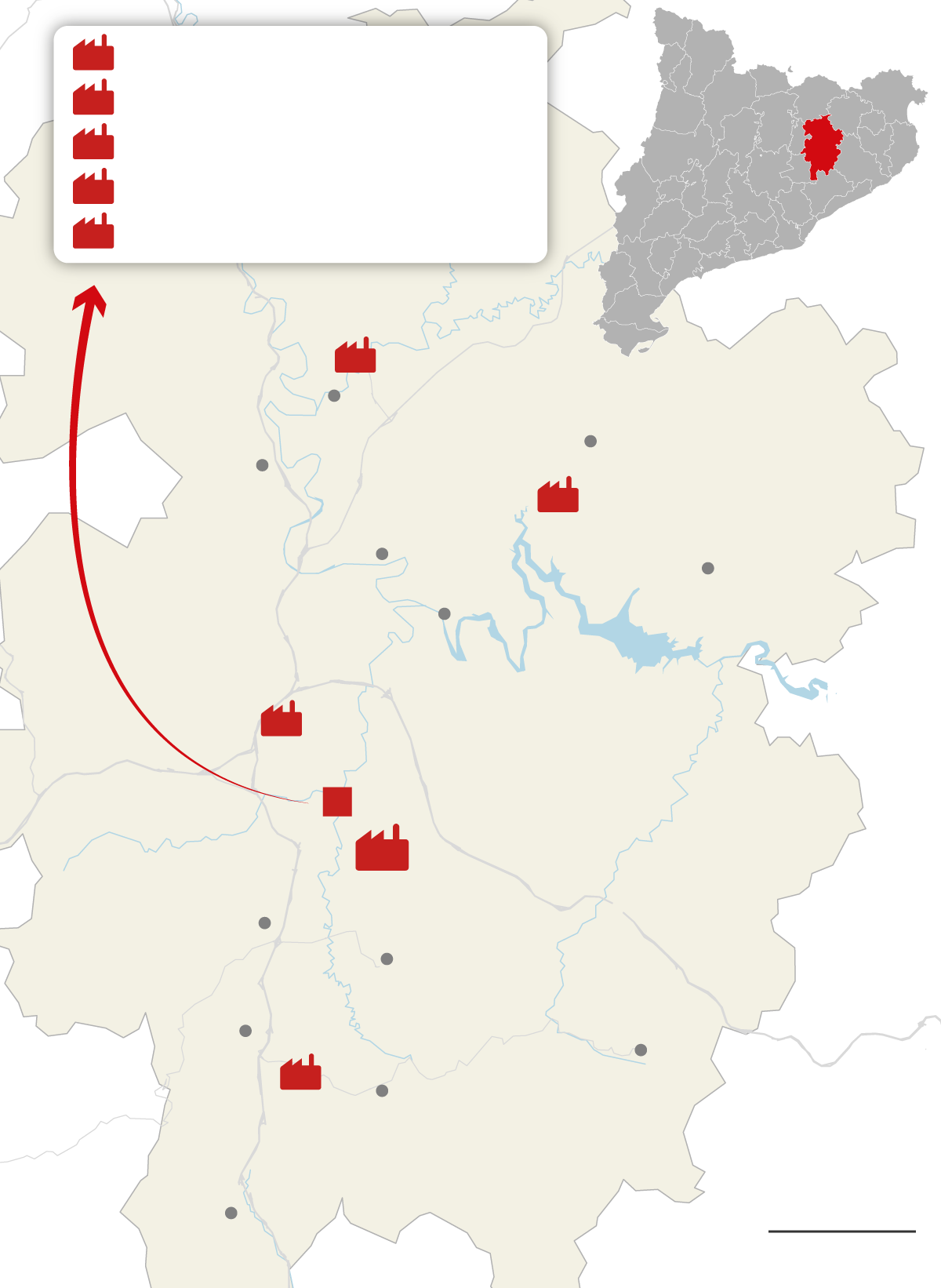
We're talking about companies that were initially family-owned, but many were bought by large groups and began to grow exponentially, especially after 2010. For example, Le Porc Gourmet, in Santa Eugenia de Berga and owned by the Jorge Group, obtained permission from the Generalitat (Catalan government) to increase its slaughter capacity from 6,000 to 15,000 pigs per day in 2012, according to the resolution signed by the then-governor. Recoder also authorized the Osona Slaughterhouse and Meatpacking Plant (Esfosa)—whose majority shareholder is currently the Costa Business Group—to build a new slaughterhouse in Vic in 2011, according to local press reports. That same year, the Patel slaughterhouse, owned by the Vall Companys Group, was given the green light to increase its production by 80% in the municipality of L'Esquirol, according to official documents consulted by this newspaper. Patel has continued to grow since then.
"Osona is a special place because of the large number of animals slaughtered daily. Pigs from other countries, especially Belgium and the Netherlands, are also slaughtered," says a veterinarian from the Catalan government who works in a slaughterhouse and prefers to remain anonymous. The regional councilor for Economic Development, Josep Casassas, puts a figure to this large volume of production: more than 30,000 pigs are slaughtered daily in Osona.
Just as these meat companies were beginning to grow more and more, housing construction in the region slowed down due to the real estate crisis, and the construction of social housing became almost nonexistent from 2013 to the present, according to data from the Diagnosis of homelessness and residential exclusion situations in the Osona region, carried out in July 2023 by the UNESCO Chair in Housing at Rovira i Virgili University. But neither did the roads adapt to the growing volume of trucks, nor public transport to the movement of workers.
Should these companies assume any social responsibility? ARA contacted the ten meat companies in Osona with the highest turnover in 2024. All but one, Embutidos Monells, declined to comment. One argued that the responsibility should lie with the public authorities, but preferred not to participate in the report because it wants to maintain a good relationship with the newspaper. Meanwhile, sources from the Department of Agriculture clarified that the factors considered when approving the expansion of these industries are not the availability of housing or services in the area, but rather food hygiene, animal welfare, urban planning, and environmental benefits. "The need for labor," they said. "Public-private coordination is needed so that municipalities can cope with this social pressure," emphasized Marçal Ortuño (ERC), president of the Osona County Council, who believes that public authorities cannot continue to bear the entire responsibility alone.
This newspaper has also interviewed a dozen mayors from Osona whose municipalities—or neighboring towns—are home to one of these large meat processing plants. On the one hand, it's surprising that there has been no coordination whatsoever between municipalities; on the other, that most mayors admit they never anticipated that the workers from these companies would come to live in their towns. And what's even more striking: they still don't anticipate it now. Immigrants don't factor into any housing considerations. ARA has visited several municipalities in the region. This is what we found: a veritable ticking time bomb.
Nowhere to live
The three tents are camouflaged among the trees and bushes of a vacant lot south of the city of Vic, and if you're not looking closely, they're completely inconspicuous. Empty water jugs lie scattered on the ground, clothes hang from the tree branches, and the remains of a dying fire are scattered about. It's nine in the morning, and the bitter cold seeps into your bones. Maisa emerges half-asleep from one of the tents, and Ibrahim follows shortly after. Inside, four other companions are still resting. They are all from Senegal and arrived in the Canary Islands by boat.
Maisa and Ibrahim have been in Spain for two years, four months with work permits, and two months working at a slaughterhouse in Santa Eugenia de Berga. They say finding work was easy, but finding a place to live is impossible. So for the time being, they've settled in an open field.

Right there they cook, wash, and try to keep warm by a small fire they make with firewood. They fetch water in jugs from a fountain and try to charge their cell phone batteries with a small solar panel, which is of little use at this time of year because the sun isn't strong enough. Maisa is 40 and Ibrahim is 25, and they say they are paid very well at the slaughterhouse: up to 1,800 euros a month if they also work weekends or as needed.
"They take advantage of foreigners," declares Albert Fuentes, 48, a CCOO union representative and one of the few Catalans still working in a slaughterhouse, the one in Patel, although he's not employed by the company itself, but by an external contractor. This is also quite common in this sector.
"It's an assembly line job," he explains. For example, one person is in charge of slitting the pigs' throats one by one, and this is what they do all day long. Others, however, are in the so-called "dismemberment room," where they butcher the animal. Some remove the entrails, others gut it... Albert is in charge of cutting the ribs and the baconHe has a twelve-minute break every two hours: in one hour they kill and butcher between 510 and 520 pigs. "Before we did 450 pigs an hour, but now the line is getting faster and faster," he complains.
Toni Iborra, the lawyer for the Cárnicas en Lucha (Meat Workers in Struggle) collective, confirms that it is common practice for large companies in the sector to use external companies to hire workers, which allows them to hire and fire employees without accruing seniority, he denounces. According to the Osona Socioeconomic Observatory, the temporary employment rate in the region is 54.2%, and job turnover has increased since the labor reform came into effect in 2022. Sources in the meat sector justify this by stating that there is not the same availability of animals for slaughter and processing throughout the year: in summer, pigs have more difficulty fattening due to the high temperatures, and therefore there are fewer available. "That's why, in accordance with the law and the Workers' Statute, we use subcontracting, as is the case with other sectors that have seasonal peaks," they argue. When it was detected last November an outbreak of swine fever in Collserolaa total of 458 workers hired by one of these external companies They also lost their jobs, affected by a temporary layoff (ERTE).
Unrecognized tendinopathies
"Tendinopathies of the back, elbow, wrist..." lists family doctor Neus Font, clinical director of the El Remei Primary Care Center (CAP), located in the southern part of Vic where most immigrants live, on the other side of the Mèder River, which serves as a natural border with the rest of the city. The pathologies she mentions are common among meatpacking workers due to the repetitive movements they perform. The problem is that the insurance companies don't recognize them as work-related illnesses, even though, she says, "there are some truly blatant cases." This, she assures, is a daily occurrence at the CAP, something that further overwhelms the center.
Stefania Valentina, 38, had tendinitis, yet she continued working at the Patel slaughterhouse. "I'm not afraid of work," she explains. She's from Romania. She lost her father at age 12 and started working at 13, first in the fields and then on a goat farm. She came to Catalonia in 2017 with a three-month contract to pack fruit in Lleida, and then began working at the slaughterhouse. Her husband and children arrived later. "They sold the goat farm to buy plane tickets," she explains. They live in Manlleu on a fourth-floor walk-up apartment with dampness, for which they pay €399 a month in rent. Stefania is clear about one thing: she doesn't want any of her children—she has five, aged 11, 14, 15, 17, and 21—to work in a slaughterhouse. His seventeen-year-old daughter speaks perfect Catalan with a Vic accent, and she wants nothing to do with meat products either.
Shadows in the Darkness
Shortly before five in the morning, workers begin arriving at the Le Porc Gourmet slaughterhouse. It's pitch black, the light is dim, and it's bitterly cold. However, most arrive by bicycle or on foot. Only the luckiest use scooters. Few carry any lights. They are shadows in the darkness.
The entrance to the slaughterhouse isn't massive, but rather a trickle. The workers arrive according to their position in the production line. Those who slaughter the pigs are the first.
"If we asked, the company would be willing to provide a bus for the workers, but they don't need it because they don't come from that far away," says Mamadou Galde, the Senegalese president of the Le Porc Gourmet workers' committee, who has worked there for eighteen years and is delighted. He says that Le Porc Gourmet is his livelihood.
Most of the workers travel to the company from Vic via a rural road that connects the capital of Osona with the neighboring municipality of Santa Eugenia de Berga. There, in April 2020, two Le Porc Gourmet workers were swept away by a flash flood while on their way to work, attempting to cross a ford over the Gurri River, which had overflowed that day due to heavy rains. In December 2024, the Vic City Council announced it would build a new, improved footbridge, financed equally by Vic and Santa Eugenia de Berga—each municipality contributing approximately €108,000—with a further €50,000 contribution from the meat group. But almost six years have passed since that tragedy, and nothing has been done.
Arnau Comajoan, representative of the Public Transport Promotion Association, confirms that there are no buses in the region connecting to the industrial parks, except for one line that stops at the so-called "meat island"—an industrial park north of Vic—but it doesn't run on Saturdays or during August, and its schedules don't coincide with the regular service. A 2021 study by the Osona Socioeconomic Observatory reveals this: only 4.8% of the region's population uses public transport. This is a problem that has already been addressed. The Regional Council recently participated in the European project Beyond the Urban URBACT to improve mobility and hopes that the Generalitat (Catalan government) will take action in 2028, when the concession for the intercity bus lines, which fall under its jurisdiction and are the ones that should connect to the industrial parks, expires. Illegal transport
At 2:30 in the afternoon, Emmanuel waits outside Le Porc Gourmet with his ten-seater van. He's from Nigeria and worked for seven years in Patel until he had an accident, he explains, showing a bone that protrudes visibly from one of his wrists. Since the €1,000 pension he currently receives isn't enough to support his three children and send money to his mother in Nigeria, he transports workers. Illegally. He charges €30 per month per passenger and makes five trips a day.
When the first shift ends in Patel, it's curious to see the movement of vehicles outside this other slaughterhouse. The white workers usually travel alone by car. The sub-Saharan workers travel at least three or four in the same vehicle.
At the entrance to the slaughterhouse, a young Nigerian man waits. He says he's looking for someone to take him home because his usual coworker has stayed to work overtime. He lives in Vic in a rented room, which he is willing to show you if his name doesn't appear in this report. The room is small, about 2 meters wide by 3.5 meters long. There is a bed, a tiny wardrobe, and a bookshelf. Three other people also live in the apartment, and there is a bed in the dining room for potential temporary tenants. The young Nigerian pays 300 euros a month for the room, which includes access to a kitchen and bathroom. He also confesses that he is actually undocumented. He works using his brother's work permit; they bear a striking resemblance, and his brother is currently in the Netherlands.
“Why do Black people like me only find work easily in these companies?” asks another young man, Andy, 29, originally from Ghana, before starting his shift at Le Porc Gourmet. He says he studied accounting in his home country, that he has sent out resumes everywhere, but has only found work slaughtering pigs. He lives in Vic at a friend’s house, who has put a bed in the dining room so he can sleep. He pays him 250 euros a month.
Currently, it is even difficult to find a room to rent in the capital of Osona. Immigrants, moreover, must compete with students from the University of Vic who are also looking for accommodation. Landlords prefer to rent to a student rather than a foreigner.
Real Estate Racism
"There's real estate racism," denounces Maira Costa, an activist with the Platform for People Affected by Mortgages (PAH), who complains that opportunities to build social housing in the region have been missed, and that incomprehensible things have happened, such as the Manlleu City Council closing the local housing office. The consequence of all this is that 55.8% of immigrant households have five or more people, according to the Osona Socioeconomic Observatory. Another significant statistic is that the foreign population in Vic increased by 34% between 2011 and 2021, while the number of households only grew by 7% in the same period. "In the last two years, it seems that new housing construction is picking up. But these homes are very expensive, making them inaccessible to young people or the foreign population," explains the Observatory's technical manager. In other words, it doesn't solve the problem either.
And the fact is, most immigrants want to live in Vic or Manlleu, because there are more services there and because their compatriots also live there. Torelló is another favorite municipality.
"This growth must be stopped. We should declare a socio-demographic emergency," states the mayor of Vic, Albert Castells (Together), who demands that President Salvador Illa request the transfer of immigration powers to the central government to curb the arrival of foreigners, or "do whatever is necessary legally to protect the cities."
"It's not the fault of the meat industry. The Osona region has created a pull factor due to its economic dynamism. People arriving in Vic must have a life plan, a job, and a place to live. We cannot accommodate any more undocumented immigrants," adds the mayor. Some organizations, preferring to remain anonymous, claim that the City Council has asked them not to assist undocumented immigrants. Currently, undocumented immigrants are present in almost eight out of ten municipalities in Osona, according to the Diagnosis of homelessness and residential exclusion situations in the Osona region"Housing is the responsibility of the Generalitat (Catalan government). Making grand announcements isn't enough. They need to get down to business. The responsibilities can't fall on the town councils," says Arnau Rovira (Junts per Catalunya), the mayor of Manlleu. He acknowledges that "currently, no social housing is being built" in his municipality, but instead, they intend to "grow industrially." "We need more IAE (Economic Activities Tax)," he argues, referring to revenue from the tax on economic activities.
Costa Food Meat SL
Grup Baucells Alimentació SL
Industrias Cárnicas Montronill SA
SIC Outsourcing SL
Escorxador frigorífic d’Osona SA
Mafrigès SA
Sant Vicenç de Torelló
Torelló
l’Esquirol
les Masies de Voltregà
Patel SA
Manlleu
Tavertet
Roda de Ter
Casa Tarradellas SA
Gurb
VIC
Le Porc Gourmet SA
Santa Eugènia de Berga
Malla
Taradell
Viladrau
Tona
Seva
Embutidos Monells SA
Sant Miquel de Balenyà
Centelles
5 km
Costa Food Meat SL
Grup Baucells Alimentació SL
Industrias Cárnicas Montronill SA
SIC Outsourcing SL
Escorxador frigorífic d’Osona SA
Mafrigès SA
Sant Vicenç de Torelló
Torelló
l’Esquirol
les Masies de Voltregà
Patel SA
Manlleu
Tavertet
Roda de Ter
Casa Tarradellas SA
Gurb
VIC
Le Porc Gourmet SA
Santa Eugènia de Berga
Malla
Taradell
Viladrau
Tona
Seva
Embutidos Monells SA
Sant Miquel de Balenyà
Centelles
5 km
Costa Food Meat SL
Grup Baucells Alimentació SL
Industrias Cárnicas Montronill SA
SIC Outsourcing SL
Escorxador frigorífic d’Osona SA
Mafrigès SA
Sant Vicenç de Torelló
Torelló
l’Esquirol
les Masies de Voltregà
Patel SA
Manlleu
Tavertet
Roda de Ter
Casa Tarradellas SA
Gurb
VIC
Le Porc Gourmet SA
Santa Eugènia de Berga
Malla
Taradell
Viladrau
Tona
Seva
Embutidos Monells SA
Sant Miquel de Balenyà
Centelles
5 km
Without planning
In fact, this is a classic scenario throughout the region: municipalities that have authorized the expansion of industries without any kind of regional planning, housing, services, or infrastructure. "It's urban planning more typical of the 90s: mushrooming all over the region," observes the mayor of Roda de Ter, Toni Mas (ERC).
"The bypass is urgently needed," say the banners hanging from the houses along the road that runs the length of this town of almost 7,000 inhabitants. Every day, dozens of trucks pass by on their way to the Patel mega-slaughterhouse, located right next door. In other words, while the neighboring municipality of L'Esquirol collects the taxes from this meat processing plant, Roda de Ter is the town that bears the brunt of the truck traffic.
The mayor of L'Esquirol, Àlex Montanyà (ERC), estimates that around 600 people work at Patel, but very few live in this town of 2,303 inhabitants. "We don't have housing here. The slaughterhouse is farther from the town center of L'Esquirol than from Roda de Ter or Manlleu," he explains, implying that they live in those other municipalities. "I'm more concerned about the housing needs of the town's young people than those of the workers," he adds. The same situation exists in Sant Vicenç de Torelló (population 2,118), where the Mafriges slaughterhouse is located, which has also been growing in recent years. "The current urban development plan allows for the construction of single-family homes or semi-detached houses. We even have housing problems for young people," agrees its mayor, Enric Mayo (Sumem).
Or in Santa Eugenia de Berga (population 2,350), home to the large Le Porc Gourmet slaughterhouse with some 1,500 workers. Its mayor, Xavier Fernández (Juntos), says they have done "very little urban development in the last 30 years." They are now working on the municipal urban development plan (POUM) to begin developing a new area, but they want to ensure that "a variety of housing" is built. "If we build only one type of housing, it's possible that many [slaughterhouse] workers will come to live in Santa Eugenia, leaving the townspeople without options."
Single-family homes with gardens
The mayor of Gurb, Josep Casassas (Units per Gurb), admits that they too opted for industrial growth but not for urban or residential development, precisely because of the town's proximity to Vic and Manlleu. Gurb is a municipality of 2,700 inhabitants next to the capital of Osona, where there are mostly single-family homes with gardens. Therefore, the meatpacking workers don't live there either. However, its health and education services have been affected: "Residents of Vic [non-foreigners] want to come to the primary care center or take their children to school in Gurb." The reason? The saturation of these services in the capital of Osona.
There are a total of 234 companies in the municipality of Gurb, more than half of which are linked to the meat sector. Among them is the giant Casa Tarradellas, which had a turnover of more than €1.5 billion in 2024 and employs around 3,000 people. "These companies contribute more than 50% to the municipal budget," acknowledges the mayor. In other words, they are extremely important.
"Small municipalities have limited resources because they have very small populations. However, they must provide the same services to residents and handle the same bureaucracy as larger municipalities," explains Òscar Sendra, vice president of the Federation of Municipalities of Catalonia, justifying their attempts to generate revenue through industry. In other words, things are not as simple as they seem. He also says that these town councils sometimes feel "abandoned" because they have to deal with large companies that have far more resources, staff, and management capacity than the local administration itself.
Beyond the complete lack of housing planning, some mayors highlight the increase in robberies and squatting in the region. This has caused alarm in smaller towns. Adding to the problem is the significant number of empty homes in some municipalities, and the fact that up to 48.7% of the foreign population in Manlleu, 34.8% in Torelló, and 31.5% in Vic live below the poverty line, meaning their income is less than 60% of the average for the area. In fact, organized groups have emerged that specialize in squatting. rent them Then there are people looking for a place to live. There are also cases of drug use.
"More economic, technical, and police resources are needed. With the Local Police, we can't conduct drug investigations. This depends on the Mossos d'Esquadra (Catalan Police), but when you ask for help, they tell you that the Mossos are also short-staffed," complains the mayor of Torelló, ERC Ortu.
Last September 29, two hundred outraged residents stormed the town council meeting in this town of just over 15,000 inhabitants to demand a solution to the occupation of three properties on a central street. Two members of Aliança Catalana took the opportunity to speak publicly and criticize the council. Their words were especially applauded by the audience.
"We're not racist. Moroccan families live on the street and we don't have any problems. What's new is the violence, the drug trafficking, the parties, the robberies... We don't want criminals," says Roser Mas, a resident of Sant Josep Street, where the three occupations took place. She has worked for years in social services in Manlleu and, in theory, is a socially conscious person. However, she states: "You may agree or disagree with Aliança Catalana's policies, but they tell the truth. They report on things that happen."
All of this demonstrates that parties and institutions face a significant challenge if they want to prevent the exponential growth of the far right predicted by polls in the upcoming elections.
