Nerea Pérez de las Heras: "The worst thing about losing a leg, more than the pain, is the bureaucracy"
journalist and communicator
-
CAT -
CAST
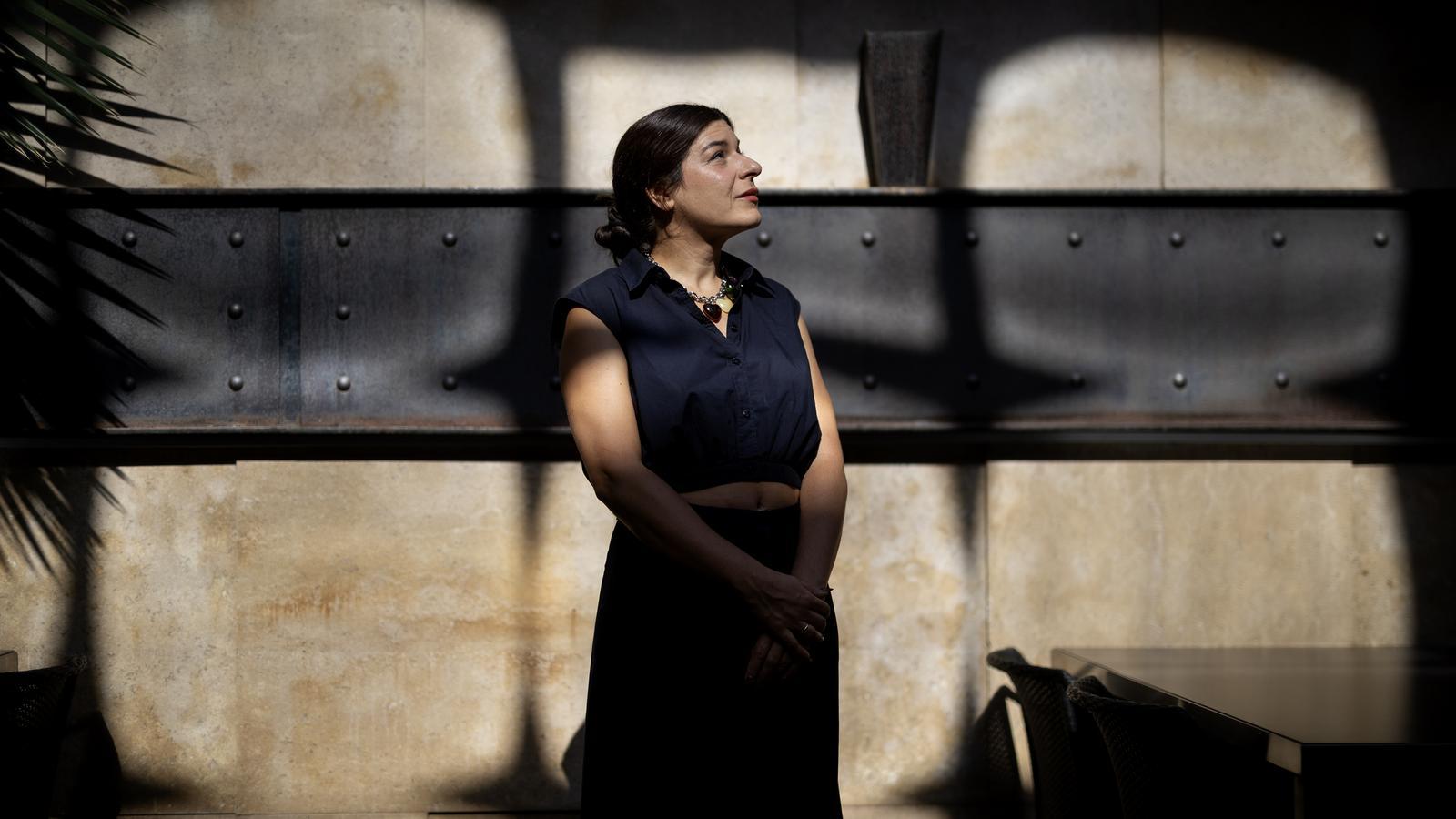
A person in a wheelchair raising a rifle. It is the image that Nerea Pérez de las Heras (Madrid, 1982) has on WhatsApp and which is, in reality, the logo of a fictional terrorist group that brought together people with disabilities. It was invented by Álex de la Iglesia in the film Acción Mutante. She already had a combative outlook before the summer of 2023. She had filled theaters with the monologue Feminismo para torpes, which would end up becoming a book; she wrote for different publications and co-hosted the podcasts –which continue today– Saldremos Mejores and Lo Normal. She had already turned 40 and was with a group of friends in a cove in Menorca which can only be accessed on foot or by boat. It was July 3 years ago. That day she was wearing a new swimsuit. The propeller of a sailboat severed her right leg, which was amputated after three operations. She explains this in the book Fantasma (Alfaguara), where she flees from narratives of overcoming to combine intimate narration with an essay that traverses love, disability, housing, and a fierce defense of public healthcare.
It was July 23rd, the day of the general elections.
— And I asked for the result. For a brief moment I returned to myself and remembered what was worrying me just before the accident.
One might think: what nonsense the elections are compared to what had happened to you.
— I knew quite quickly that the leg was lost, even though they tried to save it. And it is much more difficult to be disabled in a right-wing country where healthcare is privatized. It is a mistake to say that structural things are not important when something happens to us. It is the opposite: what is structural becomes important precisely when you are vulnerable.
You narrate with precision how you apply a tourniquet, how you arrive at the ambulance… and how the body works to protect you from pain.
— It is true that it defended me in a survival situation, yes. But I have also learned that pain has two opposite mechanisms, and the nervous system can be refractory to treatments. There are people who have had serious injuries... and have pain afterwards without an apparent cause.
What comes to mind when you think of room 225 at Son Espases hospital?
— Relief and joy. Look at what a crazy thing. I had taken care of my parents in hospitals, always in shared rooms. And when it was my turn for a private one… You don't know what luck it was to be able to have privacy in such a horrible moment.
The friends arrived quickly.
— And the first thing I thought was: but are they crazy? They bought a ticket to get here, in high season, what a fortune. And now they won't find a place to sleep. So for me, in my alienation, it was like it wasn't that big of a deal. Because I could have died and in the face of that, everything else seemed less serious. And then we hugged each other, we cried… and yes, it really was a big deal.
It took them a long time to complain about something in front of you.
— They were taking care of me. They considered that they could not complain because their problems were of no importance after what had happened to me. Later that awareness fades away. You cannot become your wound, your disability.
Were you very worried about worrying?
— A lot. Especially with my parents, who were already old, fragile, could not take care of me and I did not want to put them in a situation in which I was vulnerable. And I do not know, sometimes when you put on the mask of strength so as not to worry, by dint of faking strength, the real strength ends up emerging in you. Fake it till you make it they say. I did not tell my parents what had happened until weeks later, when I was already in Madrid and I was able to go see them with my siblings.
You say something beautiful about your mother.
— That she understood, long before I did, that everything important was intact. She doesn't see very well, but she came closer, touched me, hugged me, and said: you are alive, I don't care about the rest. And my father, on the other hand, was horrified, horrified. I compare it to coming out of the closet, you have to let people handle things as best they can.
You felt that you had not been able to maintain its creation. Why?
— I have been lucky enough to have been loved very much since I was little, and since I am the youngest of five siblings, I have always been a toy, I have had the consciousness of a toy, and I felt that I had broken it. That I was a disappointment. That is also why I hid it, I was not capable of bearing their discomfort.
Behind stories like yours there are narratives of overcoming. Are you a better person today?
— What I had to learn about public space and the country where I live, I already knew. What surprises me is the unconsciousness of the rest. Why don't you know it? Are you an adult and nothing has happened to you? Not to you or anyone you know? Have you never gone to the emergency room without a single euro in your pocket and been treated? Do you consider that something like that has to happen to have an awareness of the welfare state?
But perhaps something about the whole process has surprised you.
— The monitoring of disability. That I have to go through a tribunal, that there isn't a minimum I can receive without processing paperwork, that they review it as if I were going to grow! Worse than the pain, it has been the bureaucracy, it makes you feelan idiot. It has been an ordeal to access what I need, which is little: a parking card that I use every two months. But people with greater disabilities have to put up an exaggerated fight.
You had to resort to a private clinic during a moment of great pain in the stump.
— One of the longest waiting lists in the Community of Madrid is for plastic surgery, which I needed. And waiting meant at least another year in a wheelchair, losing muscle mass. I emptied my piggy bank. I spent my savings looking for a solution to the pain in every place I could. The public health system saves you, but then it lacks the resources to guarantee quality of life.
You went back to writing in a hurry, because an editor who didn't know you had had the accident asked you for an article about Rubiales and the controversy after the Women's World Cup.
— I think I needed it, it gave me a sense of normality, of feeling that life went on. But above all, I was anxious about money. I went back to work at full speed, now sometimes I put my hands to my head. But I am self-employed, I work with traditional media and with their transition to the networks. And there you cannot disappear so easily for two months.
It is on social media where you make it public a month after the accident. And you end up in Hola.
— I cannot lack anything else. Anna and I love it, because the article was in that language typical of the magazine, pompous and cheesy, always reflecting a Disney-style romantic love, but in this case between lesbians.
We haven't talked about Anna yet. What has she meant in this process?
— Everything. We have been almost symbiotic. I realized it while going up and down the stairs of the fifth floor where we live. I would go up and down with crutches and she would carry the chair, always accompanying me because we were terrified that I would fall. And since the lights would turn off because they were automatic, we would get scared and have little heart palpitations. Synchronized. Now, fortunately, we go up and down stairs calmly. But she did not leave my side at the hospital, and she has had her own journey.
From the beginning I touched you, I hugged you… Have you had conflict with your body?
— For us, this has not been an issue. But many women who lose a limb do not feel comfortable with their body. An academic explained to me that many no longer feel feminine. It didn't even cross my mind. But I did feel lucky to have it.
In fact, what bothers you the most is pity. Have you felt much of it?
— Yes, from strangers. It bothers me a lot because I think they take for granted that their life is better than mine. Or people who say: now I see that my problems are small. And I always think: or not, maybe your life is shitty. But mine is fine. Disabled people sometimes have shitty lives, especially because of the context: the outings, the bureaucracy, the sidewalks... But there is a bit of everything.
That is why you like stylists.
— They have a way of seeing the body that also amuses me; they play with you as if you were an object. When they were doing the fitting for an event, one of the stylists told me: of course, you are a brunette, winter tone, but now you are also wearing silver. We have to combine the metal with the bracelet… And it was liberating. There was no look of strangeness. This is what there is, and that's that.
And you can put on heels.
— 6 centimeters maximum. I told her she couldn't wear any more, because the prosthesis doesn't allow it. And she said to me: neither you nor anyone else, my dear.
Let's talk about the ghost.
— Most people who have lost a limb report that they still feel it. I don't want to give spoilers for things that are at the end of the book, but when I touched a point on my knee – the inner side where they had directed the skin to make the stump – I felt a point in the air, in the void. It is very strange, but the brain has a body map that it does not easily forget. There are people who live with it their whole lives, like a ghost. It is real and poetic.
You say that we have come into the world to lose.
— Indeed, you grow and you lose: friends, loves, collagen… Life is not an upward curve that later worsens with old age. In any case, a saw, with losses, peaks, all of it. One of the things we must accept is that in this world of winners' propaganda, we have come to keep losing things.
And is it love that saves us? Or is that cheap sentimentality?
— Love saves us, but not the romantic kind. Love saves us in the sense of being able to put yourself in someone else's shoes. We are saved by others, who also destroy us.
