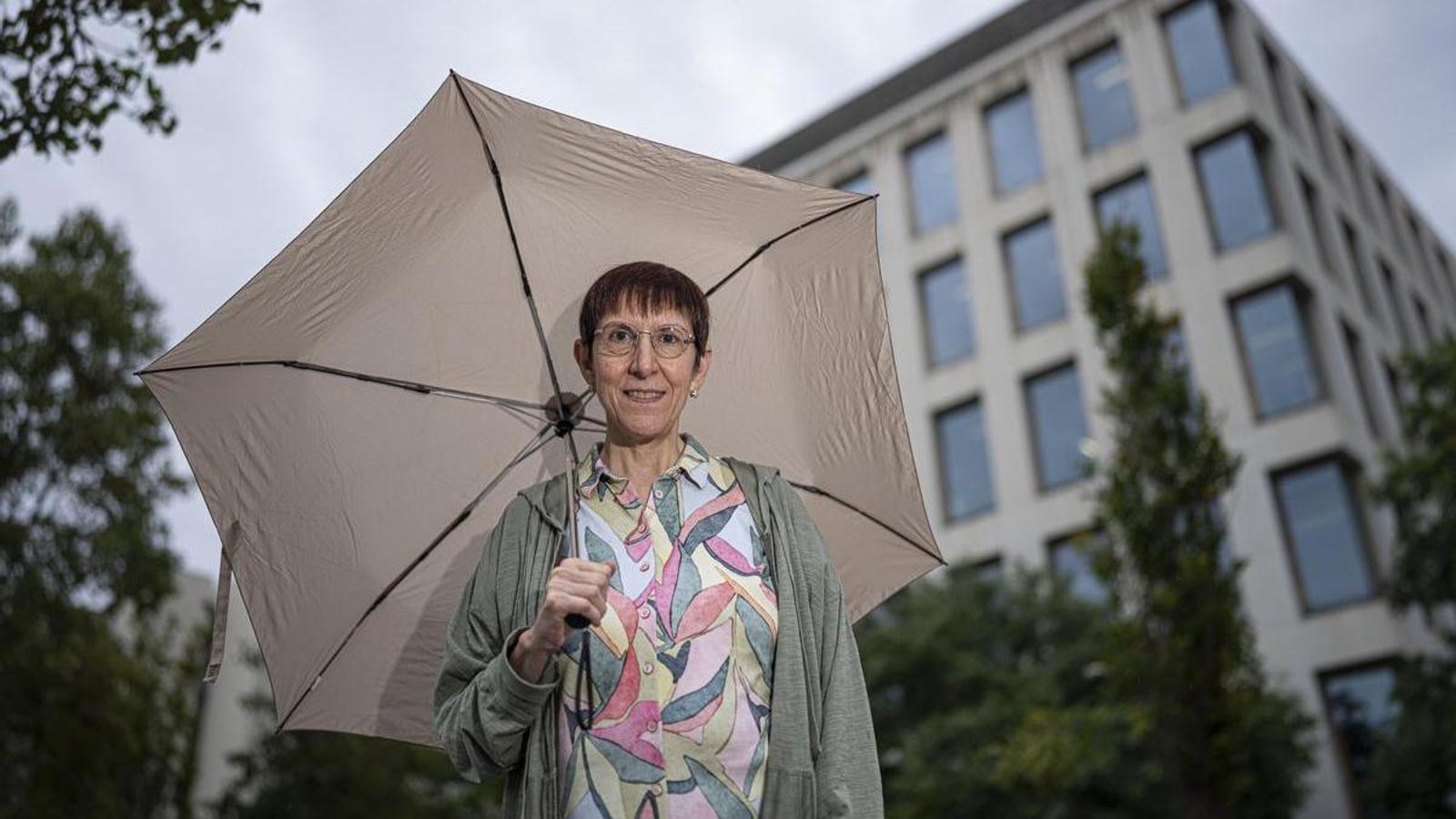
Nogués confesses that she is not much of a jewelry wearer, just the same pair of earrings and her wedding ring. Around her neck, however, she wears an exception: the blood-drop shaped pendant that her siblings gave her when she turned 60, in 2025. It symbolizes everything that for decades has been an important part of her life: blood, the laboratory, and science. “They have always seen me, since I was very young, dedicated to the laboratory. It is my second home and a very important part of my life”.
"We still cannot manufacture blood artificially, but we are working on it"
The scientist Núria Nogués investigates how to obtain red blood cells in the laboratory to complement donations and help in rare cases
03/11/2026 - 07:03 h
-
CAT -
CAST
With exquisite care, Núria Nogués (Barcelona, 1965) opens a small blue box and extracts a teardrop-shaped pendant with a red stone in the center. She looks at it with delight and, almost as if making a confession, lets out: "Blood is a truly extraordinary tissue." This jewel contains her story: a career dedicated to deciphering the secrets of blood groups, to understanding what makes each blood unique, and to preventing this uniqueness from becoming a health obstacle.
"From the very first moment, I was fascinated by the structures that blood cells have on their membrane and the antigens, which are what we know as blood groups and which determine incompatibilities when a person receives a transfusion," explains this immunohematologist at the Blood and Tissue Bank. When the body comes into contact with antigens it does not recognize as its own, it can develop antibodies. "It is practically impossible to find blood identical to yours, because there is so much diversity," she points out.
Beyond the best-known groups – A, B, AB, and 0 – and the Rh system, there are 49 described blood group systems and more than 300 antigens. That is why it is crucial to identify the antibodies that a person has in their plasma and that react against red blood cells before a transfusion. It is one of the tasks of Nogués' laboratory, which also specializes in finding extremely infrequent blood groups. "You can have blood with characteristics that only 0.1% of the population or less has," she says.
The Blood and Tissue Bank searches for these rare donors and is part of an international network to locate them. Sometimes, there is one in Australia, Sweden, or Canada who must be called because their blood is needed. And that is a challenge. The only source of blood for transfusions in cases of anemia, surgical interventions, accidents, oncological treatments, or transplants are altruistic donations. An extraordinary gesture, but also a limitation. And this researcher is working to solve it: "We cannot yet manufacture blood artificially, but we are working on it," she states with a glimmer of ambition in her eyes.
In their laboratory, they are investigating how to obtain red blood cells from progenitor cells and reproduce in vitro the process that takes place in the organism. They are not looking to manufacture blood of all groups, but rather to obtain red blood cells with rare profiles, useful both for transfusions and for diagnosis. "Red blood cells from donations are also a fundamental tool for identifying these antibodies," he explains. The project, in which he collaborates with the University of Bristol, received a grant of nearly one million euros in 2023 from the "la Caixa" Foundation, in the Caixaresearch health call –this year it has just granted 32.4 million euros to 80 new biomedical and health research and innovation projects–; it also has funding from the Ministry of Science and Innovation.
The symbol of a life dedicated to research
One of the potential applications is helping people with sickle cell anemia, an inherited disease that alters red blood cells and often requires regular transfusions. "Their red blood cells, instead of being like a donut, are crescent-shaped. They are rigid and, when they have to pass through narrow blood vessels, they get stuck and form blockages. This prevents oxygen from reaching the tissues and causes significant damage and a lot of pain," explains Nogués. The more antibodies they develop, the more difficult it is to find compatible blood. Therefore, having red blood cells with specific characteristics could be decisive.
Blood generated in the laboratory would not be an alternative to donations, but a complement. And the need is urgent: the population is aging, there are more and more people who need medical treatments at an advanced age, and donors are also getting older. "It is necessary to advance in the biotechnological production of red blood cells to complement donations and meet future needs," points out Nogués. Meanwhile, he reminds, donor blood remains fundamental.
