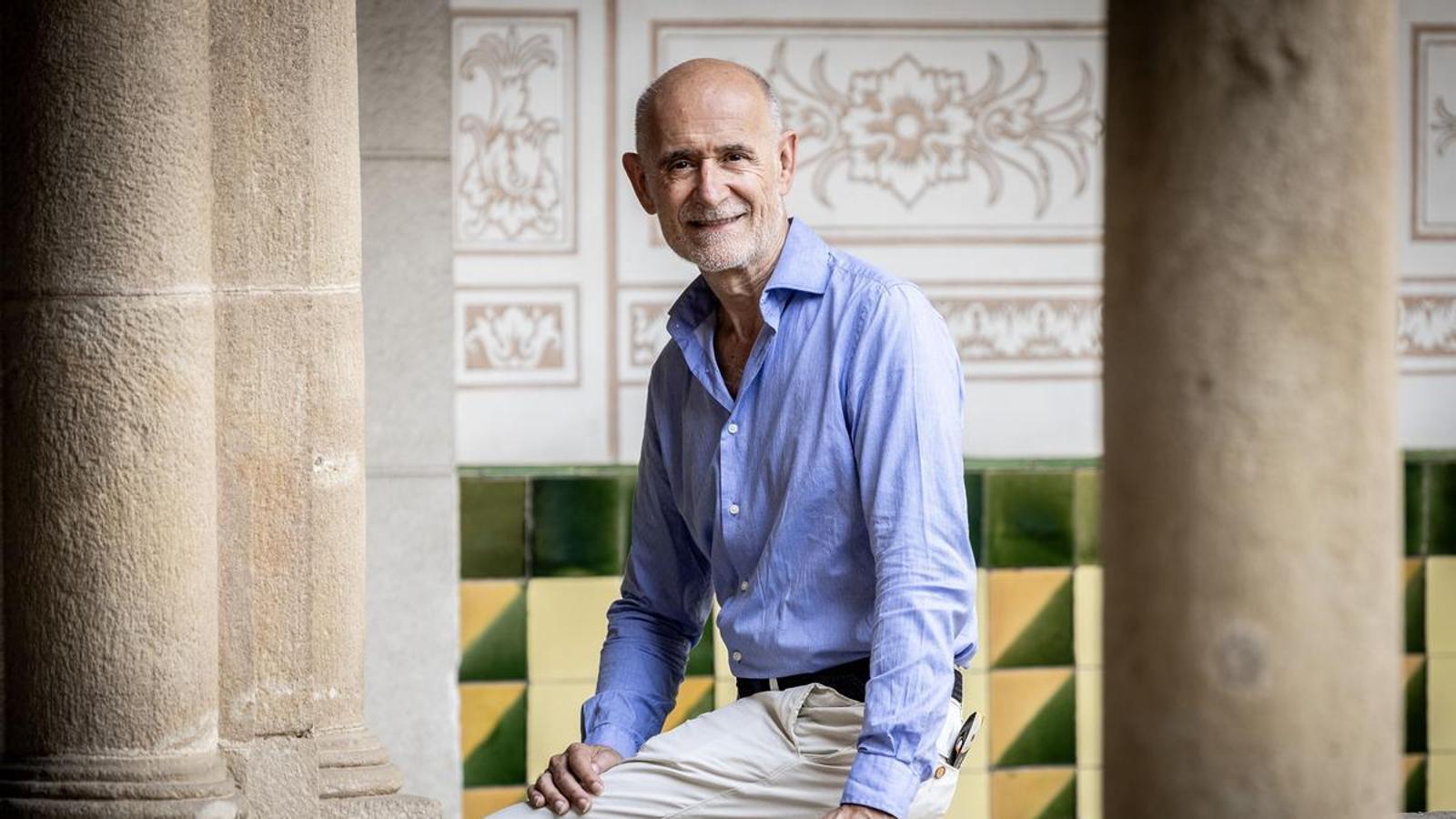
Joan Anton Català: "The total solar eclipse is so exciting that tears fall from your eyes"
Astrophysicist, quantum chemist and science communicator
-
CAT -
CAST
Make the most difficult easy: getting science, and especially everything related to the universe, to awaken the curiosity of those who listen. And not only that. He is capable of spreading his passion for the cosmos and, in turn, for life. With only a few days left until the total solar eclipse that can be seen from Catalonia, Joan Anton Català, astrophysicist, quantum chemist, and science communicator, is the most sought-after man, but he makes a space in his busy schedule to explain to us how extraordinary this phenomenon will be that we will be able to see on August 12. The eclipse of the century (Cossetània) is the guide it has published for those who do not want to miss any detail.
The first pages of the book say that an eclipse is a spectacle that everyone should see at least once in their lifetime. Why?
— Because it is the spectacle in capital letters of nature in the sky. There is nothing more spectacular. It has nothing to do with auroras, however beautiful they may be, or with a lunar eclipse. A solar eclipse is a very emotional thing. Besides, it makes you feel connected to something that goes beyond you… To the universe, to nature, to humanity. It is such an exciting moment that tears fall from your eyes.
That's why it recommends watching it with the one you love most?
— What you want is to share this with those you love and with your friends. We get emotional, we hug, we want to share these fleeting moments. We will feel as if nature had stopped, as if time had stopped. It is very impressive. In fact, they say that whoever has seen one can no longer stop seeing more. I can attest that it is so. You are so impressed that you look at the calendar to see which is the next one.
How many have you seen?
— Only one. I'm here bragging about having seen them and I've only seen one in total, which was in 2017 with my family. We went to the United States and it was spectacular.
As explained, therefore, a solar eclipse is a very exceptional event.
— In Catalonia there had not been a total solar eclipse since 1905 and the next one will be in 2180. So this is our eclipse, nature has taken a very long time to prepare this spectacle for us. Next year there will be a very beautiful one in southern Spain and North Africa, but we will have to move.
How is it possible that an object as small as the Moon hides an object as large as the Sun?
— This is due to a casual effect of perspective. The Moon is 400 times smaller than the Sun, but it is 400 times closer to us than the Sun. And this makes the visual size of the Sun and the Moon the same, more or less, so that the Moon can hide the Sun and give us total eclipses. But this will be lost in the future.
Why?
— Because the Earth and the Moon move away from each other by 4 centimeters each year. This will make the Moon appear smaller and smaller in the sky, and there will come a time when it will not be large enough to completely hide the Sun, even if it is perfectly aligned. We don't need to worry, as this will happen in thousands of millions of years.
The guide explains that eclipses are not exclusive to Earth.
— No, there are other places in the Solar System that have eclipses. Firstly, to have an eclipse you need to have moons, you need to have satellites, and they need to be big enough to completely block the Sun. Mercury has no moons, Venus has no moons, Mars has two, but they are two small, irregularly shaped rocks that are not big enough to hide the Sun.
But Jupiter does, and Saturn, too.
— Jupiter has 95 moons, but it has four especially large ones that are big enough to cover the Sun. But, unfortunately, we cannot go there because there is no surface. And Saturn has a very large moon, which is Titan, but there is also no surface where we can stand to see them. Result? Earth is the best place to see eclipses.
Let's go back to the eclipse on August 12th. Can you explain a bit about its duration?
— It will start around 7:35 PM as partial. It is the moment when the Moon's disk is biting the Sun. This part is what we have to look at with approved glasses. Then, the moment of almost totality will arrive where we will see a sliver of Sun and suddenly it will get dark. At this moment, the Moon projects its shadow on the Earth and we will find ourselves under the Moon's shadow, which is very poetic. And it will be then when we can take off our glasses. In fact, we have to take them off because otherwise, we won't see anything.
And then?
— The sky will be darkened, the stars will come out, we will see Venus very bright, the temperature will drop and we will see the sun completely covered by the Moon and surrounded by the solar corona, which is a diffuse light. This will happen exactly at 8:29 PM on August 12th. It will last a very short time depending on where we are. For example, in the city of Lleida this will last 30 seconds, in the city of Tarragona it will last one minute and one second. The place where it will last the longest is the area between Amposta and Castelló de la Plana, which will last one minute and 37 seconds.
It is very ephemeral…
— Yes, but very, very, very intense. And then, all of a sudden, the Moon will continue to move and begin to uncover the Sun. A flash of light will come and it will be day again. At that moment, immediately, we will have to put on our glasses again and the second part of the partiality will come. It should be noted that the Sun will be very low on the western horizon.
Therefore, it is very important to choose the right place from where we will look at it.
— We cannot have obstacles, nor buildings, nor trees, nor hills, nor mountains on the horizon that are too high. This complicates the viewing of this eclipse a little more, because the millions of people who will move to see it will end up in similar places. We will look for those viewpoints or places in our towns that have a clear view on the western horizon.
It speaks of millions of people who will want to see the eclipse.
— The Spanish government, when it made its first estimates at the beginning of the year, calculated that 10 million more additional visitors than those who already come every summer would come to all of Spain. Therefore, major mobility collapses are expected in the days before, on the day of the eclipse, and on the return. That is why it is very important to try to travel in a staggered manner a few days before, let no one expect that on that day they will be able to take the car from Barcelona and go down to Tarragona. Let's remember that the AP-7 does not need a total solar eclipse to get blocked. Neither does Rodalies. Planning will be necessary.
So, once the eclipse is over, it's best to stay where we are, right?
— Yes. In addition, that same night we will have the moment of maximum intensity of the Perseid meteor shower. Therefore, it is a continuous session: total solar eclipse in the evening, we rest a little and at night we watch the shooting stars of the meteor shower, which, moreover, will come in the best possible conditions because there is no Moon.
What would be the basic kit for good observation?
— A comfortable chair. Water, to hydrate ourselves. A sandwich wouldn't go amiss. A cap, very clear too. Sunscreen, important. If you allow me, my observation guide for this eclipse to fully enjoy the details. Mosquito repellent. And, above all, approved glasses. We don't play with that.

Focus a lot on this glasses thing. How can we know they are suitable and approved?
— We must ensure they have the ISO 12312-2 certification. They are very cheap glasses, bought at any astronomy shop and in many opticians. We will put them on during the partial phase and, when it suddenly gets dark, we can take them off to see the eclipsed Sun. Afterwards, at the moment the first flash of light reappears and it gets light again, we will put them back on. And, very importantly, in areas where the eclipse is not total, we will not be able to take off the glasses at any time.
One last thing: throughout history, eclipses have been considered bad omens by different civilizations. Fortunately, the advent of scientific knowledge put an end to their bad reputation.
— Yes, because we have realized that they are not only not bad omens, but quite the opposite. They are a reminder of the fortune we have of being alive, of being on this planet and of being able to enjoy this spectacle. And this should serve to remind us of the luck we have of being part of humanity and of sailing in a ship that is unique and is called planet Earth.
