Sheinbaum invites Sánchez to Mexico and thanks him for the recognition of the abuses of the conquest of America
The presence of the Mexican president in Barcelona marks a before and after after the pause in diplomatic relations in 2019

-
CAT -
CAST
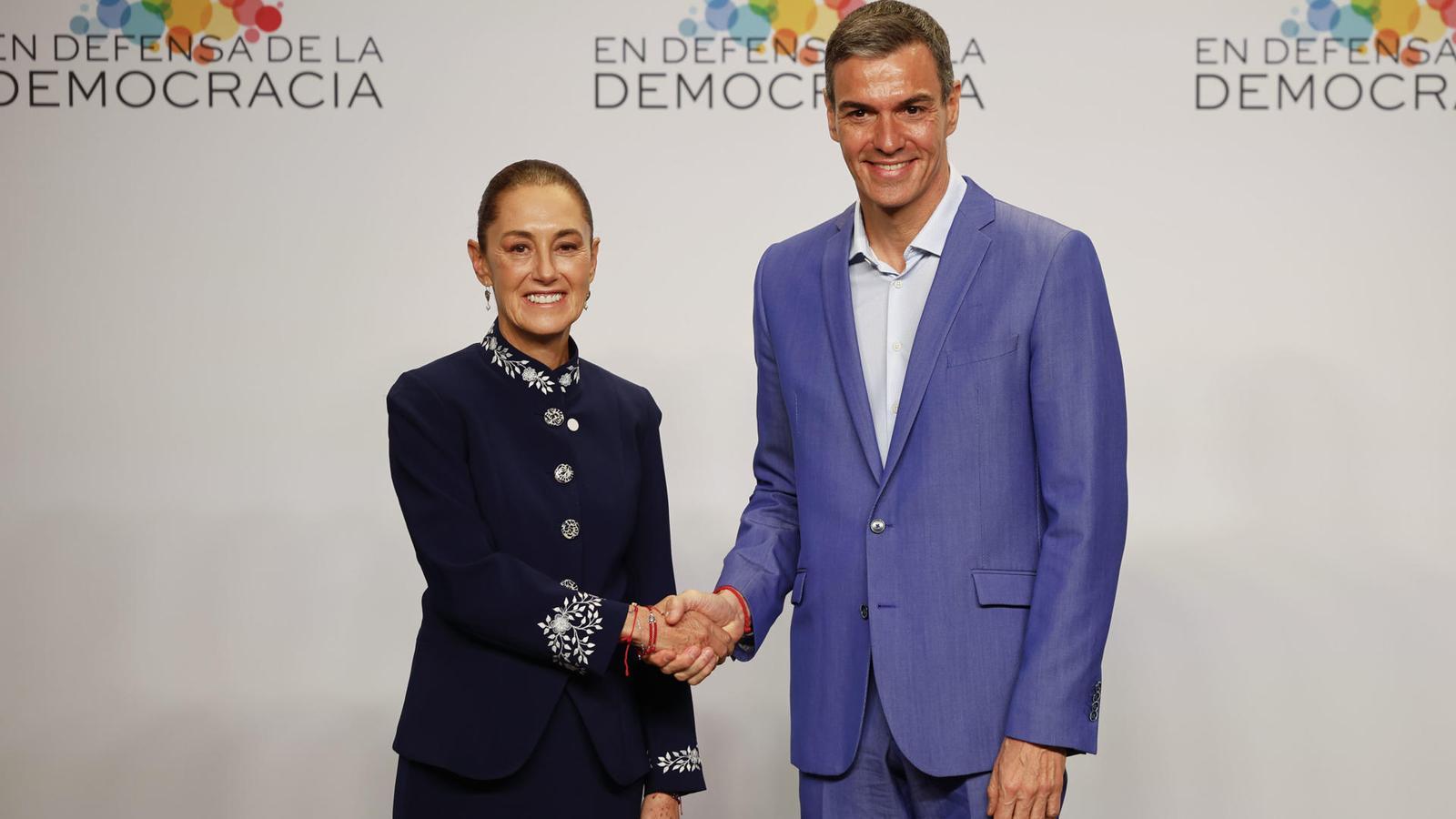
MadridThis weekend in Barcelona there were many photos, many summits, and a lot of media attention due to the presence of world leaders at the progressive meeting organized by the Spanish president, Pedro Sánchez. But there was one that is especially relevant and signifies a before and after in the diplomatic relationship between two countries: Spain and Mexico. After eight years of tension, the Mexican president, Claudia Sheinbaum, visited Spain to participate in the multilateral forum in defense of democracy, but also to hold a one-hour bilateral meeting with Sánchez.
The Mexican president took the opportunity to invite him to visit Mexico, taking advantage of the fact that the next edition of the summit in favor of democracy will be held precisely there. "There has already been an approach with Sánchez and also with the king," highlighted Sheinbaum, who celebrated that during the meeting, the Spanish president agreed with her that the Spanish conquistadors committed abuses against the indigenous peoples of America. "The important thing is the recognition of what the arrival of the Spaniards meant," Sheinbaum remarked when asked if Sánchez had apologized on behalf of the Spanish state. During her speech at the summit, she precisely vindicated the history of her people.
Sources from the Spanish government have indicated that the rapport between the two presidents has been "fantastic" and that they have discussed how to continue strengthening the cultural, economic, and social ties between the two countries. For La Moncloa, there was no diplomatic crisis with Mexico either, despite the fact that relations had not been going through their best moment for some time.
Sheinbaum's presence in Spain is an important step in resuming relations, as the bond between the two countries was absolutely shattered at an official level when the State refused to apologize for its colonial past. This will take place in Catalonia, which is no stranger to the Mexican president's biography. Her first husband, Carlos Imaz Gispert, was the son of exiles from Spain with Basque and Catalan roots. His mother was Montserrat Gispert, a Catalan scientist who grew up in Mexico following her family's exile from Franco's dictatorship in 1942.
What has happened between Spain and Mexico?
1977: the resumption of relations
Let's start at the beginning. Mexico never recognized Franco's regime, it was always faithful to the republican legality in force before the 1936 coup d'état and played a key role in welcoming Spanish exiles to the point that Mexico City was the seat of the government of the Republic in exile —it later moved to Paris—. For this reason, relations between Mexico and Madrid did not resume until after the dictator's fall, in 1977, spearheaded by the Spanish Foreign Minister, Marcelino Oreja, and his Mexican counterpart, Santiago Roel. The culmination of the normalization of relations came with the visit of King Juan Carlos I to Mexico, during the presidency of José López Portillo, the first by a Spanish monarch since the country's independence.
Exponential increase in political and economic ties
With the resumption of relations, political dialogue began and economic exchanges increased. This is confirmed in his work Mexico and Spain, 40 Years of Reunion by UNAM researcher Mario Ojeda, who states that between 1977 and 1981, economic and commercial exchanges between the two countries "multiplied by 26". Mexican exports to Spain went from 21 million dollars to 814 million, and Spanish exports to Mexico from 50 million to 369 million, making Spain Mexico's second-largest customer and sixth-largest supplier. However, these economic relations took on a "paternalistic" tone from Spain, in the words of Ojeda himself, and problems began with the entry of Spanish companies into strategic sectors. In fact, over the years, the State became the second-largest investor in Mexico after the United States, notes Luisa Treviño, a graduate in international relations from El Colegio de México and former diplomat.
In any case, during the early years, and especially since Felipe González came to the Spanish government, Treviño points out that the political relationship was very close. She identifies 1992 as an important date, when the Ibero-American Summit was consolidated in Mexico—the first had taken place a year earlier in the Aztec capital. Mexico's presence at the summit, explains the specialist, is highly relevant for the other Spanish and Portuguese-speaking states because it indicates that it will be a collaboration of "brotherhood" and not control by the old powers.
López Obrador: the change
Half the world. Women in indigenous MexicoRegarding this episode, Treviño recalls that beyond foreign policy, the events are also directly related to polarization within Mexico. "Pro López Obrador supporters think Spain should apologize; on the other hand, those on the right believe Spain should do nothing," she states. A situation that is replicated in the State: while the left sees gestures as necessary, from PP and Vox they even claim the Spanish role in the past. "We had to civilize America, there we established a new order," said the Madrid president, Isabel Díaz Ayuso, who corrected the king's gesture.The turning point
For all the aforementioned reasons, the step taken by Sheinbaum this weekend is relevant. For Treviño, it is an "beginning of rapprochement" again between the two countries and it comes preceded by moves previously made by Spain. He cites a first Princess of Asturias Award to the National Museum of Anthropology of Mexico in 2025 and also statements last year by the Minister of Foreign Affairs, José Manuel Albares, in which he spoke of the "injustice" of the colonial past. At the same time, Treviño lists, the gesture of King Felipe VI has also been key within the framework of the exhibition The Half of the World. Women in Indigenous Mexico, at the National Archaeological Museum of Madrid. "There have been moral controversies about how power is exercised from day one. The Catholic Monarchs, with their guidelines, had a desire for protection. Afterwards, reality means that it is not fulfilled as intended and there is much abuse," said Felipe VI, who has been invited to the Football World Cup that Mexico will host between June 11 and July 19.
Two key dates
In addition to Sheinbaum's presence this weekend in Barcelona, there are two more key dates in the future that will decide whether or not there is a full recovery of relations between Spain and Mexico. A meeting of the Ibero-American Summit is planned for November 4 and 5 in Madrid. Will Claudia Sheinbaum participate? For now, she has not ruled it out, which would mark a before and after following the snub that López Obrador inaugurated in 2018. And the other key date will be in 2027, when it will be 50 years since the resumption of relations in 1977. Will it be an anniversary that inaugurates a new cycle?
