"Vox and Aliança threaten the anti-militarist consensus that existed in Catalonia"
The Catalan pacifist movement claims its validity in the face of the return of warmongering discourse and the increase in military spending in Europe
-
CAT -
CAST
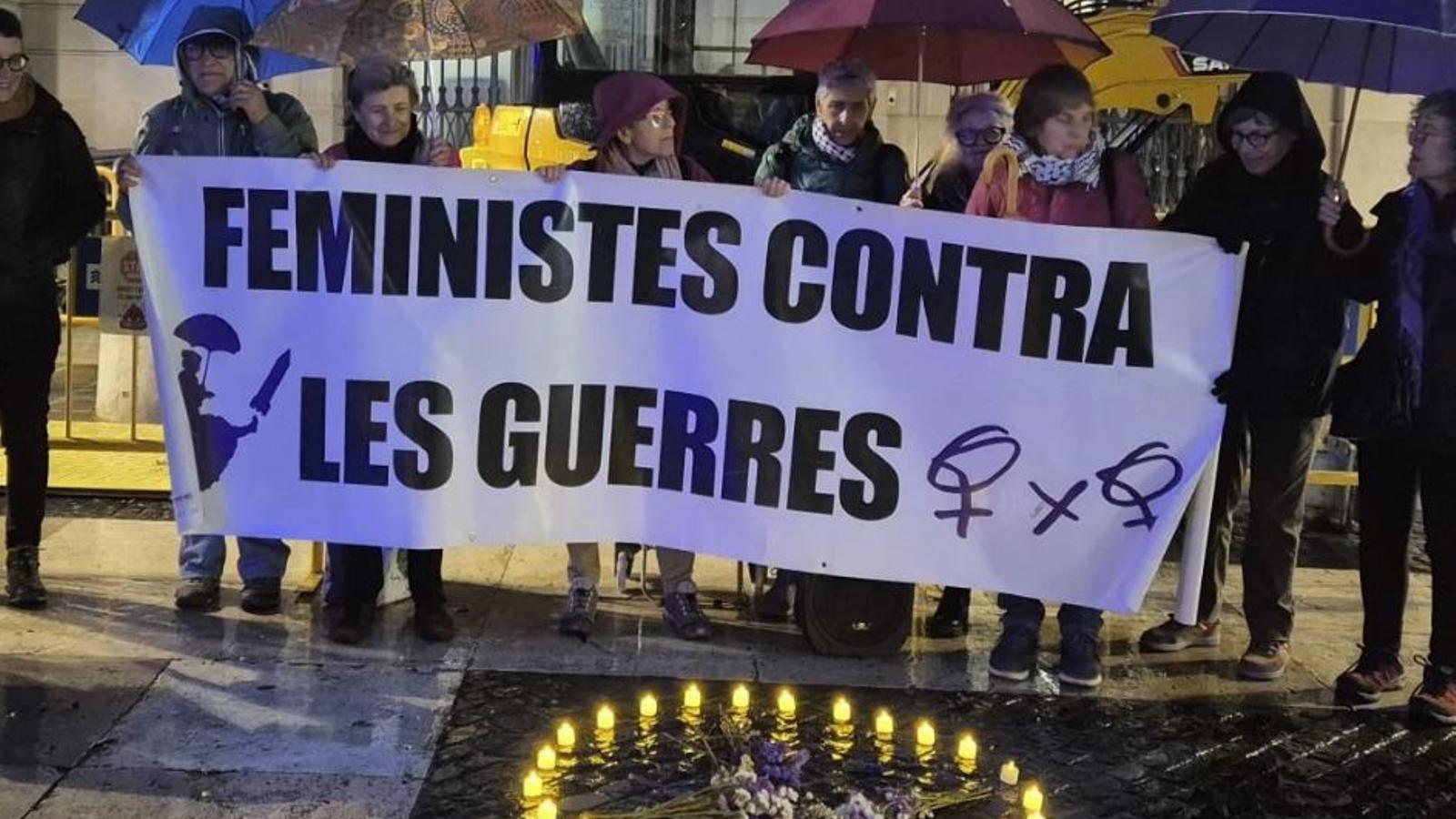
BarcelonaIn recent months, concepts such as “military spending”, “defense budget” and “military service” seem to have re-entered our common vocabulary. At a time when Europe appears to have recovered old ghosts and the drums of war are beating with an intensity not seen for decades, the Catalan pacifist movement finds itself at a political and social crossroads. “Historically, Catalonia has been a great promoter of peace, an antimilitarist country”, highlights Montse Santolino, a member of Lafede, the benchmark federation of Catalan entities working in the fields of peace, human rights, and development. Proof that the Catalan pacifist movement is still alive is the collective Dones x Dones, which, on the first Thursday of each month, has been protesting in silence in Plaça Sant Jaume for four years to protest against wars.
However, the peace movement in Catalonia has taken a turn in recent years. According to Arés Perceval, co-president of Lafede, the transversal consensus that historically existed in Catalonia "has been totally threatened with the arrival of Vox and Aliança Catalana", actors, in her opinion, "with militaristic premises and proponents of the war business". A change that, according to her, has dragged the PP along and placed the PSC in an ambiguous position. In a recent statement, Lafede criticized that the socialists were “promoting meetings with large arms companies to facilitate their access to public funding”.
The excuse of Ukraine
However, the international context is working against it. The invasion of Ukraine has served as an excuse for a wave of militarization that was already brewing within European institutions. Santolino warns that the rearmament discourse is not new, but it has accelerated: "This rearmament discourse comes from Von der Leyen, from the European Union, and there has been strong work on this for years." This trend translates into pressure to increase the percentage of GDP allocated to military spending, a figure that the peace movement sees as a direct attack on social investments. "The public debate on this is non-existent," the activist laments.
With the memory of the great civil disobedience campaigns still fresh, Santolino warns that if PP and Vox govern in Spain, mandatory military service "will be back on the table." Following models such as the French or German ones, the activist believes that policies would be applied progressively and that the army would be presented as a "super attractive" option in the professional field, almost like a "paid vacation" where one could learn a lot. A warmongering normalization that is already perceived at the Education Fair, where the army continues to be present despite having approved Parliament resolutions prohibiting it. Santolino regrets that the regulations are "scrap of paper" while attractions like this year's are exhibited: a fighter jet where "boys were queuing by the thousands" to get on it.
Catalan law
In the institutional sphere, Catalonia also does not start from scratch. Since 2003, the country has had the law for the promotion of peace, a tool that, despite being pioneering, many point out has been relegated to the back of the drawer. “There were guidelines for things that had to be done, but in reality, they have not been done,” denounces Santolino. The lack of impetus for the law led to the creation of the Catalan Forum for Peace, a participatory process that began almost three years ago. The ultimate goal is to put the pacifist agenda back in the spotlight and also to force the Government to present a proposal for a Director Plan for Peace to Parliament before the end of the year. The ball, therefore, is in the Government's court, which
