How the manager of Can Jorba saved his life after being sentenced to death in 1938
The businessman's grandson delivers an unpublished letter and drawing from his captivity to the Manresa Memory and History association
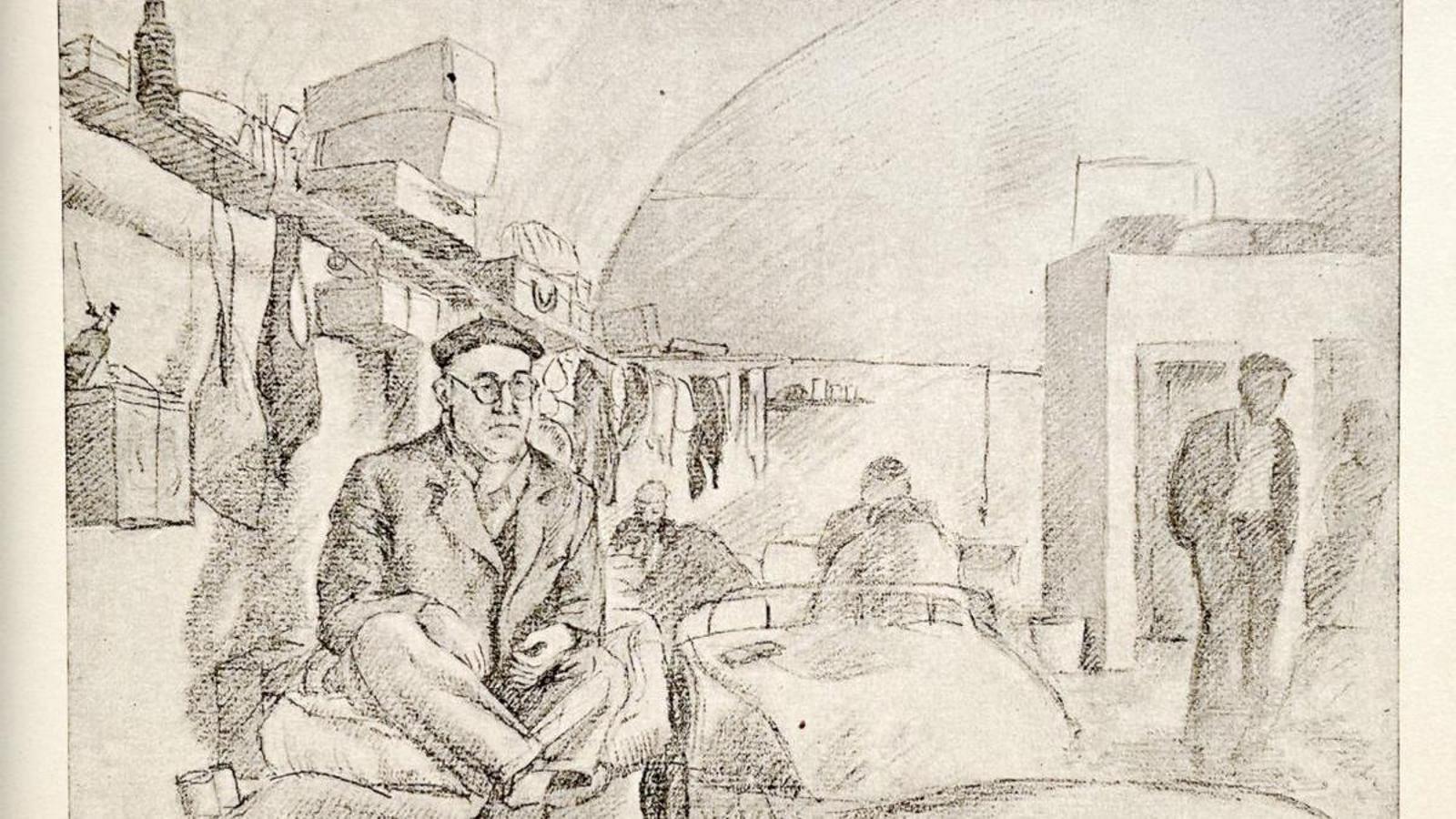
Barcelona"I believe that today or tomorrow they will take us to Montjuïc. [...] I have nothing but to thank our Lord God who gives me reason and occasion to suffer [...] Do not lose hope. Cheer up!".These are the words written by Domènec Ribas Prat on November 11, 1938, two and a half months before Franco's troops occupied Barcelona. Ribas (1888-1955), manager of Magatzems Jorba —Can Jorba, on Portal d'Àngel in Barcelona—, addressed it to his wife, Neus Jorba, just after learning of the sentence condemning him to death. Although his file has not been preserved at the Model Prison, the text indicates that when he wrote the letter his transfer to Montjuïc Castle was imminent. Together with the text, Oriol Font, the businessman's grandson, has handed over to the association Memòria i Història de ManresaMemòria i Història de Manresa an unpublished drawing by an unknown author that portrays the businessman during his captivity in Montjuïc.
According to the family's testimony, the reasons for his arrest are related to his religiosity and to the fact that he had facilitated the celebration of clandestine masses at his home, on Carrer de Santa Anna, during the Civil War. In fact, there is a photograph of an altar set up in his home. The letter, on the other hand, also makes his religious convictions very clear. There is another testimony of his religiosity and his condemnation. In May 1955, the obituary published in the magazine Jorba, details his arrest: “The sectarianism did not forgive his good character and persecuted him fiercely during the red rule, being arrested and taken to Montjuich, where the so-called tribunals of... justice condemned him to death, from which penalty he was able to escape by the design of Divine Providence”.
Evacuation to La Garrotxa
The letter that the businessman sent to his wife ends by explaining that some friends are working to get a review of the sentence, but that he is already resigned to his fate. In January 1939, faced with the imminent fall of Barcelona, Ribas was part of a forced evacuation of prisoners towards the French border. During the retreat, the group stopped at the sanctuary of Santa Maria del Collell (Garrotxa), where about fifty inmates were executed on January 30. Ribas, in a turn of events that the Revista Jorba itself would describe years later (in May 1955) as a "design of Divine Providence", managed to save his life and avoid execution.
“The Catalan Church has not yet recognized or thanked all the efforts that Companys made during the Civil War”, he recalled to the newspaper ARA. During the Civil War, there was violence from both sides. Nevertheless, the dictatorship's repression was much more fierce and systematic. Punishment was carried out at all levels, starting with the confiscation of properties from Republican families and continuing with the purging, detention, and punishment of all those suspected of being opposed to the dictatorship. It is estimated that in Catalonia, 3,385 people were executed, and throughout the State, according to Paul Preston, more than 50,000. Hundreds of thousands were sent to concentration camps and prisons. More than half a million took the path into exile. On the other hand, the late historian and monk of Montserrat, Hilari Raguer, always championed the work done by Lluís Companys to help many priests take the path of exile. “The Catalan Church has not yet recognized or thanked all the efforts Companys made during the Civil War,” he recalled in the newspaper ARA.

