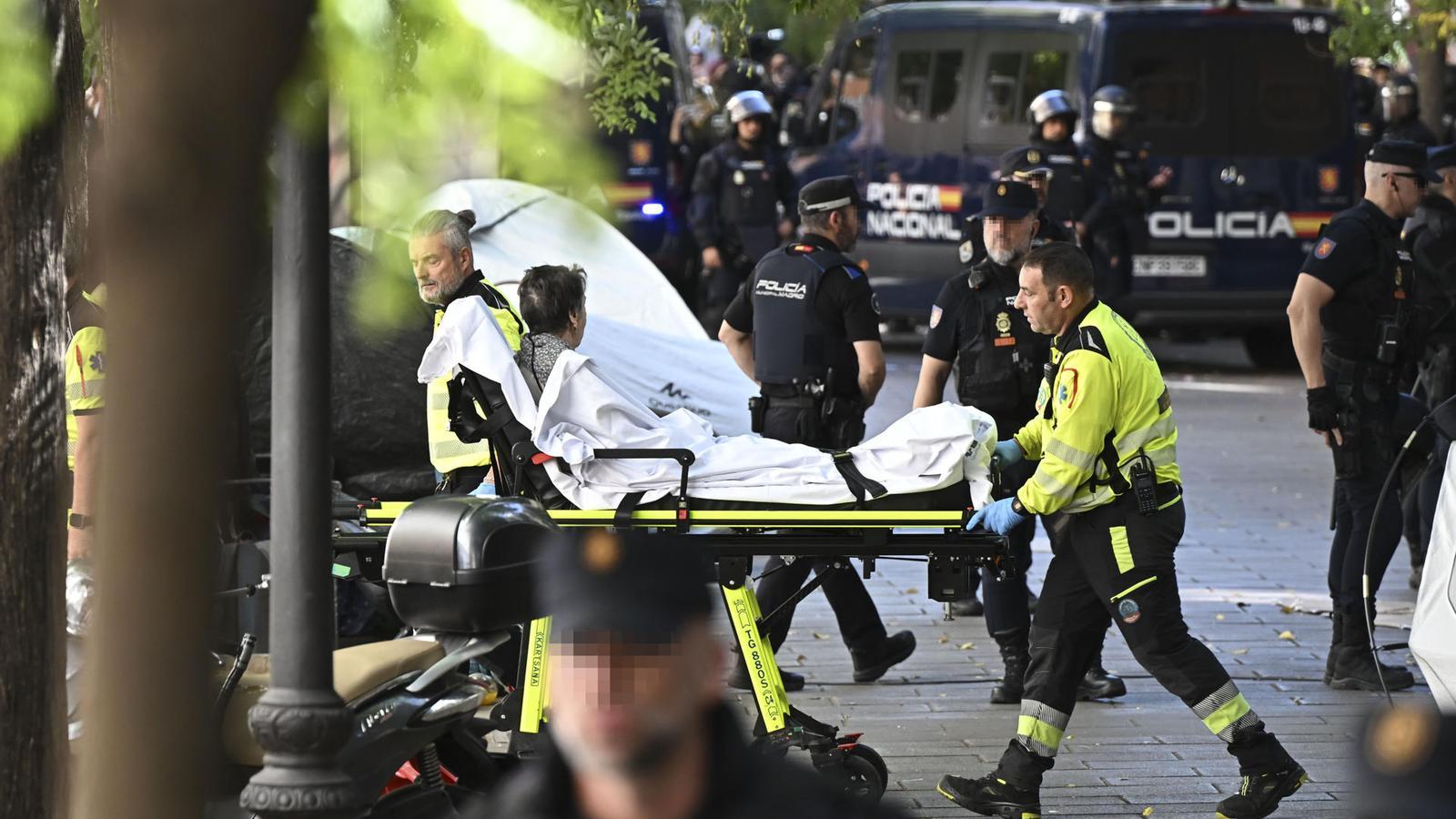
On the street, on a stretcher and well tied up

-
CAT -
CAST
MadridThe eviction of Maricarmen Abascal in Madrid is one of those events that mark a stage of Spanish life. It has an enormous symbolic weight, just as in the eighties it was held by Cojo Manteca, a boy with a disability who was then 20 years old and became famous for how he lashed out against street furniture during the student protests that took place in Madrid in 1987. The significance of the current protagonist's appearance on all the news is quite different from that of Jon Manteca Cabañes, who was born in Arrasate in 1967 and died in Orihuela in 1996. However, the images that unite them have many things in common, although the protest was undoubtedly carried out with more dignity by Maricarmen Abascal, because Manteca went down in the country's graphic history striking all kinds of glass and telephone booths with his crutches, when they were a mandatory fixture on city streets.
Jon Manteca emerged from the crowd with his crutches as an expression of a broad protest movement, and left a mark of limited urban destruction along Madrid's Gran Vía. He did so on the occasion of mobilizations that ended with the resignation of the Minister of Education of those years, José María Maravall, a scholar of social democracy and with more of a profile of a university professor than a political manager.
Those protests forced Felipe González's government to rethink priorities in higher education, as part of the dialogue with the youth, which was in essence that of the baby boom, now already in the process of retirement. Maricarmen Abascal's action—who knows if she was also in those mobilizations of the time when she must have also been in her twenties—will surely not cause any resignation now, but it has been as effective or more so than that of her companion in a possible photographic exhibition on the history of social movements in Spain, Jon Manteca, a disabled boy who unfortunately died very young, at 28 years old.
A case that cries out to heaven
The case of Maricarmen Abascal is one that cries out to heaven, especially due to its provisional ending, that of her departure from the house where she has lived for 71 years, on a stretcher surrounded by paramedics and police officers. This image, by itself, is one that describes a complex situation, and it will be installed forever in the collective memory. In reality, if this story is ever taken to the cinema, even harsher versions can be made. For example, by having the woman's accidental companions abandon her between two cars, already out of sight of the protesters, or at the base of some random tree, like trash that is now useless and a burden on the system. I say this because Maricarmen tied to the stretcher brought me back once again to some frames that I had forgotten, covered by the passage of time, but which were very shocking years ago, to me and I dare say to all of Spanish society.
Look for these images, you will find them on the internet. It is a work made especially for Spanish Television in the 70s. It was called La cabina, and it starred José Luis López Vázquez. It was the story of a man who, on any given morning, after dropping his son off at the bus, enters a telephone booth and gets trapped inside. What happens from then on is quite distressing and surreal. Kafka could have been one of its screenwriters. They were, in reality, José Luis Mercero, the director, and José Luis Garci, also a filmmaker and winner of the Oscar with the film Volver a empezar. The fact is that López Vázquez sees people approaching him, trying to get him out of the booth, but they fail one after another. And finally, some Telefónica employees arrive and take him to a warehouse where there are other men locked up in the same circumstances and stored with complete indifference, like broken, old, and unrecoverable junk. I have not been able to, nor have I wanted to, avoid remembering it.
Maricarmen Abascal has reminded me these days of López Vázquez trapped in his phone booth, without being able to get out or receive help from other people, who fail in their attempt to free him from the trap he has fallen into, set in this case by who knows who or for what reason. Except that they take him away with indifference and practically to throw him away like a broken toy. You have to think that for many months the impact of La cabina made people talk in those glass phone boxes by putting a foot in the door to prevent it from closing, for fear of being stuck inside without being able to get out, like the unfortunate protagonist of the medium-length film.
A hasty political reaction
It is quite significant that Maricarmen Abascal's experience can evoke these memories, making all of us, or many of us, feel helpless. And it is shameful that it has to be an episode of this nature that triggers a political reaction of haste and scrambling to agree on what should have been agreed upon long ago. Polls say that the housing problem is a torture for many people in Spain, an unbearable situation.
I know that at the Constitutional Court, every time they have to deal with an appeal on this matter, they do not quite know how to handle it, just as it happens with the issue of immigration. The right to property, the defense of the vulnerable, economic freedom, the protection of the general interest and social interest, everything goes into the blender, and it is very difficult to extract a broad-spectrum preparation that includes everyone's legitimate interests. A demonstration that parties are not all the same, that ideologies continue to exist, and that pacts and shared definitions are always needed to avoid dramas, for example, evictions as an expression of violence, without alternative solutions and without elemental pity.
I hope that on Tuesday there will be agreements in Congress for the most distressing situations. We need a counterpoint to spectacles like the one in the last plenary session, following the display of a pepper spray canister by a PP deputy. The PP, at full throttle. Later, the product spread through various parts of the chamber because an employee of the Popular group poured part of the contents into a sink, so they could hand it over empty—as the deputy had said it was—to the police. Such frivolity regarding what women must carry to protect themselves in Ceuta. Meanwhile, Maricarmen Abascal is waiting to be allowed to stay in her neighborhood.
