The president of Ceuta who does not get along with Vox and stopped the expansion of Jesús Gil
Juan Jesús Vivas (PP) has raised his tone against the Sánchez government over the migratory crisis, despite having a dialogue-oriented and institutional profile.
-
CAT -
CAST
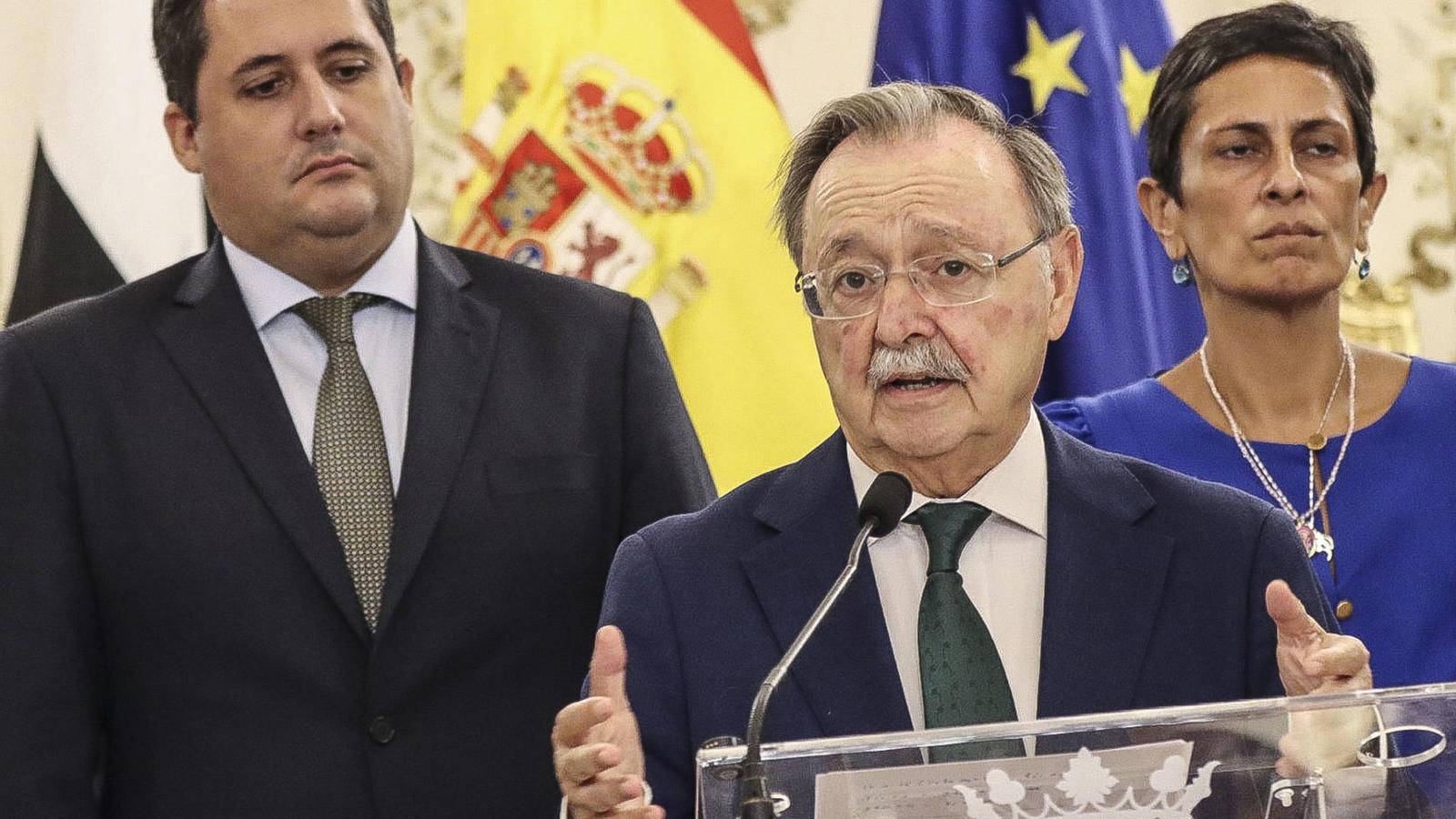
MadridJuan Jesús Vivas (Ceuta, 1953) has become a daily media presence since July 30. The massive influx of immigrants into Ceuta, the territory he presides over, is the cause. Vivas has been a tireless spokesperson for the unease this has generated among the population of the autonomous city and has put a face to the PP's political offensive against the management of Pedro Sánchez's executive. The appearances of this popular baron, one of the most veteran in the State, have increased in intensity as normality has not been restored with the passing of the days. Although within the PP Vivas is one of the so-called moderates, on this occasion he has become a battering ram against the Spanish government for its management of the migration crisis.
Precisely the fact that Vivas is one of the politicians with a dialoguing and collaborative tone has led the Spanish government and the PSOE to blame Génova and, specifically, Alberto Núñez Feijóo for having "contaminated" him by imposing "directives" that complicate understanding between administrations. In the last week, the president of Ceuta has given an ultimatum to Sánchez to resolve the situation in the autonomous city, threatening to go to court, and has demanded the return of all immigrants, including minors.
In 2021, during the previous major migration crisis in the autonomous city, Vivas publicly defended the management of the Spanish government and the Minister of the Interior, Fernando Grande-Marlaska, in the face of the massive influx of immigrants. In 2023, the president of Ceuta also aligned himself with Moncloa for the transfer of immigrant minors to the Peninsula, which caused tensions with PP regional leaders. Vivas also does not get along with Vox, with whom he has never wanted to make a pact and with whom he has openly confronted since the far-right entered institutions. On this occasion, however, Vivas has distanced himself, at least initially, from the Spanish government's proposal to bring 500 immigrant girls to other autonomous communities.
Sources from the PP consulted by ARA do not believe that the president of Ceuta feels comfortable with this confrontational role, but they attribute it to the need to defend the autonomous city and not to internal pressures. Vivas is a politician very attached to his territory, whom he has governed for more than two decades and, they add, always prioritizes maintaining stability, security, and coexistence in Ceuta, above partisan interests. "He is a much-loved and valued person. A conversationalist, who maintains harmony and is capable of bringing together different sensitivities and communities," describe the same sources, who point out that, of all PP politicians, he is the one who has received the most praise from socialists for this predisposition to reach agreements.
Against Jesús Gil
Vivas came to the presidency of Ceuta by ousting the party of the controversial former mayor of Marbella, Jesús Gil. Under the name GIL (Grup Independent Liberal), the party of the also businessman, a symbol of urban corruption and former president of Atlético de Madrid, expanded to other towns in the south of the State, including Ceuta. With a motion of no confidence, in 2001, Vivas ousted Antonio Sampietro, the then president. The PP candidate obtained the support of the PSOE, among others, to achieve this.
The contrast between GIL's populism and the sober style of Vivas, who is a career civil servant in Ceuta – where he has always lived except for the period when he studied economics in Malaga – is precisely what made him ascend politically. In the following elections, in 2003, Vivas won by an absolute majority. GIL disappeared from the Ceuta Assembly and the popular president has become the political leader who has remained, uninterruptedly, in an institutional position for the longest time. Vivas lost the absolute majority in the last elections in 2023, but with the abstention of both the PSOE and Vox, he managed to govern once again.
The multicultural flag
Vivas claims his will to represent the transversality of Ceuta. In his numerous appearances, he has proclaimed the need for "unity" of all citizens of the autonomous city "whatever their origin, whatever their name, and whatever they think". In his executives and on the PP lists, there have been representatives of the Muslim, Jewish, and Hindu communities throughout all these years. Precisely this defense of the multiculturalism of the territory he governs has led to public clashes with Vox. During this crisis, in fact, Santiago Abascal's party has called for Vivas's resignation and has accused him of "favoring Spain's enemies". Vox reproaches him that, unlike the rest of the PP, he chooses to sideline them and to make agreements with the PSOE of Ceuta and the party Movement for Dignity and Citizenship, led by a Muslim woman.
