BarcelonaThe judicial timing had willed it that the final session of the trial against the national police officers who emptied the eye of the activist Roger Español would be held on an October 1st, nine years after the day of the referendum in which the pro-independence activist was mutilated. On this Thursday's session—awaiting resumption in the afternoon—the inspector in charge of the operation and a sub-inspector have already testified, while in the afternoon another sub-inspector and the riot gunner who shot Español will do so. For now, the strategy is very clear and both agents have replicated it: shielding themselves behind the "extreme gravity" of the October 1st situation due to the "throwing of cobblestones, sticks" and other objects; arguing that the distance from which the shots were fired was appropriate for this maximum gravity, around the 15 meters that allows it according to the usage circular—in reality, it was 14.12 meters in the shot that caused the mutilation, according to the Mossos' expert report—; and that they were fired "with a bounce" just as the protocol dictates, including the one that emptied the activist's eye—experts demonstrated that the eye injury could equally be caused by firing towards the ground—.
A concatenation of elements to avoid prison, given that the private prosecutions are requesting sentences of up to 13 years. Especially due to the fact that recklessness could lead to a conviction, but could avoid prison by falling under the amnesty. It is necessary to prove the intentionality and the cruelty against Español, and so far the agents have made it clear that one "cannot train" for shots with a bounce. The defense's thesis is that a previous incident might have triggered the desire to punish him, which would be supported, moreover, by the fact that the officer fired three times towards Español's area.
And yet another element, which in this case harms the riot gunner and benefits the account of the other three higher-ranking defendants: according to Inspector Ángel Diego Vaquera—number 73861—, general orders to fire do not mean they must be executed because there is the "ability to decide not to fire" on the part of each riot gunner depending on the context, "in case of doubt" and taking into account the "principle of minimum intervention".
Grotesque beginning
Be that as it may, there have been several plot twists: the session was suspended around eleven because the inspector had specifically alleged "a health problem" that had "forced him to move to a hospital center" to undergo "tests", according to his defense; and at one o'clock it resumed with the patient in the room with the aim of finishing the judicial session as planned.
The judge had demanded "proof" from the defense, which the court examined and understood the absence as "justified": the accused went to the Sagrada Família clinic, to the emergency department, for health problems related to "arterial hypertension and he had to undergo tests at the hospital center". His discharge at 11:20 a.m., however, allowed him to arrive at the Palace of Justice. At one o'clock, however, the session allowed for the viewing of a video of the mutilation incident, before moving on to the statements, the main event.
The magistrate, moreover, had declared in the morning his intention to resume the session this very Thursday. The session began more than half an hour late with respect to the scheduled time and without Español's prosecution knowing why. The delay was caused by the inspector's no-show, but the activist's lawyers were unaware of it, which the judge himself reproached the State Attorney's Office for, which is in the eye of the hurricane of criticism. The lawyer Benet Salellas had even requested a search and arrest warrant to detain him immediately, but he finally came motu proprio.
The judge was understanding with his words, which, de facto, ended up pointing out the State Attorney's Office for not having communicated anything to the prosecution: "He understands and shares them, the court delayed it because it knew the circumstance", he said. In any case, he pointed out that "he has no reason to question the information that has been conveyed to him about the health problems" of the inspector.
Controversial statement
Among the accused are the inspector in question, who is the head of the unit, the sub-inspector, another sub-inspector from the area, and the shotgunner who fired at Roger Español. In this Wednesday's session, the expert report from the Mossos also clarified that the shotgunner is the one who fired at Español. For the first time, it was accredited, without any of the parties questioning it. The Mossos confirmed that this shotgunner used the weapon in the direction of the area where Roger was up to three times. The weapons experts from Omega explained that the way of firing could cause the ricochet to go high and reach such delicate areas as the head.
It is true, however, that the Mossos reported that the Spanish police officer did not aim directly at Roger Español, but for Irídia and the activist's defense, this circumstance and the ricochet effect of the projectile do not prevent confirming the brutality in the operation that October 1st. This is the only case of police violence during the referendum that is being tried without the amnesty having been applied to the officers due to the gravity of the events. 97% of the police officers have received the grace of the penal oblivion law of the Procés.
Pro-independence support for Roger Español
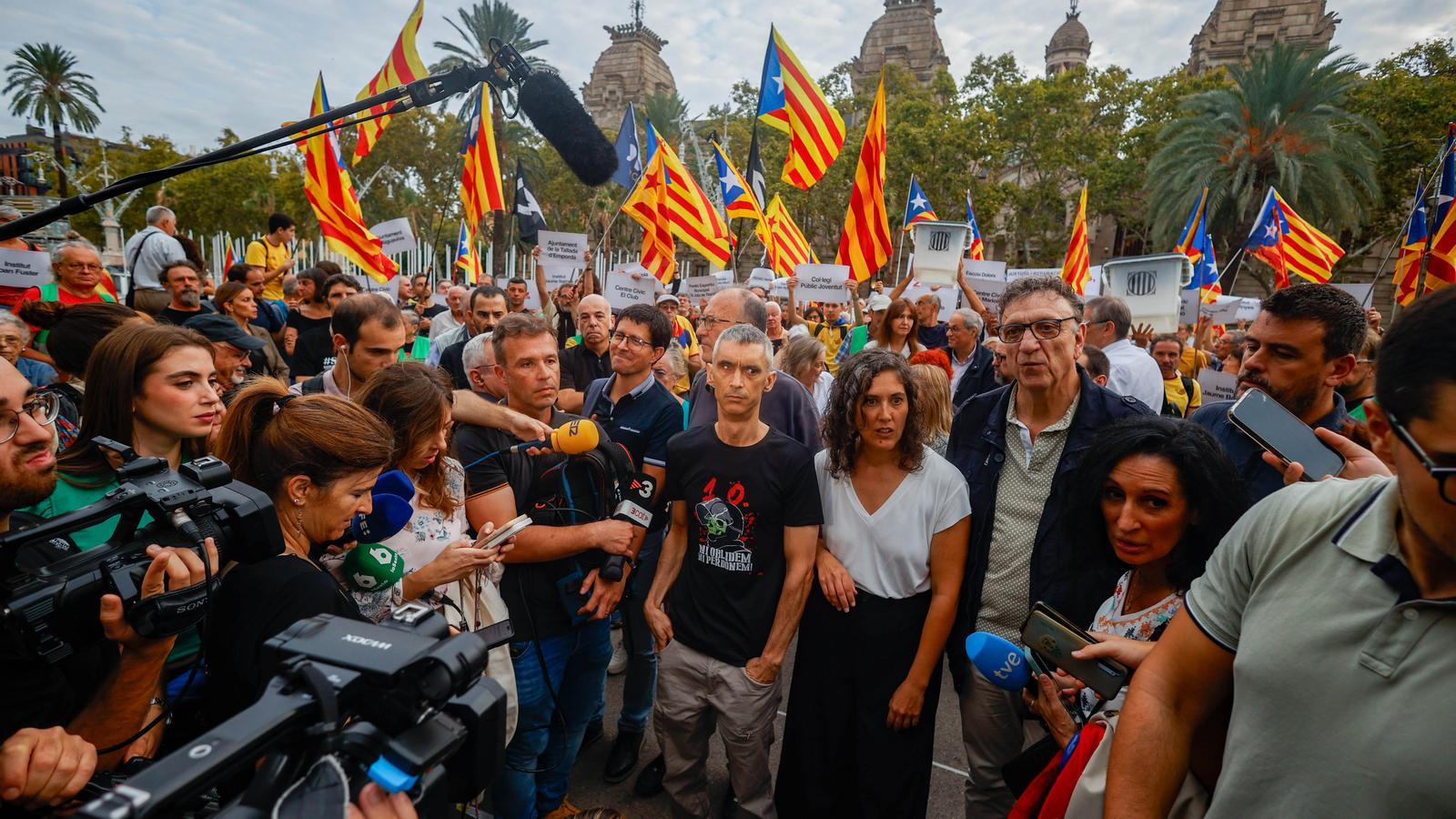
Before the session began, there was a pro-independence rally in support of Roger Español with Òmnium, the ANC, Irídia, Junts, ERC, and the CUP. In a statement to the media, Español emphasized that he intends for the four accused police officers to be convicted, and therefore, for the "police brutality" of the State to be condemned as well. At the same time, he reaffirmed the October 1st referendum and called for rubber bullets to be banned, a sentiment echoed by Carles Guillot, another person who was mutilated and a founder of Stop Bales de Goma (Stop Rubber Bullets). Meanwhile, the lawyer and director of Irídia, Anaïs Franquesa, asserted that all "expert evidence" had been collected to secure a guilty verdict.
In parallel, the presidents of Òmnium and the ANC, Xavier Antich and Josep Vila, maintained that the pro-independence struggle "continues" and expressed their support for the activist, as did the general secretary of Junts, Jordi Turull, who stated that "it is regrettable" that justice has still not been served "nine years later".