The keys to Ayuso's most controversial trip: "We had to disappear. We were in danger"
Sánchez accuses the president of the Community of Madrid of being a "creator" of problems

-
CAT -
CAST
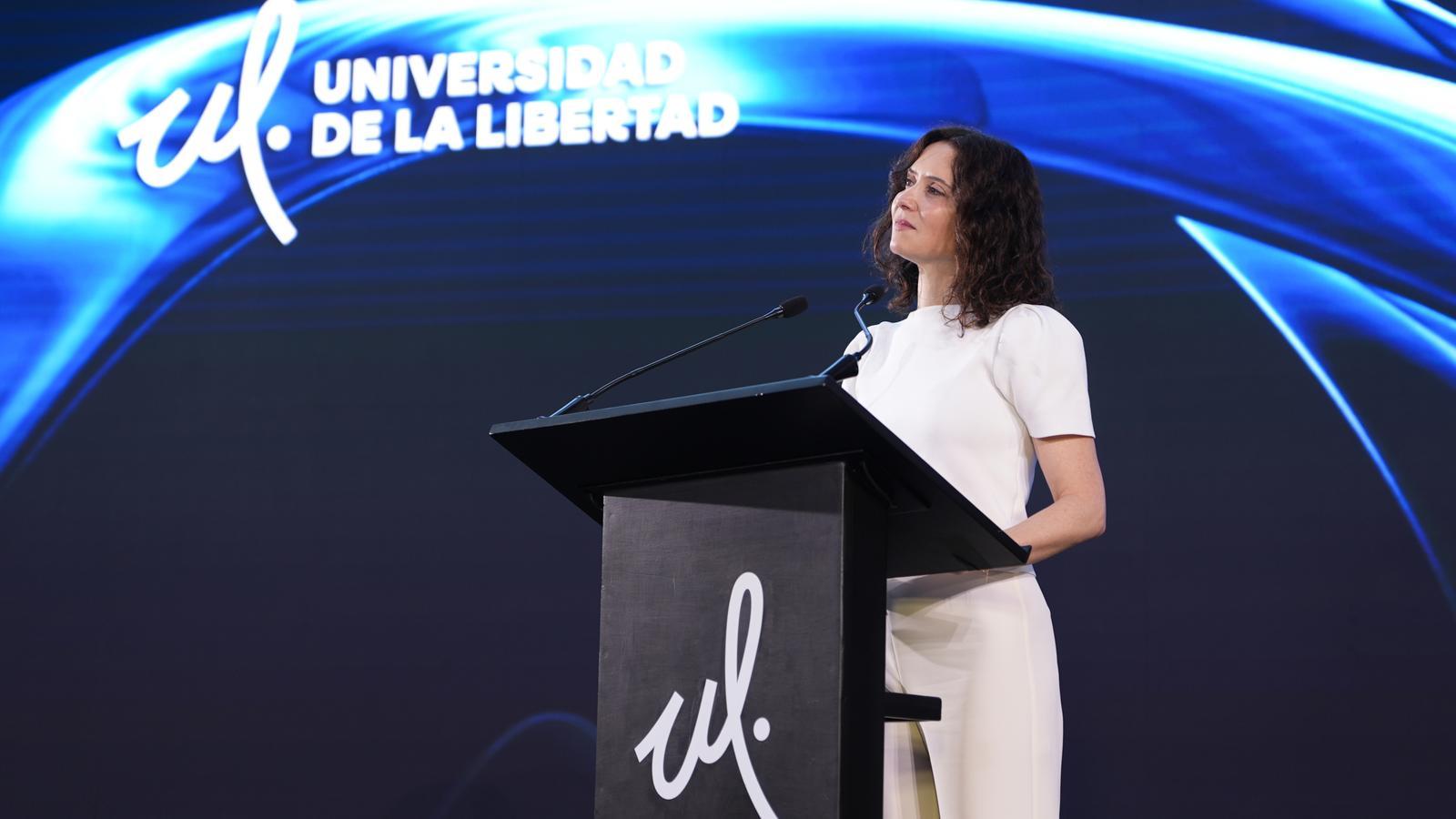
MadridThe controversy is associated with the name of Isabel Díaz Ayuso. In fact, for years she has made this her particular political strategy, but surely her latest trip to Mexico has exceeded all expectations. An official trip that, on the one hand, has called into question the reconciliation process between Spain and the country presided over by Claudia Sheinbaum after years of frozen relations; and on the other hand, has ignited Mexican politics and society to the point where Díaz Ayuso's team decided to leave the official trip ahead of time. This Monday, the president of the Community of Madrid has opted to blame the Spanish and Mexican governments: "We had to disappear. We were in danger".
According to her account to COPE, these two institutions did not guarantee her the security she deserved as an autonomous president, in a country —she said textually— that is immersed in "drug trafficking. "It is profoundly violent and dangerous and the government has abandoned us," the popular leader censured, wondering if this would have happened to the president of the Generalitat, Salvador Illa. She also added that since Morena, Sheinbaum's party, came to power, there have been "hundreds of politicians murdered" and "more than 100,000 disappeared."
Ayuso has not been left without a response: the Spanish president, Pedro Sánchez, replied from Moncloa that she is a "creator" of problems, but that he did not intend to "polemicize" with her. Sources from the Ministry of Foreign Affairs assure that "at no time" did Ayuso communicate to the Spanish embassy or the ministry "any problem or concern for her security" nor did she "facilitate her agenda." They also added that she rejected the security that the government of Mexico provides in these cases.

What has Ayuso done in Mexico?
Ayuso has not specified what happened to make her feel insecure, but she stated that anything could have happened to her and her team at any moment. The fact is that the official trip lasted up to ten days —from May 3 to 12— and started off tense because the president of the Community of Madrid participated in a tribute to the figure of the conqueror Hernán Cortés. She did so alongside musician Nacho Cano, who is a personal friend of Ayuso and who has produced the musical 'Malinche' to advocate for mestizaje in the same vein as Ayuso. This provoked protests around the event and even the Metropolitan Cathedral of Mexico City decided not to host the event titled 'Celebration for the Evangelization and Mestizaje of Mexico' due to the uproar that was generated, with protests from citizens included.
From the regional government, they recall that Mexico is the second-largest investor in the Community of Madrid after the United States. Therefore, as soon as Ayuso arrived, she met with the Spanish chamber of commerce. Regarding the authorities, the meeting with the mayor of Cuauhtémoc, Alessandra Rojo de la Vega, from a right-wing coalition formed by the PAN and the PRI, is noteworthy. They call her the "Mexican Ayuso" on social media, and the Madrid government itself distinguished her with an award this past March. In other words, they have ideological alignment.
Ayuso's tour continued from May 6 in Aguascalientes, already on the third day of her trip. The right-wing governs there, and she was recognized with a medal of civil merit for "defending Hispanidad," but she was booed in the street and boycotted by Martha Márquez, a politician from Moreno (Sheinbaum's party), when she was about to give her speech. After this episode, there was no official agenda for two days until Ayuso's team announced on Friday, May 8, that they were withdrawing from the trip. She thus ceased to go to Riviera Maya, where she was scheduled to attend the Platino Awards for Ibero-American Cinema.
What was Sheinbaum's government's response?
Mexican President Claudia Sheinbaum responded forcefully to the controversy generated by the leader of the PP in Madrid. In her opinion, the tribute to Hernán Cortés could only be the product of "ignorance." "Cortés ended up buried in Mexico because they didn't want him in Spain. Not here either, but in the end, he ended up abandoned. That is the ignorance of coming to pay tribute to him," she summarized.
Luisa Treviño, a graduate in international relations from El Colegio de México and a former diplomat, speaks with ARA and assures that Ayuso's trip was "very poorly planned." "Poorly advised," she summarizes. To begin with, she points out that a tribute to Cortés will never succeed among the popular classes of Mexico — although she qualifies that the history of the conqueror is "more complex" than presented and there is a part of the right that defends him — so it could hardly have a good social reception after the event with Nacho Cano. Furthermore, she highlights that during the trip she only met with leaders of the opposition, the PAN, and has been accompanied by media sympathetic to the right. She specifically mentions TV Azteca, owned by businessman Ricardo Salinas, who, although he was a personal friend of Sheinbaum's predecessor, Andrés Manuel López Obrador, ended up being his "arch-enemy." That is, she has not maintained any institutional meeting with Morena, which is the left-wing party that now governs Mexico.
The internal key
Salvador Martí, professor of Political Science at the University of Girona, believes, however, that Ayuso was precisely seeking this controversy. "It was the only way to have media presence," assures this specialist in Latin American countries, as he points out that until now she was completely unknown to the population there. Furthermore, he adds, in this way she has found confrontation with Sheinbaum, who otherwise would not have addressed her because Ayuso is not a head of state. "Now they know who Ayuso is, but not Alberto Núñez Feijóo," says Martí, who believes it is also part of the Madrid native's strategy to establish herself as a Hispanic American reference. Of course, in his opinion, the fact that she chose the figure of Hernán Cortés to do so, is so unpopular that it does not benefit either the Mexican right or her plan to seduce the Latin American migration living in Madrid.
At this point, Treviño adds another perspective: the controversy has also served Sheinbaum well as a "smokescreen" in domestic politics. It has coincided with the extradition request by the United States of the governor of Sinaloa, Rubén Rocha Moya, and several officials, accused of having ties to drug trafficking. This was the main problem Sheinbaum faced before Ayuso's arrival, as it places her government in a dilemma —the Prosecutor's Office has so far seen few indications of guilt— and, moreover, Rocha is from her party. The president of the Community of Madrid opened another front.
