The National Court paralyzes the installation of the migrant camp at the port of Ceuta
The judge investigating the Ceuta crisis summons as witnesses Vivas and the former chief of staff of the government delegation
-
CAT -
CAST
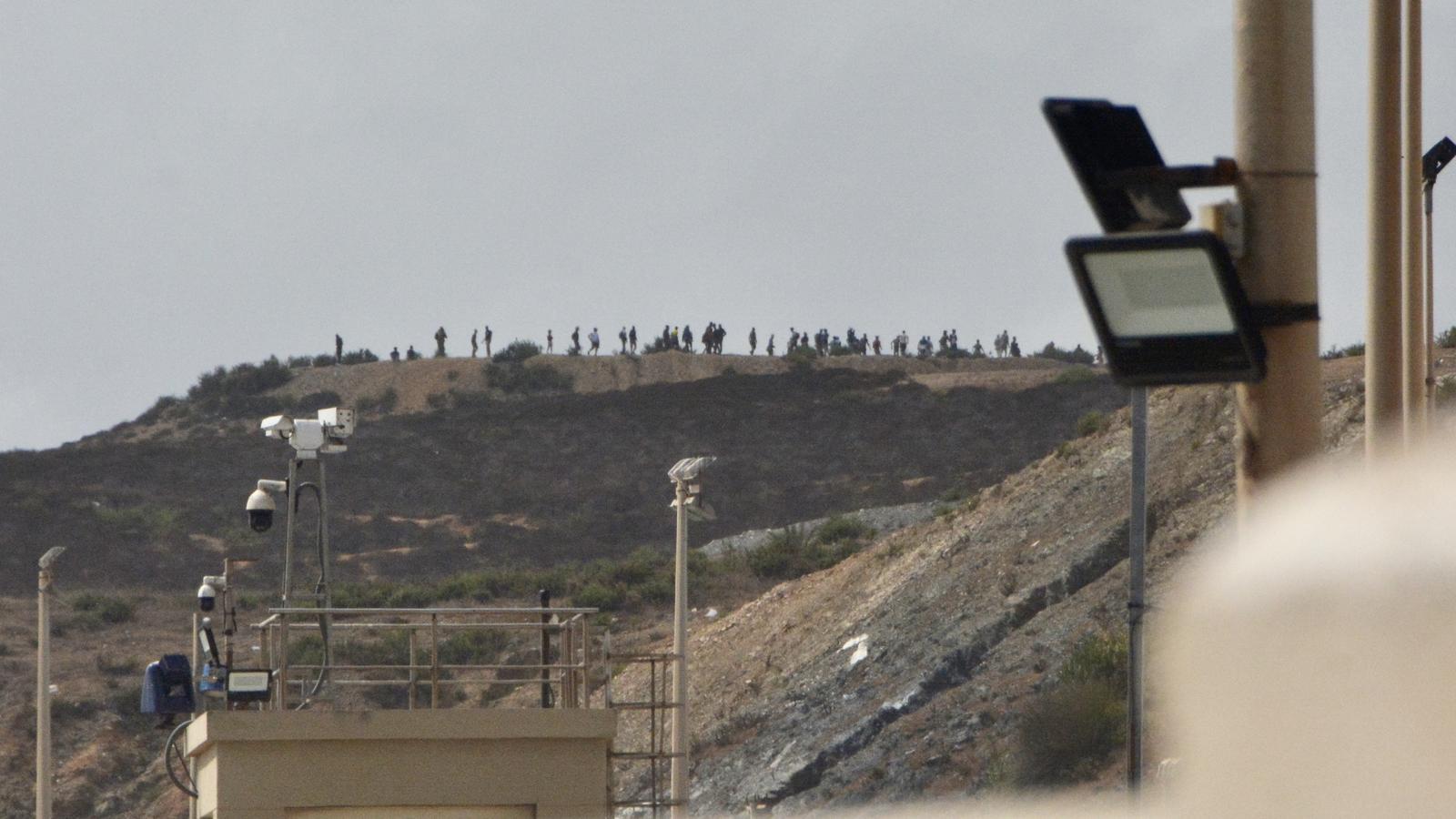
MadridThe management of the Ceuta crisis is crossed by judicial decisions. The National Court has halted the installation of the immigrant camp at the port of Ceuta. An initiative by the Spanish government to house a thousand people temporarily, which had clashed with the Ceutan executive. However, it was a police union, the Unified Police Union (SUP), that caused it to be stopped with a very urgent precautionary request. The contentious-administrative chamber of the National Court has agreed to this, at the request of the SUP, until it can study the documentation from the Ministry of Transport and resolve the precautionary measure.
Sources from the Spanish government have not hidden their "perplexity" regarding the decision, as the relocation to the port, they claim, was "the most suitable and had all security guarantees." "Getting immigrants off the streets of Ceuta is a priority, ensuring them decent reception conditions in adequate infrastructure," they insist. Ten days ago, Óscar Puente's department decided to take control of the port and authorize the Secretary of State for Migration to make temporary use of a 16,000-square-meter area of public port domain located in the Poniente Expansion, Phase I, of the Ceuta port service area. The union alleges that it is a danger to place a camp in this critical infrastructure. The PP has celebrated that the National Court has listened to the complaints that had been expressed from Ceuta, while the PSOE has regretted the decision. In the opinion of Sumar, it should lead to accelerating transfers to the peninsula.
Additionally, the National Court judge investigating the mass entry of immigrants on July 30, María Tardón, has summoned the president of Ceuta, Juan Jesús Vivas, and the former chief of staff of the Spanish government delegation in that city, Gonzalo Sanz, to testify as witnesses on September 30 and October 1, respectively. Furthermore, she is also requesting the "alerts and risk analyses" that police and military organizations may have issued and that warned of the mass entry. If they existed, the magistrate wants to know who the recipients were and the means used to send them, as well as the date and time.
This has not been the only judicial move this Wednesday. The Ceuta Public Prosecutor's Office has also made a move and has advocated for investigating whether there is alleged responsibility on the part of the Spanish government delegate, Miguel Ángel Pérez Triano, in the massive entry of migrants, given that it was the delegation of the autonomous city that received the warning of the calls to cross the border through the CNI.

Specifically, it seeks to clarify whether there were "decisions or omissions that could have influenced the development of events." This was stated by the public prosecutor's office in a document sent to the National Court a few weeks ago, to which Europa Press has had access, in which it also advocated for Judge María Tardón to lead the entire investigation—and not the courts of Ceuta. Sources from the State Attorney General's Office have clarified that this is a report by the chief prosecutor of Ceuta regarding who is competent to investigate the facts and that the public prosecutor's office "has not made any statement on the merits of the matter."
"The investigation into the conduct of the government delegate requires examining together the circumstances in which the massive entry of people swimming took place, the information available to the Spanish authorities, the forecasts and measures adopted before the arrival of the people to the coast of Ceuta, the organization of surveillance, containment, assistance, and reception devices, the orders, instructions, or decisions issued by the competent authorities, and the possible existence of relevant omissions in terms of prevention, assistance, or protection," the Ceuta prosecutor noted in the document.
In fact, a resignation has already taken place in the Ceuta delegation due to these events. The chief of staff to Pérez Triano, Gonzalo Sanz, resigned after the declassification of the Ceuta documents by the Spanish government, in which there was a WhatsApp conversation with the CNI warning about calls reaching 180,000 people on the day of the Moroccan throne. Pérez Triano's version is that the information did not reach him, but his chief of staff says it did. Be that as it may, the Spanish government maintains that these alerts, as well as others from the police, cannot be considered solid warnings of what happened, since they insist that neither the CNI, the Civil Guard, nor the National Police foresaw the "magnitude" of the crisis.
