The government moves the migrants to the port of Ceuta, but calculates that 3,000 remain on the streets
Health confirms a case of mpox among one of the unaccompanied minors
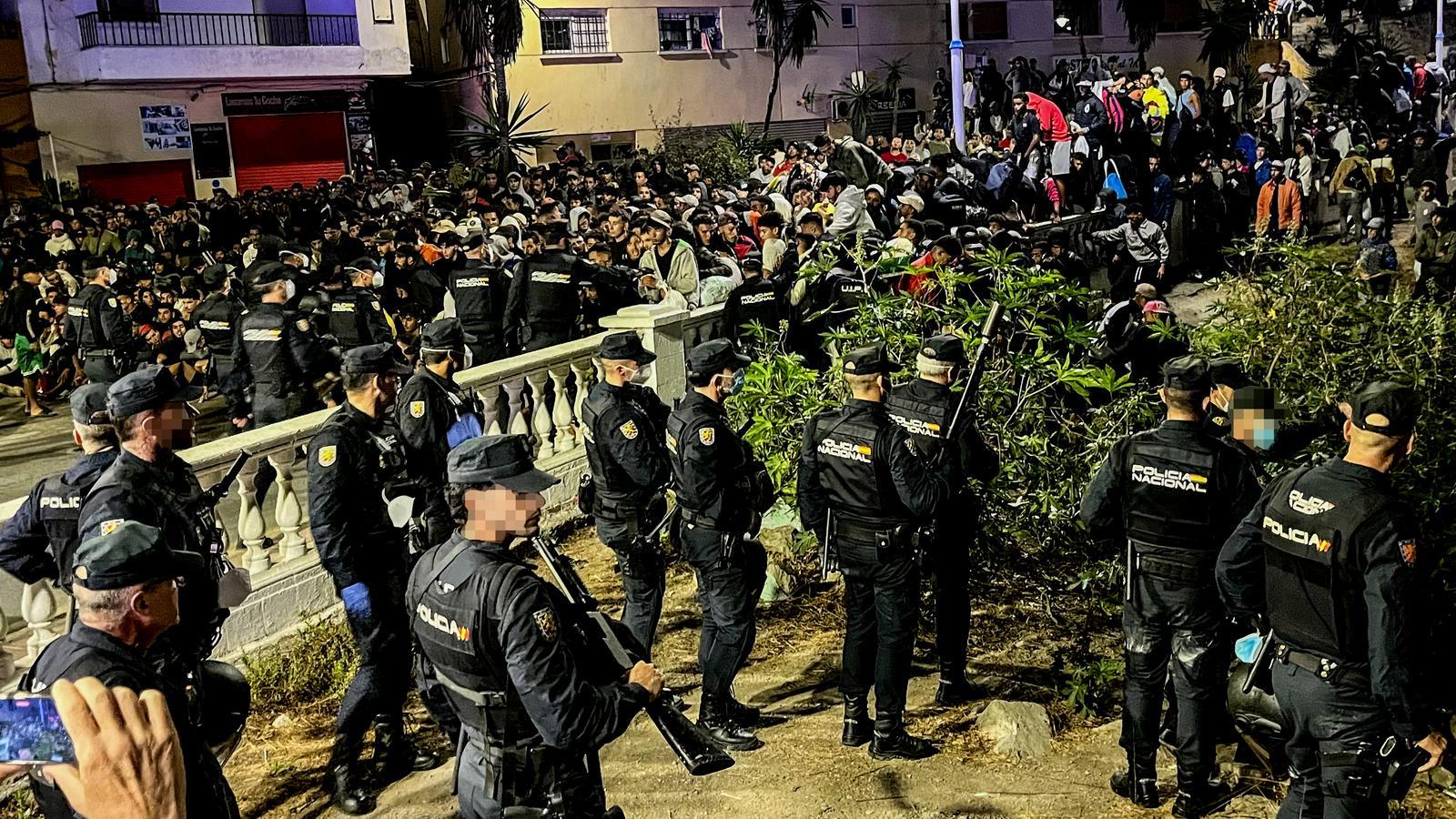

MadridAfter a month and almost twenty days sleeping in the open, the idea of being able to have a roof, even if it is in a provisional camp, is what has led numerous migrants in Ceuta to rush out first thing in the morning to get a place in the facilities that the Spanish government has set up at the Port of the autonomous city. There were places for 1,700 people and they were all filled a few hours later. "We have successfully relocated the people without any significant incidents," indicated the Minister of Territorial Policy, Ángel Víctor Torres, through the social network X.
Living on the streets, however, migrants will continue to remain, some of whom are minors, assume sources from the Spanish government, who take for granted that new spaces will have to be opened in the coming days if an end is to be put to the homelessness situation of these people. The same sources estimate that there are about 3,000 people who still do not have a place to go and who are between the streets, the mountains, and the beaches of Ceuta. In fact, El Trampolín beach, where this Friday morning many migrants were waiting impatiently to be able to get a place, has not been completely emptied. "The sooner the spaces are [open], the sooner returns can be made and normality will be recovered," point out sources from La Moncloa.
After weeks of a dance of figures by the administrations regarding how many migrant people remained in Ceuta, now the Spanish government speaks of between 9,000 and 10,000 people, although it acknowledges that "it is difficult" to specify, taking into account that some migrants have chosen to hide in the mountains or even in houses, which evidences the human drama. In addition, there are migrants who had entered Ceuta days before.
This is how the operation has proceeded
Once the initial moment of nerves and rushing had passed, the transfer of migrants to the camp was carried out in a staggered manner. After this Thursday the National Court finally authorized the relocation of people in this space, Spanish police and Civil Guard agents began early in the morning the transfers from the beaches of El Trampolín and Benítez, where many of the adults and minors who entered the autonomous city are living in poor conditions. It must be taken into account that on these beaches it is estimated that until now there were more than 4,000 people, more than double the capacity of the port facilities.
According to Efe, the operation carried out by the police was as follows: initially, the agents gathered all the immigrants at Benítez beach, including those who were at El Trampolín beach. From there, more than 3,000 people began to move along the Benítez promenade in the direction of the service road that is near the temporary reception facility established by the Spanish government.
It was at this moment that the agents began to separate the people into smaller groups to facilitate entry into the camp and proceed with their identification. This caused moments of tension because the migrants were trying to move forward to secure a spot and some broke through the security cordon, according to the same agency. At this point, the police intervened to regain control and prevent a stampede by firing shots into the air. Afterwards, it was possible to continue with the operation without further incidents.

Interior Ministry sources report that there has been a reinforced deployment of the National Police and the Civil Guard since July 30th of 1,600 officers in Ceuta and that, specifically, in this Friday's operation there are about 240 National Police agents on the ground. On the other hand, the Health Department confirms to this newspaper that there is a case of mpox detected in one of the unaccompanied minors who were being sheltered in a center. Right now, he is isolated to prevent further infections.
Political clash
The PP, which in its particular race with Vox has made the migration crisis a goldmine to harden the anti-immigration discourse, has not taken long to try to take advantage of the images of the scrambles seen in Ceuta during the transfer. From Melilla, the leader of the PP, Alberto Núñez Feijóo, has attacked the Spanish government, accusing it of being unable to maintain "public order" in a Spanish city. "The only solution is the return of everyone who has invaded Ceuta," he declared in statements to the media. The conservatives denounce that the State's security forces and bodies are "overwhelmed" and once again blame Pedro Sánchez for the "lack of control" in Ceuta.
In the Moncloa, they insist on the "irresponsible" attitude of the PP regarding the migration crisis, as well as for questioning an operation in an unrealistic way before it has finished. "We have been in communication from the first hour with the government of Ceuta," government sources indicate.
