The end of the world: a stroll with Jordi Hereu
Jordi Hereu cites us to a neighborhood special for him, the Bon Pastor, despite being born and raised in the district of Sant Gervasi
-
CAT -
CAST
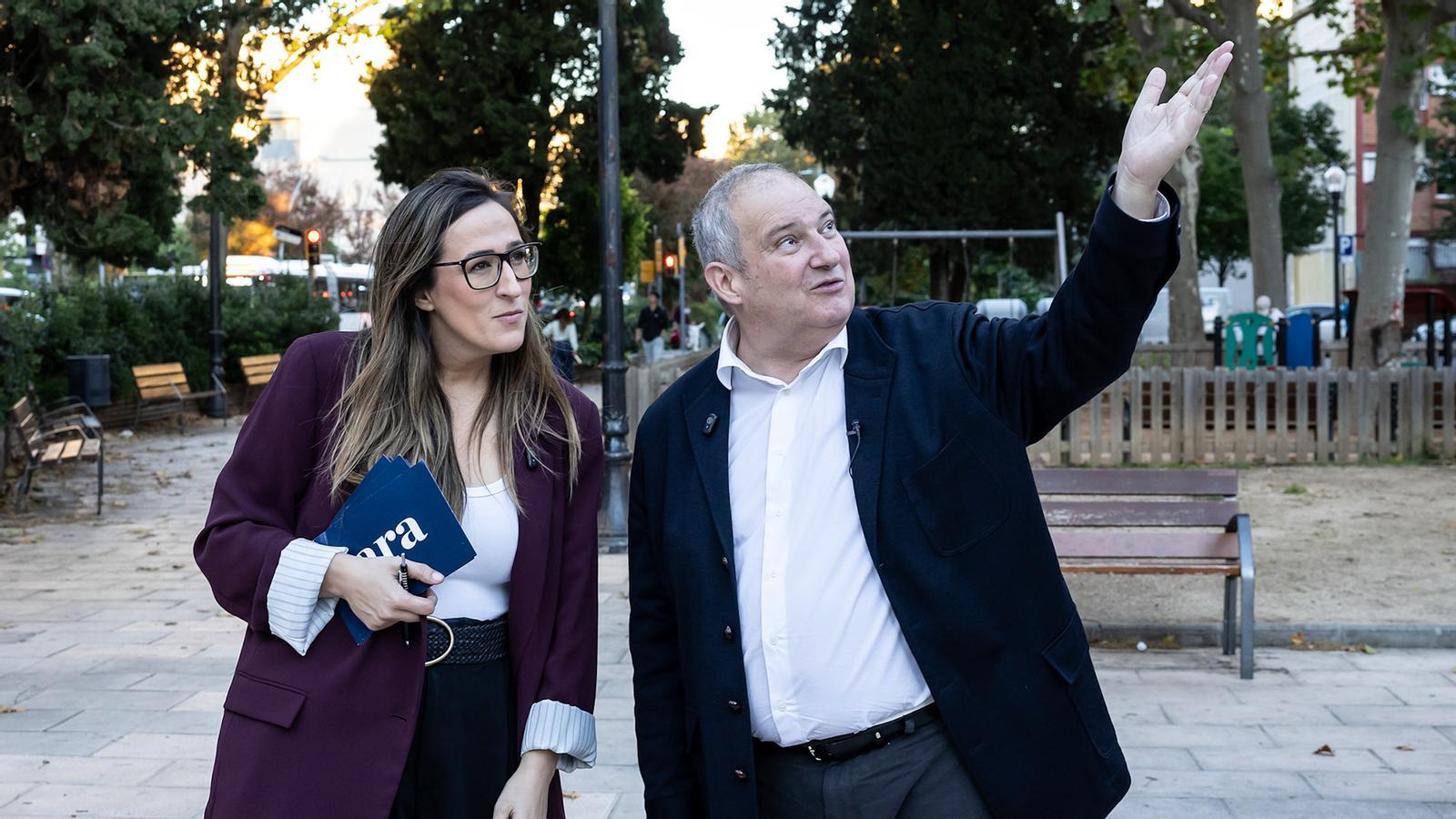
Jordi Hereu meets us in the Bon Pastor neighborhood of Barcelona. You weren't born here, right?, I ask him as soon as we meet. He tells me no. In fact, he was born at the opposite end of the city, in Sant Gervasi, but he assures me that it is a neighborhood he loves and that brings back good memories, because he was a councilor there for several years.
We meet near the church, and the PSC candidate explains that he remembers the graffiti that was there for a long time and said: “We are the armpit of the world”. With Hereu today is Paquita, who will later accompany him to a party event. She had been president of the neighborhood association and says that the graffiti reflected reality: an abandoned neighborhood. She explains that what changed their lives was the subway. “Now I feel like I belong to the city”. Hereu remembers that it was one of the happiest days of his life. We head walking towards the cheap houses and a group of children approach the cameras and ask if we are “the TV”. Do you know who he is?, I ask. Silence. I explain to them that he is a candidate in the elections, and he adds that he had been mayor of the city when they had not yet been born.
I ask him about Sant Gervasi and his childhood. He went to the Sant Gregori School and studied business administration and management at Esade. “It doesn't seem like you were raised in a nest of communists…”, I tell him. He smiles. He explains that the school had a Catalanist character and that there were rather people affiliated with Convergència. His colleagues at Esade, in fact, saw him as a rara avis, but he has always been interested in public affairs and territorial development. “I became politicized at eleven years old, after seeing a rally of the Socialist Regrouping with Pallach”.
Pere Virgili takes some photos, but he is demanding; he is not sure how they are turning out and makes us stop. I take the opportunity to change the subject. "They probably don't ask you much about love, right?". "Love?", he repeats. And, after the initial surprise, he explains that he was twenty years old when he met Belén, who was sixteen. Today they have two children. The younger one works in management at a company and the older one, who studied acting, is about to start a project to go around schools all over Spain performing The House of Bernarda Alba. "Speaking of schools –I say–, you sent them to a charter school. Isn't that a contradiction for a left-wing politician?". He argues that it is not. "I defend policies to strengthen the public network, but also that everyone can send their children wherever they want", he replies. He explains that his wife has been working as a primary school teacher in a public center for twenty years, "which means she has seen all the country's challenges over the last twenty years".
We arrive at the cheap houses. Hereu says that, back in the day, there were anthropologists who defended keeping them. Paquita stays close to us and explains that one of them said to her: "What I would give to live in one of these houses in Bon Pastor". And she replied: "I'll trade it with you tomorrow". Today, a part of those houses is preserved, which has been turned into a museum. We have to go in to do the campaign interview. On a balcony nearby it reads: "Stop evictions". Before closing the door, Virgili stops us and says: "First, we'll take a few more photos". And a group of children pass by quickly on their bicycles. "Six seven, six seven", they say. An image and a phrase that are, both at the same time, a reflection of the passage of time.
