The day the Catalans entrusted their future to the Statute
Catalonia voted in a referendum on a text that Congress had already watered down

-
CAT -
CAST
BarcelonaOn June 18, twenty years ago today, Catalonia voted on the Statute in a referendum. Without many queues —only 49% of Catalans eligible to vote participated—, but with a broad majority of 73.9% —20.76% voted against and 5.34% abstained—, the country's basic law was ratified, already cut back from its birth in Parliament and which would still suffer a hard blow four years later in the Constitutional Court.
The feeling that day was bittersweet, because a text was being voted on that was not exactly what the Catalan chamber had validated in September 2005 with 120 votes in favor, from CiU, PSC, ERC and ICV-EUiA. What had changed?
"Catalonia is a nation," said the first article of the 2005 Statute. The tripartite government and CiU had reached an agreement to place a historic claim of Catalanism in the text and give it legal validity. The agreement, however, had all the signs of hitting the State's wall. And so it was. "The Parliament of Catalonia, collecting the sentiment and will of the citizens of Catalonia, has broadly and overwhelmingly defined Catalonia as a nation. The Spanish Constitution, in its second article, recognizes the national reality of Catalonia as a nationality," the preamble of the 2006 Statute ended up saying — which the Constitutional Court also struck down later.
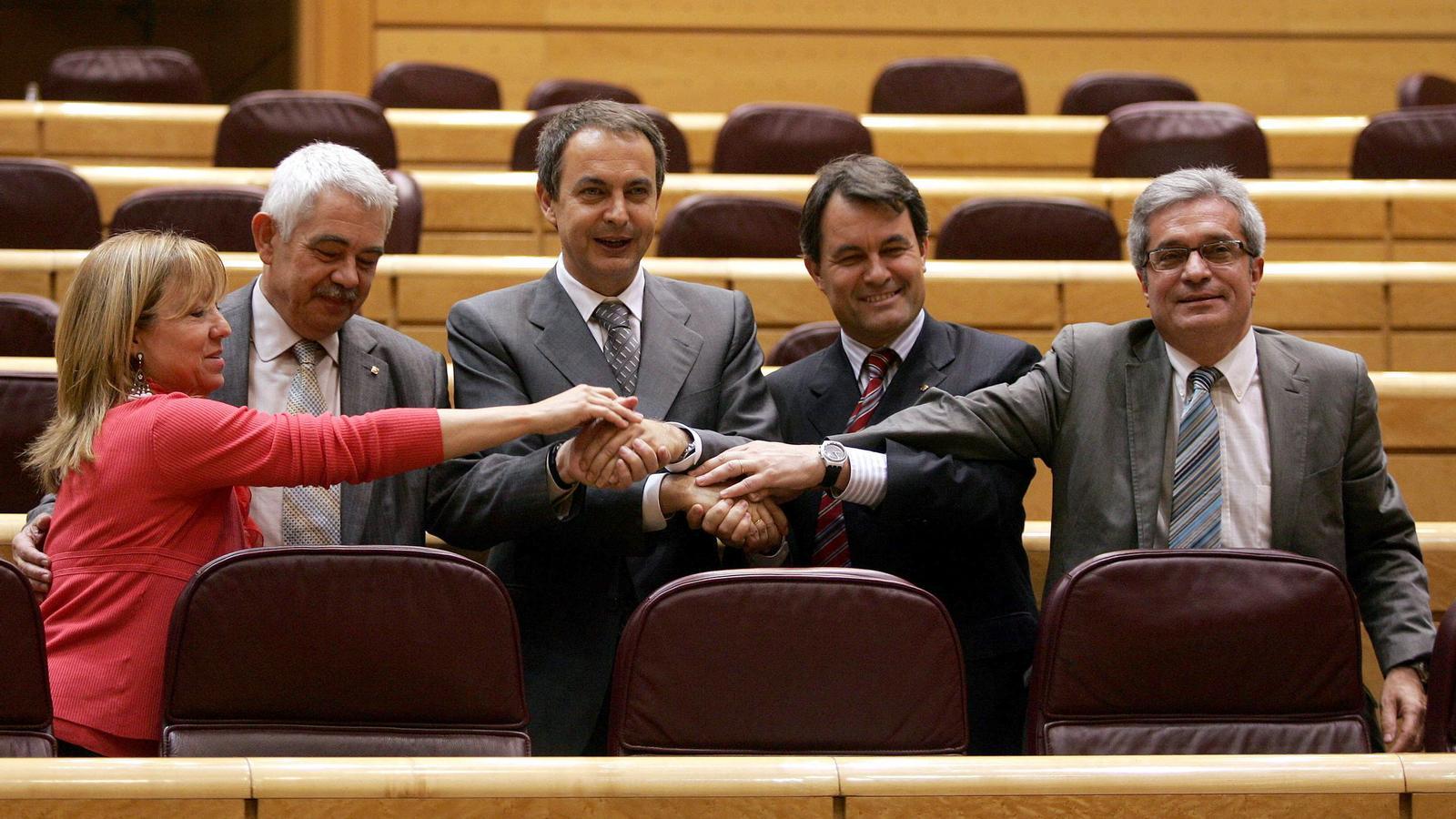
The recognition of Catalonia as a nation had moved to the preamble and, therefore, no longer had legal value. Furthermore, in the first article, "nation" had been changed to "nationality," as Catalonia is recognized in the Constitution. This was the point of agreement reached by the former Catalan president and former CiU leader Artur Mas, and the former Spanish president José Luis Rodríguez Zapatero, at the meeting on January 21, 2006, in Moncloa. "He [Zapatero] did not want "nation to appear and I told him that I could not renounce Catalonia being defined as a nation in this Statute," recalls Mas in conversation with ARA: "The way was to put it in the preamble with the formula that the Spanish courts accepted the definition made by Parliament."
In the State, any step that tried to go beyond what the Constitution stipulated was difficult to digest and met with the frontal opposition of bipartisanship and the powers that be. In fact, Zapatero immediately backtracked on the promise he made during the campaign for the 2003 Catalan elections. "I will support the Statute approved by the Parliament of Catalonia," he proclaimed at a PSC rally at the Palau Sant Jordi. Mas corroborates this: "Zapatero told me that he could not assume something so ambitious," he recalls, referring to the Statute approved by the Parliament. The former president of the Generalitat, José Montilla, one of the people involved in the negotiation process of that Statute, was convinced that after the approval of the 2005 text, negotiations with Madrid would be necessary: "We already knew that we would have to agree on certain aspects of the project".
From here, a negotiation was opened with the aim that none of the parties that had voted for the Statute in Parliament would abandon ship. And even less so the main opposition party, CiU. "Zapatero told me that either he negotiated with us, or there was no Statute," Mas recalls. Montilla understood that without CiU the Statute lost legitimacy, but he is also critical of the role played by the nationalist federation. "There were parties that constantly raised the bar to see if they could break the government," he says, referring to the executive that Pasqual Maragall presided over at that time.
The tax consortium
However, everything was unlocked in the marathon meeting on January 21 between Zapatero and Mas. "It was long and complex — Mas recalls—. Many of the things were drafted by him and me". There, besides the concept nation, one of the issues that was also resolved was how the Catalan Treasury would be. The PSOE rejected the proposal of the text that emerged from Parliament, in which the Tax Agency of Catalonia was to have the power in "the management, collection, settlement, and inspection of all taxes borne in Catalonia". "We did not have the protection of the special tax regime that exists in the Constitution", recalls Montilla. The agreement ended up being what is currently established by the Statute: a consortium with the parity participation of the Catalan and state Treasury. "The consortium may be transformed into the tax administration in Catalonia", stated the 2006 text. This consortium has never been developed.
Nor was the "normative capacity" maintained that the Generalitat could have over "all and each of the state taxes borne in Catalonia, within the framework of the powers of the State and the European Union" that the 2005 Statute provided for. However, Mas and Zapatero did agree to the transfer to the Generalitat — and to the rest of the autonomous communities with the new financing model — of 50% of the IRPF and VAT, and 58% of special taxes. In addition, they also agreed that for seven consecutive years the State would invest in infrastructure the equivalent of the weight of the Catalan GDP. This is what was established in the now-known third additional provision of the Statute, which was only complied with in the first year.
ERC leaves the statutory consensus
"That process was frustrating," says, in turn, former ERC minister Joan Puigcercós. In fact, there was an issue that he criticizes for not being reversed: the possibility of excluding Catalan airports from the declaration of general interest so that the Generalitat could manage them. After CiU's yes, the PSOE also wanted to convince one of the partners in the tripartite government in Catalonia, ERC. The former Spanish president called Puigcercós to invite him to a meeting in Moncloa the very next day after the meeting with Mas. "He made it clear to me that nothing from that agreement [the one signed with Mas] could be touched. 'What are we here for, then?'", asked the republican ex-minister. Despite the disappointment, Puigcercós and Josep Lluís Carod-Rovira went to lunch at Moncloa with Zapatero, but the meeting did not go well. The proof is that ERC ended up leaving the statutory consensus. And it did so after an intense internal debate: Carod-Rovira advocated for a yes vote in the referendum, Puigcercós opted for abstention, but the bases forced the party to lean towards a no.
In this way, ERC also called for a vote against the Statute, just like the PP, but for very different reasons. Participation in that referendum did not reach 50%, but for Montilla, this "does not devalue the result." Mas attributes the low participation to the "frustration over expectations" generated by the socialists, especially for the promise made by Zapatero himself. Be that as it may, the text ended up being validated at the polls after months of negotiations and amid a crusade by the PP to derail the process, including signature collection. After that referendum, the Popular Party would go a step further and take the text to the Constitutional Court. The Statute's journey had only just begun.
