The suspended CUP not to run in the elections in one of the four capitals
In Lleida, the CUP supporters also value making a unified list with Comuns
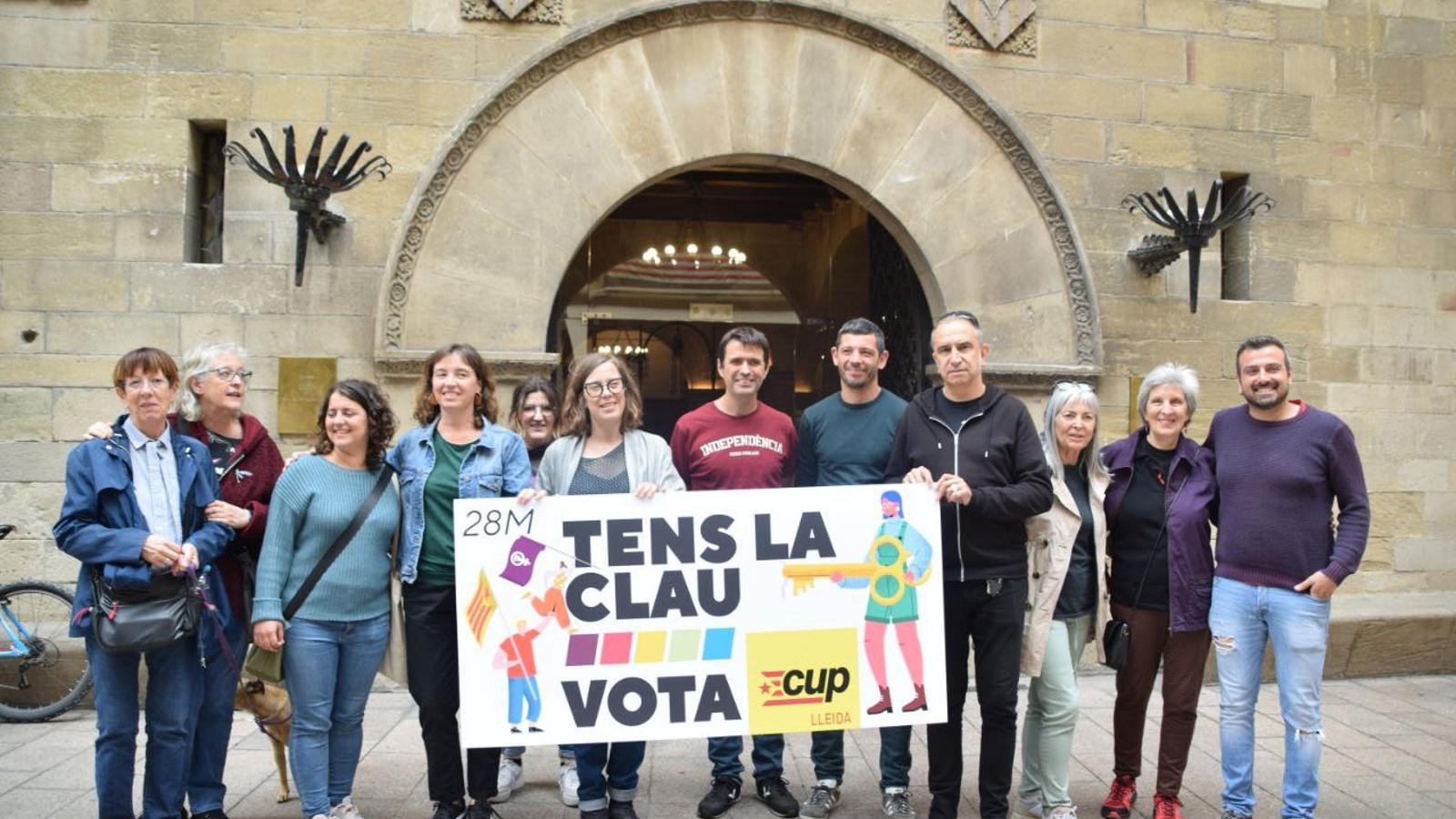

BarcelonaThe CUP usually reconsiders its decisions after a failure. It did so after losing the two seats it had in Congress in the last general elections. Then, it agreed to park its participation in the general elections and, if there isn't a 180-degree turn, it will not field a list in 2027. Also in next year's municipal elections, it could make a painful decision that the rest of the parties with a presence in Parliament will undoubtedly not make: not to run in one of the four provincial capitals.
The CUP of Lleida is in full process of internal reflection on whether to present a candidacy for the Paeria. This is one of the options that is currently on the table. The other is to form a joint list with Comuns, which did obtain a councilor in the last elections, unlike the CUP members, who narrowly missed out. Mercè Cortina, a member of the Lleida assembly, confirms to el ARA that these are the two scenarios they are debating.
"If we are inside but there is nothing outside, there is no point in having representation and we will have a very limited capacity for influence," says Cortina to emphasize one of the CUP's pillars, that institutions are "just another tool, unlike other formations." In this regard, she recalls that a good part of the CUP members have "multi-militancy" and are in numerous entities and organizations where they already work politically. "The CUP has never wanted power for power's sake, and perhaps it is time to strengthen ourselves from the outside," she adds. The CUP representative makes it clear, however, that if they do not run, it is not due to a lack of involvement from the membership itself: "It is the result of a constructive internal analysis of how we can be more useful."
The other option is to go with Comuns, but the CUP members warn that it would not be "an electoral coalition" and that the goal would be to build "a broader candidacy." Cortina admits to conversations with the eco-socialist party, while emphasizing that they have not yet addressed what form it would take, referring to the requirement that all parties make votes count for their brand when thinking about supramunicipal entities. In no case, however, would ERC join this unitary list, as defended by the Republican spokesperson in Congress, Gabriel Rufián. "This formula is discarded, we will not make a Frankenstein list," he states.
Without representation due to few votes
Obviously, the electoral setbacks that the anti-capitalists have suffered are behind this internal debate. In the last elections, the anti-capitalists narrowly missed out. The CUP supporters garnered 2,170 votes (4.58%) and were just 300 votes short of getting a councilor. In the previous ones, it was also close, with 2,434 votes and 4.3% of the total, but they lost the two councilors they had achieved in 2015. That term was the only one they had representation, capitalizing on the critical left-wing and independentist vote after debuting in 2011, without success. The commons, on the other hand, garnered 2,373 votes, which allowed them to get one councilor with 5% of the votes, despite losing half of their support.
