The epicenter of sundials
Porrera, in Priorat, has in numerous facades old clocks that have never ticked

-
CAT -
CAST
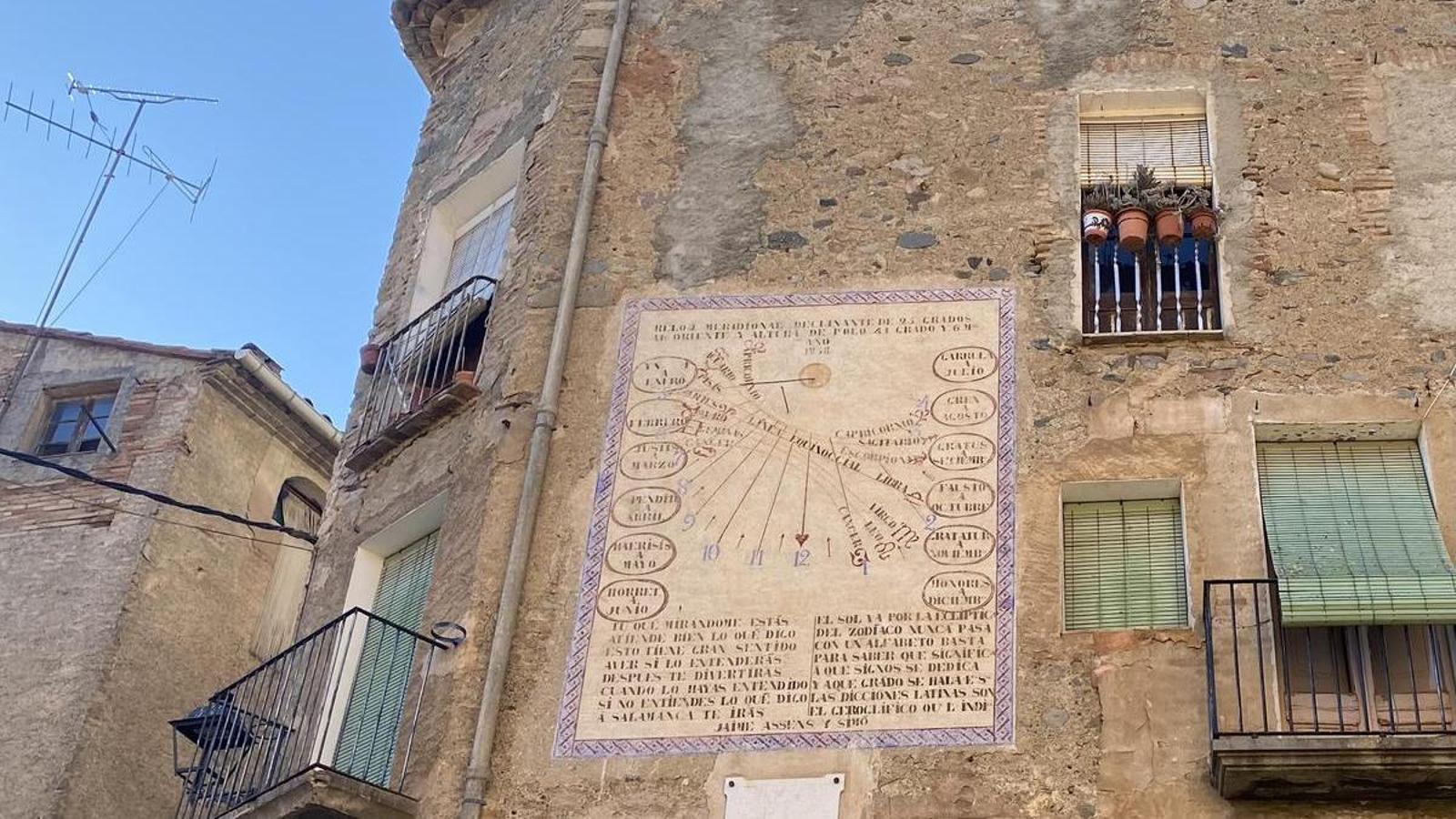
Next to the Portal de Porrera, formerly the only carriage access to the now-disappeared medieval walled enclosure, there is a beautiful sundial. It is the largest in the town and one of the largest in Catalonia. One of its curiosities is this text: "You who are looking at me pay good attention to what I tell you, this has great meaning (...), if you don't understand what I say you will go to Salamanca". It refers to the University of Salamanca. Back then (19th century) it was quite far from here!
A little further down, on Martí i Pol street, there is a spherical clock. It is hidden, very high up, at the height of a fifth floor. The numbers are elongated so they can be seen well.
I walk with Pol Agut, a member of a local family, looking for the numerous sundials on the facades. Pol works in finance, but occasionally (and passionately) acts as a guide, as he knows all the nooks and crannies of Porrera.
It is a town of steep streets. Some spaces that remained under the streets ("Accessories", you will see written: Spanish entered strongly in other times) have been used as storage rooms. Porrera has many large and stately houses. And historic wineries, some of which are still active, like Cal Pla, from the 17th century. Wine has conditioned the architecture: in Plaça Catalunya, the Eixample of Porrera, built at the end of the 19th century – before it was the space for the Carthusians' orchards – all the ground floors were made double height to accommodate wineries.
"Porrera had reached 1,800 inhabitants; now there are about 400, and we are losing them very slowly – says Pol –. On the other hand, Porreres, a Majorcan town founded by people from Porrera during the conquest of that island, has grown exponentially", he tells me when we are in front of the Agricultural Cooperative, which had been a private residence, Cal Pubill. It was one of the most affluent houses, partly thanks to the businesses that the Pubill family had in Cuba. Cal Pubill even had its own ballroom and orchestra (and it wasn't the only one in Porrera: there was also an orchestra at the Casino). On the facade, there is our objective for today's route, the instrument that tells the time through the king of the stars and the shadows cast by a gnomon. On the ground floor of the building, there is currently a renowned author's cuisine restaurant.
As in Barcelona, here too there is the Barceloneta neighborhood. It is tiny. In one of the buildings in the neighborhood there is a beautiful inclined sundial that tells the afternoon time (a normal sundial usually only tells the morning time). normal usually only tells the morning time).

"The vineyard now occupies more or less 10% of the municipal area. It had come to occupy less than 5% – in the 20th century – but, in its heyday, before phylloxera, it was over 90%. The 19th century was particularly prosperous for Porrera because phylloxera arrived a few years earlier in France. This caused a drop in French production before it did here and boosted exports of wine and brandy from Priorat – Pol explains to me. Many of the sundials are located on the facades of buildings constructed during this period, between 1830 and 1890. However, the main reason why there is little architecture in Porrera before the 19th century is that on July 11, 1822, it was plundered and burned: those were the times of the Carlist wars," he details. Precisely, in the same year, 1822, the first bridge crossing the river was built. Before that, the river was crossed thanks to some wooden ferries (a toll was charged to cross: here lies the reason why it took so long to build the bridge, which no longer allowed for tolls).
Porrera reminds me of Capellades, my family's hometown. This municipality in Anoia is full of ventanes – small arched windows located in the attics, where paper was dried. Porrera did not have paper mills, but fruit trees and vineyards. But there are also attics with rows of small windows of the same characteristics, where fruits were stored to dry: grapes, to make raisins, carob pods (food for draft animals), figs... That is why Porrera has the nickname Foradada (Perforated). Pol Agut, a native of Porrera, recites to me: "Porrera, the perforated one, surrounded by peach trees (or hazelnut trees, almond trees... 'You can say other trees that rhyme the same,' he remarks), the men go to make wine because they have no money," or alternatively ending with: 'All the pretty girls go with the foreigners.' This is what happened with the maternal grandmother of the former singer-songwriter Lluís Llach, Maria Vall, who married a foreigner. Pol recites other proverbs to me that denote the typical rivalry between towns. Like the one that was said – and some still say – about the capital of the region: "In Falset, the house is dirty and the street is clean."
We finish the visit to Plaça de l’Església. The square, of quite large dimensions, was made with the plans of the church that was to be built in Reus. In the same square, Pol invites me to read (I wouldn't have seen it; it's quite erased) "Correos y telégrafos". Both the telegraph and the telephone arrived earlier in this corner of the world than in Barcelona. The reason: the telegraph and telephone line followed the train line. And the one from Barcelona to Madrid passes nearby.
The sundials, recovered by the ownersPractically all the sundials in Porrera were commissioned by wealthy families, concentrated mainly in half a dozen ancestral homes and historic surnames. Sometimes, the family or house that paid for the sundial did not place it on the facade of the main house where they lived but in a building located opposite. Normally, these houses also belonged to the same landowning family and they rented them out to workers who cultivated their lands.
Thanks to the neighborhood initiative of the owners and the collaboration of the City Council, most of the sundials that had become deteriorated or even partially covered over time have been restored.

