The Council of Ministers declassifies the reports on Ceuta
Feijóo promises to "shield" the border with the army, if necessary, to protect the territorial integrity of Spain
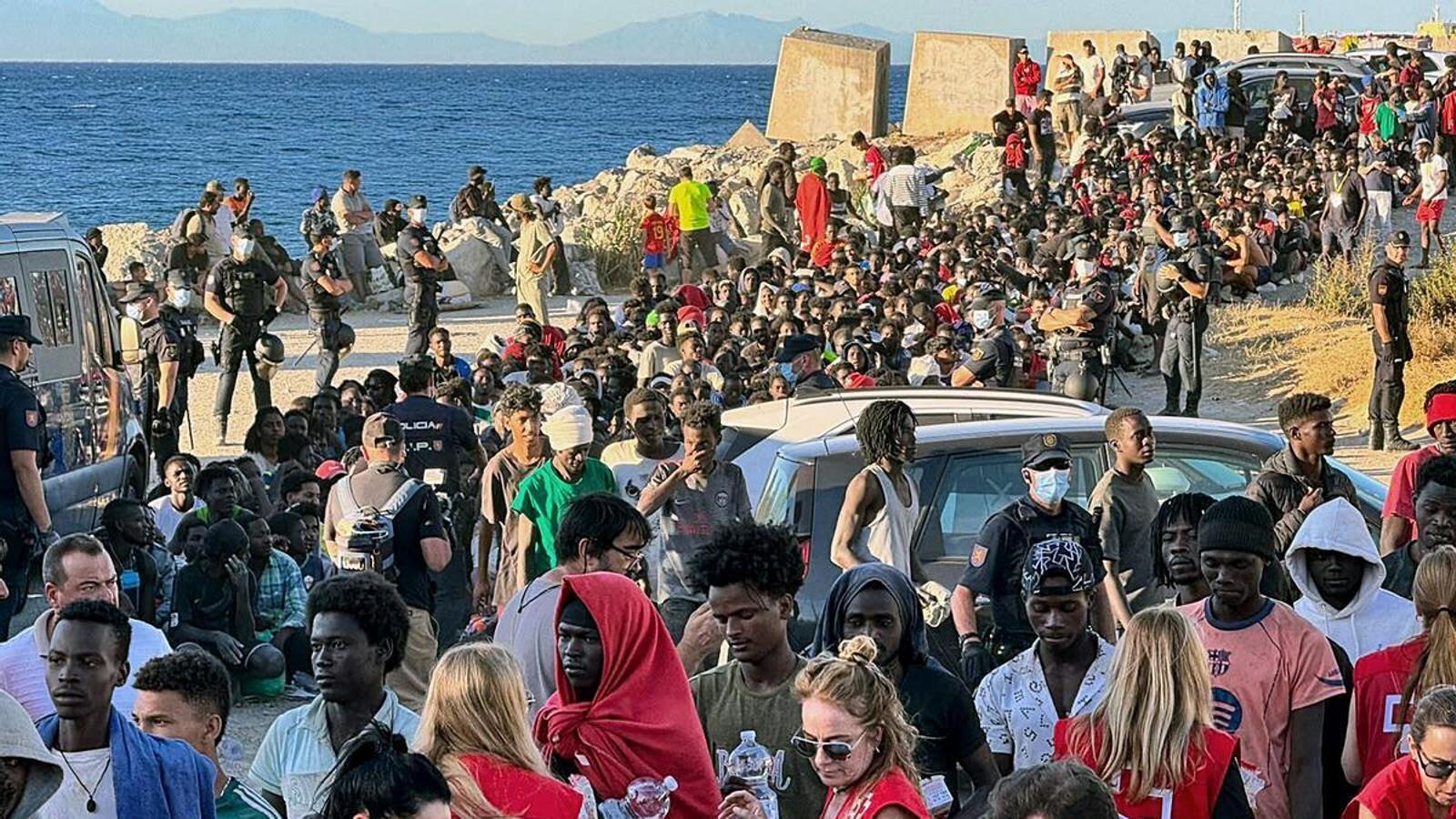
Madrid / Brussels / BarcelonaAs promised last week by Spanish President Pedro Sánchez, the Council of Ministers declassified this Tuesday the reports regarding the Ceuta crisis. That is, all documents that were prepared before July 30 regarding the situation in the autonomous city to verify whether or not the crisis situation could have been anticipated by the Spanish executive. "We are fulfilling our commitment to transparency," said the government spokesperson, Elma Saiz, although it is expected that it will not be until tomorrow, Wednesday, that the media and the public can access the papers. It is also unclear what the scope of the publication will be: although Moncloa assures that everything will be released, the Ministry of Defence had raised objections regarding the possible impact on other intelligence services.
"We have nothing to hide," said Saiz, detailing that it involves 40 documents in relation to Ceuta from July 15 to August 1. "Throughout the day tomorrow, you will have access to all the documents," she promised, adding that in case they affect national security, they will go through the Congressional Official Secrets Commission.
Pedro Sánchez's move comes after the clash of versions between the Ministry of the Interior and the Ministry of Defence. While Margarita Robles assured during her appearance before the Congress of Deputies that there were indeed verbal reports about the surge in entries into Ceuta by intelligence services before July 30, Interior and the rest of the ministries clarify that there was no warning from which an entry of 70,000 migrants on the same day could have been inferred.
The PP, however, does not trust it. The leader of the Popular Party, Alberto Nuñez Feijóo, raised the tone this Tuesday. In an interview on Antena 3, he asserted that the reports the government will publish will be "redacted" and that he trusts much more in the investigation opened by the National Court regarding the Ceuta crisis. And he issued a warning if he reaches Moncloa: he has pledged to "shield" the border and to "act and apply Article 8 of the Constitution if necessary." "Article 8 of the Constitution says that it is up to the armed forces, the army, the air force, and the navy to guarantee the territorial integrity of our country," he highlighted, adding that he wants to have a "good and loyal" relationship with Morocco, but that Spain must also make itself "respected."
"Stop embracing conspiracy theories," Elma Saiz replied to Feijóo. "Being an opposition party that only puts spokes in the wheels does not help Ceuta at all. I demand that you act with responsibility," the Spanish government spokesperson exclaimed to the PP. Regarding the judicial investigation opened at the National Court on the Ceuta crisis, the Spanish executive has said that it is the "injured party" and that it will appear as such. However, it has not spared criticism for Judge María Tardón. The Minister of Transport, Óscar Puente, has questioned her impartiality and was backed by Elma Saiz as a "good jurist": "It denotes mistrust," said the magistrate, since she has a political past in the PP.
The Ceuta crisis, in Brussels
On the other hand, the Spanish government has also provided data on the current situation in Ceuta. It has estimated the number of currently registered minors at 2,004 and has assured that files will be accelerated to prioritize family reunification. At the same time, they have called for normalcy, despite the fact that there are parents this Tuesday who have decided not to take their children to school due to "fear" caused by the situation on the streets. In this regard, the Minister of Territorial Policy, Ángel Víctor Torres, has estimated the average attendance at educational centers at 70%, as well as a full presence of all teaching and non-teaching staff.
In any case, in this context, the president of Ceuta, Juan Jesús Vivas, arrived in Brussels this Monday to ask for support from European institutions because, he maintains, the city is "a pressure cooker that can explode at any moment." The Popular Party member has again clearly pointed to Morocco as responsible for the "invasion" of July 30 and 31 and has asked the European Union to rethink its "cooperation policy" with Rabat. "A cooperation policy cannot be maintained if borders are not respected," he asserted, while demanding a "categorical and unequivocal statement" that makes it clear that the borders of Ceuta and Melilla "are European." Vivas has requested that the EU grant "specific treatment" to Ceuta and Melilla, and also that the European Pact on Migration and Asylum be adapted to the unique fact of being "the only land border of Europe in Africa." A request that would consist of building "infrastructure" at the border and "the permanent presence of Frontex," the European migration control agency, in the cities.
According to Vivas's reconstruction of the events, it is undeniable that Morocco was behind the migration crisis because "it is impossible" for a mobilization of 80,000 people to take place without "the knowledge of the authorities"; because there are reports from the Spanish police that point to the responsibility of the Moroccan authorities; and because of the constant policy "of harassment, asphyxiation and intimidation" on the part of Morocco. To address the severity of the crisis, the president of Ceuta has appealed to Europe's solidarity to obtain "the necessary funding" to address humanitarian aid and the reception process.
The Foreign Minister, José Manuel Albares, is also in the community capital and has addressed the crisis in statements to RTVE. He has assured that he will ask the European Union for "more attention" and "the same financial aid" for Ceuta and Melilla as for the eastern borders. "It is the only land border that Spain and the EU have with Africa, and that makes it the most unequal and the most complex border to manage on the entire planet. That is what they must take into account," he emphasized. In this sense, Albares has assured that he will propose to the European members that Ceuta and Melilla become outermost regions, a new legal status in the EU.
