Sánchez promises to listen to "the street" on the issue of housing and Feijóo defends "a forceful change"
The leaders of the main state parties clash over the foundations of democracy

-
CAT -
CAST
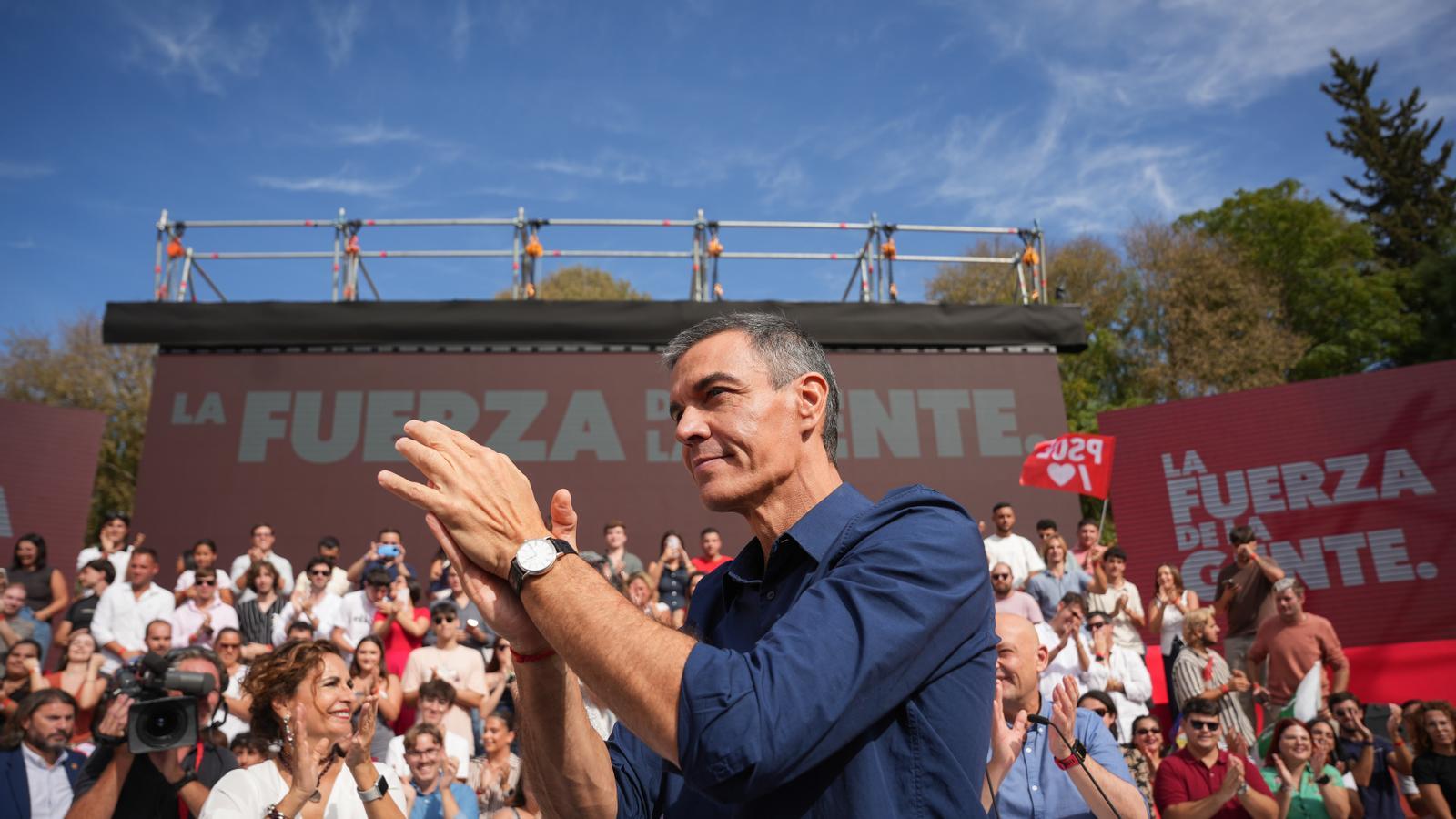
BarcelonaHigh-voltage pre-campaign in Spain for the November 29th elections. In the middle of 2026, eight years after Pedro Sánchez reached the presidency of the Spanish government, the PP draws an apocalyptic scenario if it does not win hand-in-hand with Vox to push for a "decisive change," while the Spanish government promises, now for real, to solve housing problems with courage and fight against those who "pull the strings" and harm the working classes. In the Andalusian town of Dos Hermanas and in Madrid, socialists and conservatives have contrasted two apparently antagonistic models of the country using language that has long denoted aggression.
Sánchez, accompanied by the former vice president and current coordinator of the PSOE campaign, María Jesús Montero, has tried to mobilize the entire left-wing base by saying that the right wants few Spaniards to vote and that, therefore, a majority of citizens who would support the socialist leader should not express themselves. He did so with symptomatic messages in the face of the mobilization of tens of thousands of people following the Maricarmen Abascal case, the 87-year-old woman evicted by a fund, which marked a turning point for presenting two housing decrees, which Junts rejected. Sánchez has promised to go "as far as the street wants" in housing policies, with the aim of "bringing into law what people feel." A nod to the more left-wing voters that he spiced up with criticism of the right's "messages of fear": "Those from the whoever can should do [in reference to the phrase by former president José María Aznar against the Spanish government following the approval of the amnesty] are now those of the the fewer who vote, the better," he snapped.
In his view, with the debate opened by the Spanish right regarding postal voting, they "spread lies because they are afraid of losing," something he has predicted will happen. The PP has warned of a supposed authoritarian horizon if the PSOE wins and has questioned the integrity of the elections by casting doubt on postal voting, which brings back to the table the accusation of potential electoral fraud; an accusation identical to the one from 90 years ago by the right-wing bloc.
However, with a significant voter base of small property owners, Sánchez has also defended the anti-eviction decree as a tool that "clearly protects the small property owner and the tenant". For this reason, he has rejected "pitting small property owners and tenants against each other", because it is necessary to "look upwards" and "end the speculation and abuses of the penthouse [in reference to the apartment bought by Isabel Díaz Ayuso's government] and the vulture funds". Be that as it may, the decrees are a lever for his pre-campaign and a promise that he says he will reinforce if he is elected again.
The right, on the attack
For his part, the Popular Party leader, Alberto Núñez Feijóo, has made a total amendment to Sánchez and has promised "a calm, yet forceful change." The serenity for "national reconstruction," however, is accompanied by discursive harshness: "I do not come from saunas or sewers, I come from management," he said, in reference to alleged scandals surrounding the Spanish president or the PSOE. Serenity is also not "alternation," as he has been repeating in recent months, but a total turn for Spain. With José María Aznar and Mariano Rajoy in the audience, along with multiple regional PP presidents, the Galician leader asked Sánchez "who in the PSOE gave the order to get rid of the judge investigating" the leader's brother, David Sánchez. "Who from the governing party gave the order to hire hitmen to get rid of a problem? It is a democratic question," he said regarding the alleged maneuvers by the PSOE to intimidate the judge.
Feijóo has asked that "no one ever again override the rules"; not even them, he said, without making reference to the multiple corruption cases that have plagued the party, such as that of the former minister in the Rajoy era, Cristóbal Montoro. He also promised that he will not manipulate or sell himself "to govern," even though he has already accepted that he will form a pact with Vox, despite the impact that the agreed national priority has already had in various regions.
Anchored in an incendiary rhetoric, the Madrid president, Isabel Díaz Ayuso, was also a protagonist, insisting on asking if there is a group "with terrorist backgrounds" at the housing encampment at the Puerta del Sol in Madrid.
