Salvador Illa assumes the challenge of teachers
The opposition points to the president as responsible for the crisis and Junts calls for his appearance in Parliament

-
CAT -
CAST
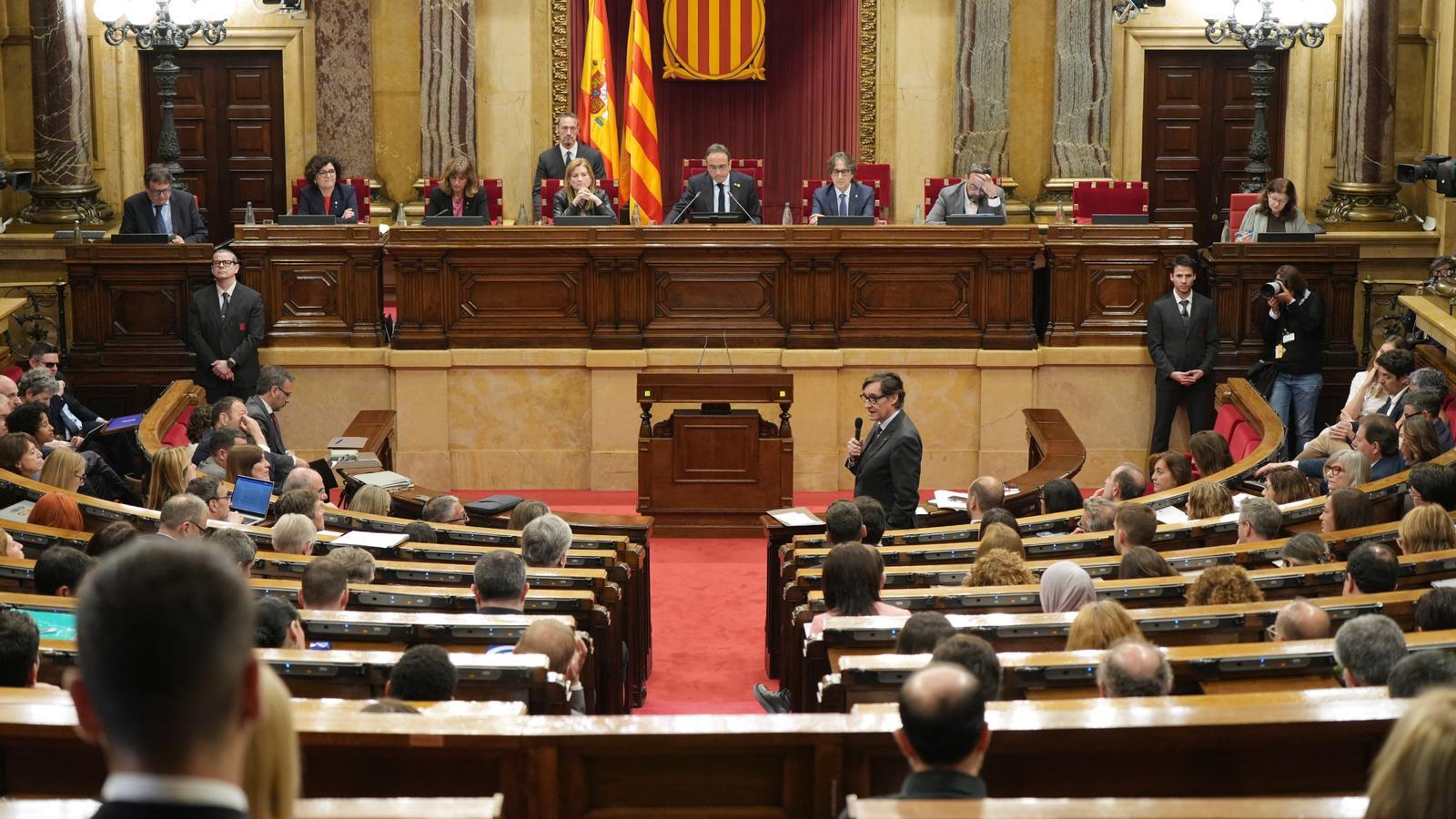
BarcelonaSalvador Illa fails to calm the waters within the educational community. Unions have called for up to 17 days of strike over the next two months in protest of the agreement the Government signed with CCOO and UGT, but not with USTEC. Salvador Illa's government, however, despite the scale of the protest, does not intend to back down and has so far defended the pact signed a few months ago. In fact, it has invited the majority union, USTEC, to join it. "An agreement has been signed that is the best ever signed," stated the President of the Generalitat during Wednesday's control session in Parliament. These words are in addition to those spoken on Tuesday by the Government spokesperson, Sílvia Paneque, who made it clear that the Government will not amend the signed agreement, but will only put "arguments" on the table to convince USTEC, to whom she also invited to join in "rolling out" this pact.
From the Catalan chamber, Illa assured that the Government maintains "maximum confidence in teachers" and that education is a "priority" for his government. In this regard, he reiterated that the executive is making "investments to reverse decades of disinvestment." However, the fact is that a few months ago the Government already saw the educational community take to the streets to protest against the socialist executive's management and have a first round of class walkouts. The Government has not managed to quell the teachers' discontent and now sees them rebelling again.
In fact, Illa's explanations have not convinced the opposition either, which has sought to capitalize on a crisis that has worsened in recent months. To begin with, Junts has already requested Illa's appearance in Parliament to provide explanations. "This crisis has a clear cause, and it is your lack of leadership, President," snapped the president of the Junts parliamentary group, Mònica Sales. "You are surely the president who has accumulated the most strikes in education in two years," added the deputy, who compared the socialists' management with that of former ERC minister Josep Gonzàlez-Cambray: "It was surely difficult to worsen ex-minister Cambray's management, but you have achieved it." Illa reminded her, in this regard, that Junts was part of that government.
Mossos in educational centers
The called strikes come as the executive has also pushed through a controversial plan to introduce Mossos d'Esquadra into schools and institutes. A measure that the opposition has also criticized. Junts' darts have been joined by those from Comuns, ERC, and also the CUP. The leader of Comuns, Jéssica Albiach, has criticized Illa for defending a measure that she considers does not resolve the "conflicts" that exist in classrooms: "I am not here to stigmatize the police, but the police should be pursuing criminals." Albiach, in this regard, has asked Illa to increase the number of psychologists and social educators instead of Mossos.
A measure that the spokesperson for ERC, Ester Capella, has also defended, asking him to withdraw this pilot plan: "In a democracy, the school educates, it is not the police who educate." The CUP, for its part, has accused Illa of adopting an extreme-right mindset. "They are adopting a mindset and a way of acting that is not characteristic of public education, but characteristic of the extreme right. We are very concerned about this," stated the deputy Pilar Castillejo, who added: "If they have surplus Mossos, why don't they send them to the borders and we kick out the Spanish police?". The leader of Aliança Catalana, Sílvia Orriols, also had her say, but in line with her racist discourse: "Why do we need more Mossos? The country has been saved by the grace of pro-immigration policies."

Illa has defended the pilot plan as a "test" that is being applied in the educational centers that request it. "Based on the result, we will decide whether to extend it or not," the president has defended. The Minister of Education, Esther Niubó, has reiterated that the Mossos will not enter classrooms and will not be armed or uniformed. Responding to criticism from the opposition and investiture partners, the minister also assured that the plan is not detrimental to expanding the staff of educators and social integrators in educational centers: "In 2027 the staff of socio-educational figures will be expanded".
