
In May 2021, during the investigation, Judge Santiago Pedraz dismissed the case against Marta Ferrusola due to her deteriorating health and because she had been suffering from Alzheimer's since 2018. Her defense requested it. The Prosecutor's Office asked for a medical examination and, once it was done, reported that it did not oppose the dismissal. One of the defense's pieces of evidence was a report from the neurology unit of the Hospital de Sant Pau in Barcelona. "The circumstances present in this case, as described by the forensic doctor, must be taken into account," concluded the magistrate.
The judge in the Pujol case justifies summoning the former president to Madrid despite his health condition: "We do not want to fall into ageism"
José Ricardo de Prada maintains that the court "needs" to see "exactly" his capabilities and denies that they want to "stigmatize him"
24/04/2026 - 19:06 h

-
CAT -
CAST
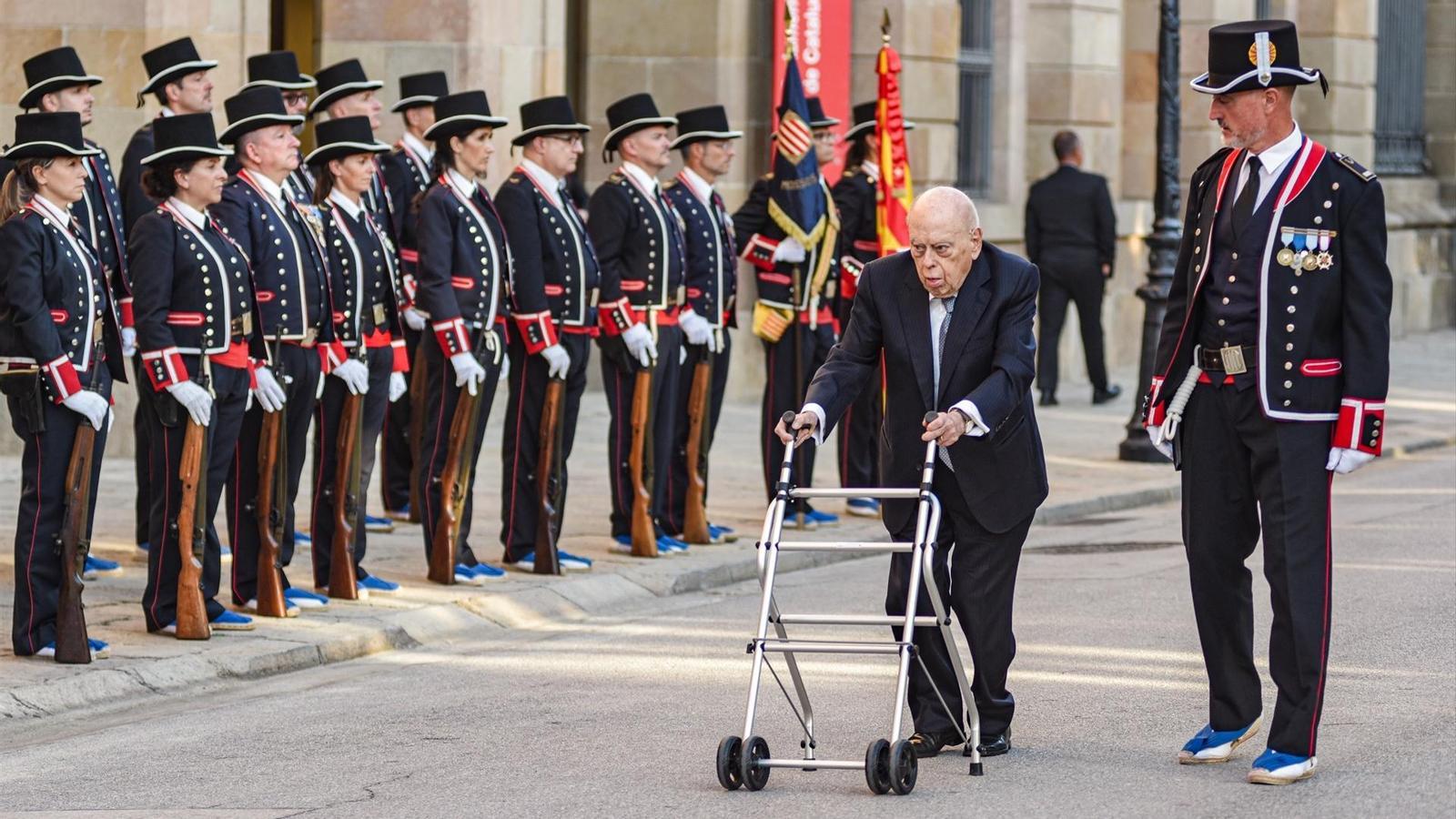
MadridThe National High Court does not want to fall into ageism –discrimination based on age– with Jordi Pujol. As the ARA has learned, this is how the president of the court judging the Pujol case, José Ricardo de Prada, argued at the start of Friday's trial session, the last one before the defendants' statements. It comes three days after it became known that the former president of the Generalitat will have to travel to Madrid on Monday for a forensic doctor to examine him and certify whether he is in a condition to continue on the defendants' bench. "The court does not want to fall into ageism," Judge Prada stated before the public session began and after one of the Pujol family's lawyers asked him to address the issue. In other words, they do not want to stop summoning him due to his advanced age. However, Jordi Pujol is not only 95 years old, but he also has markers of Alzheimer's in his blood. "I want Mr. Jordi Pujol Soley to participate in the proceedings with the certainty that he is in a condition to endure the trial," the judge added. "The court does not start from prejudice, it wants to see exactly his capabilities to determine whether he should continue or not," he concluded. Jordi Pujol's defense has opted not to file any new written submissions because they consider the decision to have been made and there is no room for modification. And they are leaning towards Jordi Pujol traveling to Madrid by car. It is not yet known for certain whether he will enter through the parking lot or not.
The judge, in his initial intervention, also mentioned the media stir that has arisen as a result of his decision: "It was the press, not you," he acknowledged. And he denied that the court wants to "stigmatize" the figure of the former Catalan president: "The court has absolutely no interest," replied José Ricardo de Prada, who guaranteed the "most respectful treatment possible" to "anyone who is 95 years old." And he even cited a Catalan author, Anna Freixas, who is a doctor in psychology from the University of Barcelona and author of Yo, vieja. Apuntes de supervivencia para seres libres. At one point, the judge even hinted that, if the "absolute impossibility" of Pujol transferring to San Fernando de Henares were confirmed, they might have to "consider an alternative." "To say that the court should move, which seems to me...", he said. But the widespread laughter in the room prevented him from finishing the sentence.
José Ricardo de Prada's plea comes hours after political representatives such as Salvador Illa and Félix Bolaños have responded to the summons. The President of the Generalitat Five months ago seeing that the former Catalan president is "fluid" and does not feel "strong enough" to even go to El Vendrell. And the Minister of Justice acknowledged that Pujol's state of health The hypothetical declaration as a defendant
If after the medical examination Jordi Pujol continues on the defendant's bench –and even if he is there–, the court does not reject that he can testify telematically: "The court will not gain much if he testifies in person or by videoconference. If he wants to testify by videoconference, there is no problem." And he says that he also has "no interest" whether it is one way or the other. That is, whether he testifies or not and whether he answers the accusations or not: "He has the right to testify what he deems appropriate and how he deems appropriate." For now, his defense's prediction is that he will not testify. José Ricardo de Prada has made it clear that, once everything is over, the former president "does not have to stay" in the room –his defense says it would be "unviable" for him to have to follow the trial from there– and he will be able to return home.
Junts will not accompany Pujol by "express request" of the family
First thing in the morning, Junts per Catalunya announced that a party delegation would accompany Jordi Pujol to San Fernando de Henares to "show him support". The delegation was to be headed by Toni Castellà and Josep Rius –party vice-presidents–, Albert Batet –deputy to the presidency–, and Salvador Vergés –parliamentary spokesperson–, along with members of Congress and senators. However, six hours later, the party backed down and suspended the accompaniment due to an "express request" from the family.
Marta Ferrusola's Precedent
