The judge forces Pujol to testify in Madrid despite medical reports against it
Half an hour before the session begins, the former president of the Generalitat will be examined by a forensic doctor

-
CAT -
CAST
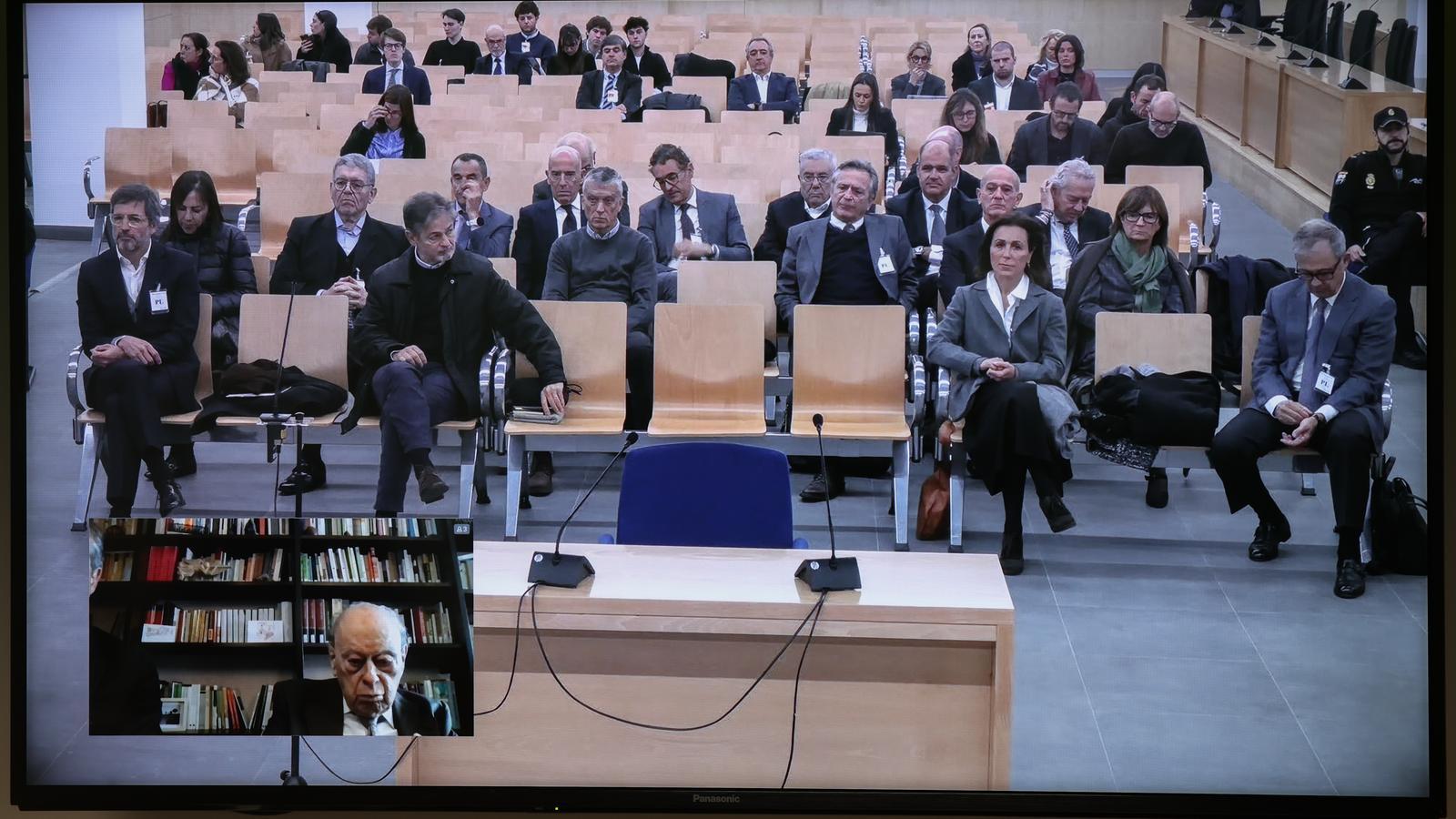
MadridJordi Pujol i Soley will have to go "personally" to Madrid on Monday, April 27, for a forensic doctor to examine him as a preliminary step to his declaration as a defendant in the trial against his family and nine businessmen that has been underway in the National Court for five months. This is stated in a resolution, to which ARA has had access, which summons the former president of the Generalitat at 9:30 in the morning, despite the fact that "forensic doctors said in November"he is not in physical or cognitive condition" to be tried. Now the National Court is once again offering him the opportunity to provide "documents he deems appropriate for his medical evaluation." At 10 a.m. the declarations of the defendants will begin. Furthermore, the forensic doctor will have to be present "for the entire duration" of Pujol's declaration. Afterwards, it will be the turn of his eldest son, Jordi Pujol Ferrusola, who has been attending the sessions throughout the trial and who spearheaded the businesses and operations at the center of the case. The Anticorruption Prosecutor's Office is requesting nine years in prison for the former Catalan president for the crimes of illicit association and money laundering.

The current leader of Junts, Carles Puigdemont, has reacted to the news on social media. "They couldn't be more miserable," he denounced. He believes that the National Court is seeking "scorn" and a photo to "humiliate not only a person, but above all what they represent" and assures that, if he were not in Waterloo, he would have accompanied Pujol to Madrid "with great pleasure." For his part, Albert Batet, deputy to the presidency of Junts, has presented the court's decision as an "unacceptable and inadmissible act of humiliation."
On November 24, the day the trial began, all eyes were on Jordi Pujol i Soley. The previous week, forensic doctors had concluded that he does not have the "necessary procedural capacity" to "defend himself adequately." That day, Pujol appeared telematically: "I am at your disposal to answer to the best of my ability, but I am not in very good shape," he stated. Previously, his personal doctor, Jaume Padrós, had warned in an interview with ARA that one of the characteristics of advanced cognitive disorders is "anosognosia," that is, the "inability to assess the extent of your deficits and how far your difficulties go." One of his sons, Oriol Pujol, had said that his father "wants to go to the trial," but had warned that "his body cannot withstand the trip" to Madrid: "It could be quite fatal," he warned.
Finally, the court disregarded the medical reports: "It has decided that the trial will begin with his presence," announced José Ricardo de Prada, the president of the court. However, he added that if there were "any modification" in his health status, the court would make the appropriate decision at the time and determine "if he is in condition" to testify. And that is what could happen next Monday. Over thirty sessions, in which the former president has been mentioned sparingly, anecdotally, and without linking him to any irregular activity, the trial has attempted to discern whether the fortune the Pujols had in Andorra came from grandfather Florenci or from money from illegal commissions in exchange for contracts.
When the investigation was closed, Judge José de la Mata concluded that the Pujol family took advantage of their "privileged position of ancestry" in "Catalan political, social, and economic life" to "accumulate an excessive fortune" that was "directly related" to "economic perceptions derived from corrupt activities." The Anti-Corruption Prosecutor's Office maintains that Jordi Pujol wove a "network of clientelism" in which he and "businessmen close" to Convergencia "shared" the "excellent benefits" from public tenders that depended on Catalan administrations. However, the dozens of testimonies have corroborated during the trial that the eldest son's businesses were real and no type of favoritism by the family has been proven.
