Junts denounces Renfe and Adif for reckless homicide due to the Gelida accident
Puigdemont's party blames the PP and the PSOE for the "unsustainable" railway management in Spain
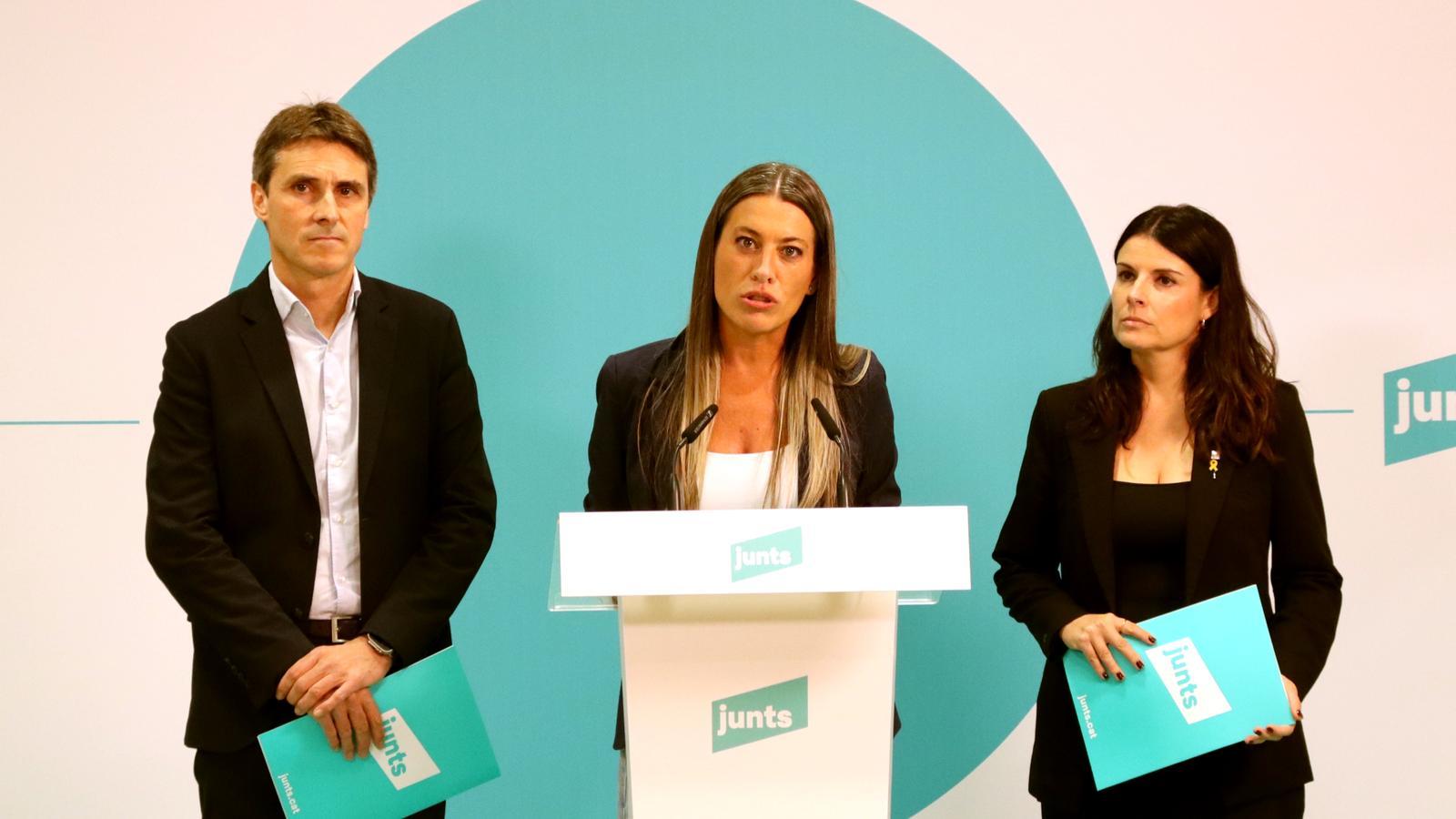

BarcelonaCriminal complaint by Junts for reckless homicide against Renfe, Adif, and the Spanish General Directorate of Roads due to the railway chaos in Catalonia. Specifically, the legal document from Junts, released this Monday, refers to the Gelida accident on January 20th, in which there was one death, but it was filed on October 20th after the team led by lawyer Gonzalo Boye studied the case, once the four-month deadline for the Government to fulfill the parliamentary mandate expired on June 18th –the Parliament approved the filing of the complaint, but the executive branch ignored it–. The crimes listed in the document against the two Spanish institutions and the general directorate that reports to the Ministry of Transport are reckless homicide, injuries, as well as the crime against workers' rights and for catastrophic risk.
A complaint that has been communicated in the midst of a pre-campaign marked by railway management, especially following the Toledo tragedy last week, in which there were about seventy deaths. In a press conference, the Junts candidate for Congress, Miriam Nogueras, blamed the PP and the PSOE this Monday for the "unsustainable" chaos of the trains in Spain.
Regarding the complaint, the Junts group intends to act as a popular prosecutor and remain a party to the case, which is being investigated by the court of first instance of Vilafranca del Penedès, to which the complaint has been referred, having been presented in the Barcelona duty court. Vox also appeared in the case and verbally attributed the disaster to "socialist negligence." More recently, the far-right party filed a complaint against the Minister of Transport, Óscar Puente, and against Adif also for reckless homicide in the Toledo case, and the PP, like Santiago Abascal's party, has appeared in the judicial case opened for the accident as a popular prosecutor.
The keys to the complaint
According to the text, Junts points to the people within the general directorate of roads, which depends on the Ministry of Transport, who were "responsible for the maintenance, inspection, and monitoring of the viaduct supporting the AP-7 motorway over the railway line" and the associated retaining walls and the drainage system, without naming anyone. It does the same with Adif, citing "the people responsible for the maintenance, inspection, and surveillance of the affected section of the line, for coordination with the motorway operator, and for the imposition of traffic restrictions" according to weather conditions; but also with the people at Renfe "responsible for evaluating and preventing risks in the driver's cabin and for the decision to maintain train service on the night of January 20th".
The accident that occurred on the R4 line caused the death of the train driver, a young man who was in a training period, and caused five serious injuries. However, in the complaint, Junts does not hold the state government responsible in any case: "The complaint is not directed against members of the State government," which can only be pursued by the Supreme Court –it notes–, nor has Junts explored this avenue among other things because "there is still no specific evidence that allows attributing any concrete conduct to any of them".
The 'juntaires' also refer to a "formal warning" hours before the accident by the Sant Andreu Comtal section of SEMAF, in which it was urged to adopt a "risk mitigation plan and for it to operate with a level of safety that, in their view, did not exist". Be that as it may, Puigdemont's party concludes that there is "sufficient evidence" to justify the investigation for reckless homicide and the rest of the crimes. On the other hand, their legal account maintains that the collapse that occurred in Gelida is not an isolated event, but that the Government itself has commented several times in parliament that there is a "lack of investment in recent decades" in the Rodalies network, in addition to the fact that the "aged and overloaded network" has been lamented.
Political criticism
Francisco Álvarez Cascos, Magdalena Álvarez, José Luis Ábalos, or Raquel Sánchez. These are the names of Ministers of Transport, or Public Works, that Nogueras has cited in her appearance before the media, to point out that "the PP and the PSOE sign" this "incompetence of Madrid." "Many years of disinvestment and centralism," in which it has opted "more for cutting ribbons to inaugurate tracks than for maintaining them," according to the Junts member, who reproaches that "Spain has not foreseen how to maintain this large network, it has not guaranteed either safety or maintenance.
Just as she positioned the economic agreement as a sine qua non condition for any future investiture, Nogueras has pointed out that the "strength" of Junts will also go towards achieving the total transfer of Rodalies and for Catalonia to be fully sovereign in as many areas as possible. "The success model" of the Ferrocarrils de la Generalitat was claimed by Nogueras, who was accompanied by the president and spokesperson of the Junts group in Parliament, Mònica Sales and Salvador Vergés, who have stressed, respectively, that "taking a train has become a lottery" in the Principality and that "the fault always ends up being the Spanish state's.
