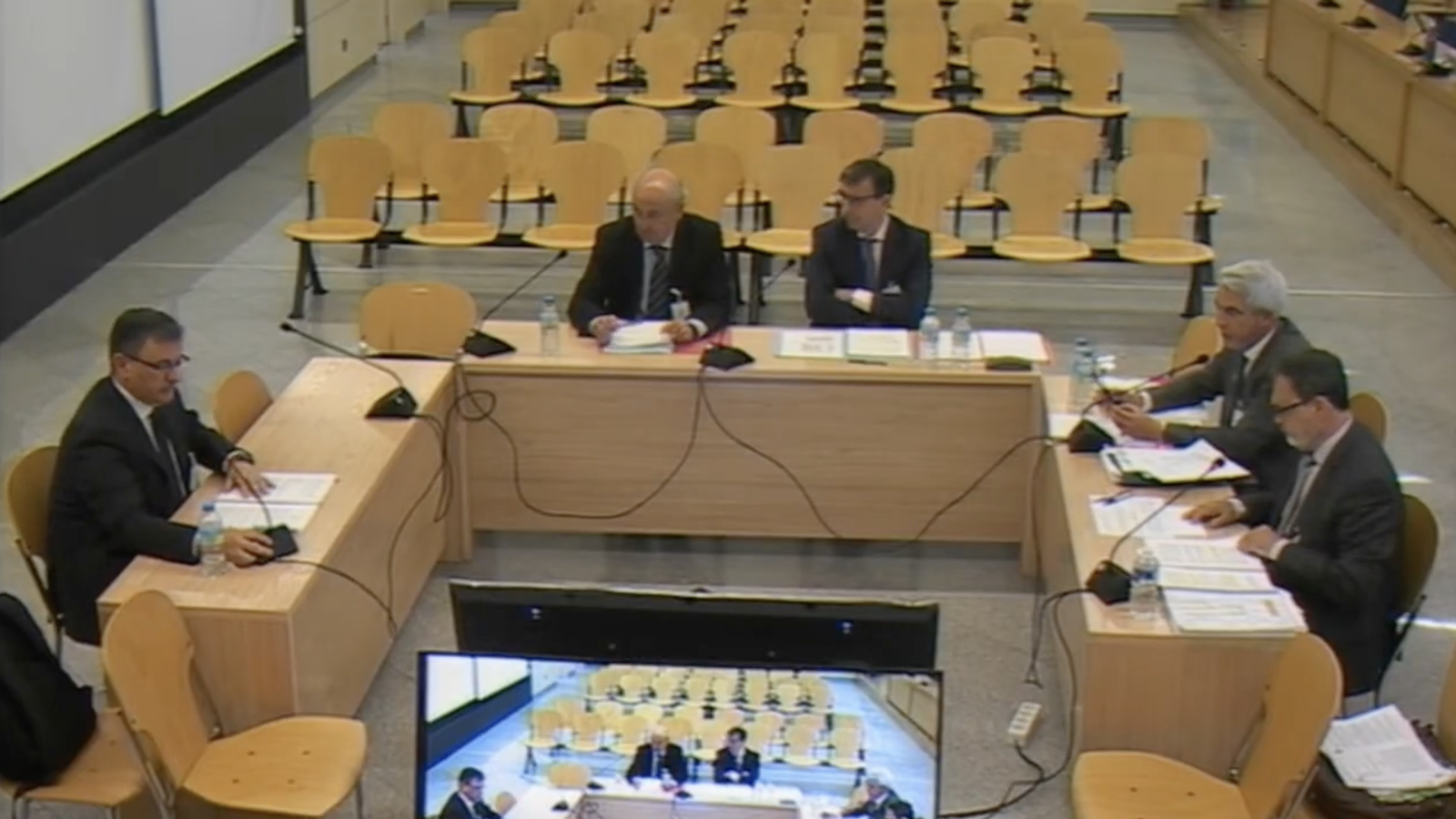
MadridThe trial against the Pujol Ferrusola family has entered its final stretch. This week has been dominated by the experts proposed by the prosecution and the defense to assess the business dealings of the eldest son of the former president of the Generalitat. And the highlight has been the confrontation between two tax experts and three specialists proposed by the firstborn's defense, which began on Tuesday and will conclude next Friday in an extraordinary session. In total, it will amount to over ten hours of testimony.
One of Jordi Pujol Ferrusola's experts was Sebastián Piedra, who – just as two experts did on Tuesday and other witnesses have testified throughout the trial – gave full validity to the firstborn's role as an intermediary in private business: "It is based on an element of extraordinary value, but which is intangible. It is a network of contacts, knowledge, and information," he summarized on Wednesday. He explained that "excessive means" were not necessary, but that "a mobile phone, a secretary, and an office" were "sufficient," and made it clear that this is a type of activity for which a contract "does not usually exist." And Luis Manuel Alonso, a professor of financial and tax law at the UB, added another argument: "If there is an invoice and it has been paid, it means that the one who pays it acknowledges that they have received the service."
On the other hand, the tax authorities doubt the business dealings – precisely – due to all these variables: "They are non-existent services that have not been rendered because there is no documentation or contract to support them." And they have cast doubt on the capabilities of the Catalan ex-president's eldest son to carry out his functions: "Action is being taken through a mere shell company, which is a pure shell, because the company has absolutely nothing. There were no material or human resources." Likewise, the expert considers that Jordi Pujol Ferrusola obtained an "unjustified capital gain" because he does not know the reason: "I don't know in what capacity he is receiving these amounts." But this is a valuation that Sebastián Piedra contradicts: "It cannot be said that it is unknown where the income comes from, as it is invoiced by the companies and is accounted for."
The interrogations that have been taking place over three days have been particularly sharp. At one point, for example, the State lawyer José Ignacio Ocio asked if the collection of an illegal commission linked to a corruption case is taxed in the Personal Income Tax. "It is an economic activity and must be taxed as such," replied Jorge Pérez García, who is a professor at the UB and also an expert for the defense. However, on Tuesday, the moments of maximum tension occurred, which forced the president of the court, José Ricardo de Prada, to intervene on more than one occasion to try to "pacify" the atmosphere. "Let's calm down a bit," he said first. "Let's lower the tone and try to have a constructive dialogue," he added later.
Who were the 900,000 euros in bills for?
One of the protagonists of the third session has been Josep Pujol, who is under scrutiny for a loan of 900,000 euros to Jorge Barrigón, one of the businessmen on trial. It was 10,700 bills that were moved in December 2009. One of the tax inspectors believes it was an operation to launder money: "It is about justifying large cash income to cover oneself."
Jaime Campaner, Josep Pujol's lawyer, has asked Sebastián Piedra about this matter and the expert has reconstructed it. The son of the former president of the Generalitat went to get 900,000 euros in cash and said it was to take them to another Andorran bank, leave them with his older brother, and make a transfer to Mexico. When he arrived at Andbank, Jordi Pujol Ferrusola told him he didn't need them because he had received a loan from Bernardo Domínguez, the father of one of the accused businessmen. And later, Josep Pujol learned that Jorge Barrigón wanted to make an investment and offered him the possibility of lending him money.
However, the bills from the two transactions were exchanged: Jordi Pujol Ferrusola received the bills –of 50, 100, 200, and 500– that his brother had withdrawn, and Josep Pujol kept the 500 bills that came from Bernardo Domínguez. Finally, however, Barrigón could not buy the shares of the company he wanted to acquire and returned the money to his friend. "He had full conviction that the money was the same, what was leaving one and what was entering the other," the expert concluded.
Xabi Alonso's Sentence
The precedent to which the Treasury resorts
As a strong argument, one of the tax experts mentioned the sentence in the case of footballer Xabi Alonso, who was acquitted of a crime against public finance for the transfer of the exploitation of his image rights to a company based abroad. He brought it up because the footballer used an "intermediary company" for "the provision of his services as a professional athlete". "But he is also doing other activities. Since he has material and human resources, he says that simulation does not apply in this case," he added.