Sánchez warns that climate denial "is the worst of fuels"
Vox denies climate change and the PSOE calls for a state pact stalled for a year
-
CAT -
CAST
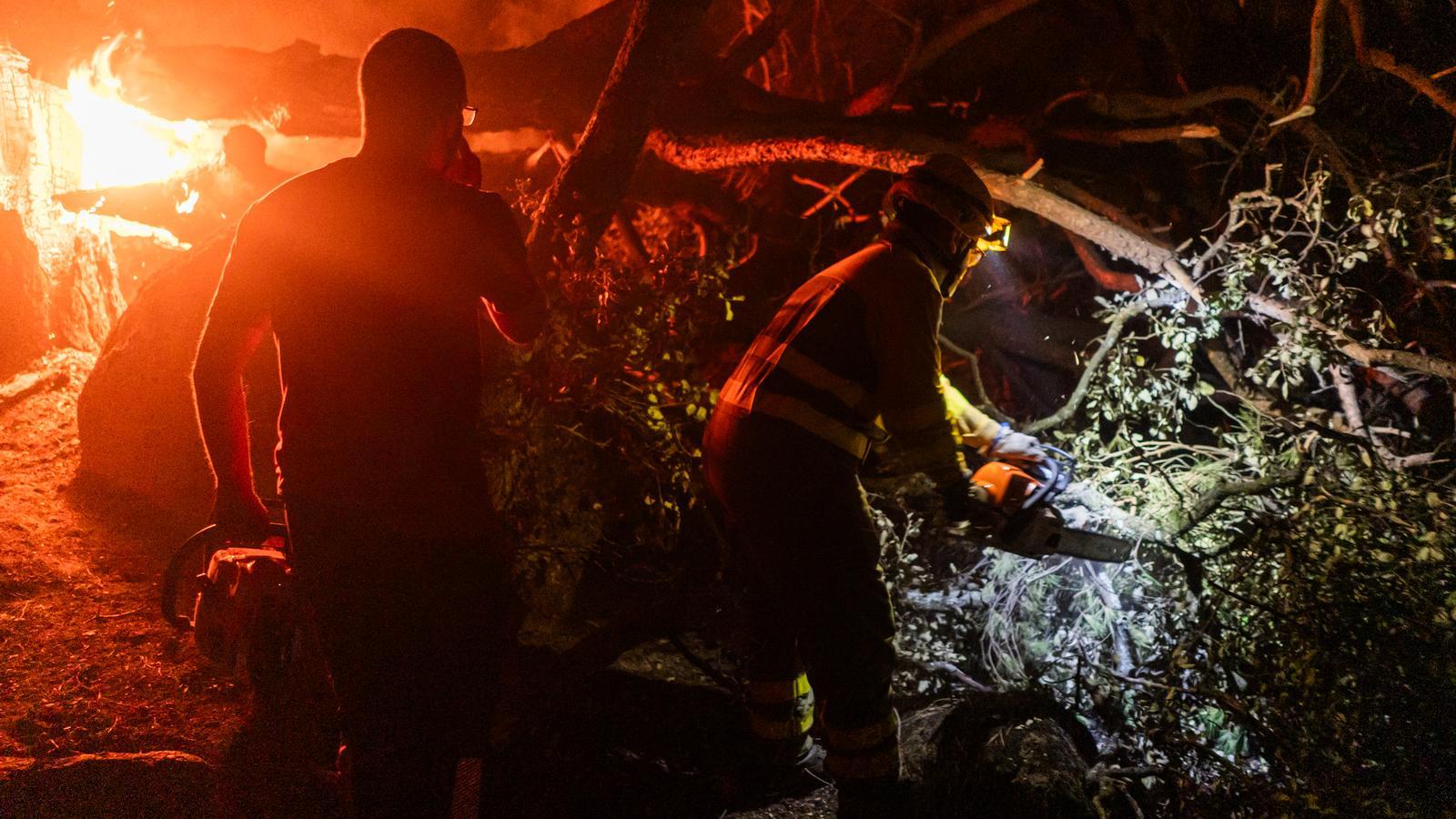
BarcelonaSpain is experiencing one of the worst fire seasons in the last 10 years, with more than 170,000 hectares burned since January. In fact, the fires in Madrid, Avila and Toledo are the "most serious and aggressive" in the history of the State, according to the Minister of the Interior, Fernando Grande-Marlaska, and the Spanish government has declared these three territories a national emergency zone, with nearly 90,000 evacuated or confined. The macro-fire affecting the center of the State joins the one from only a few weeks ago in Almeria, where there were 14 deaths — the last confirmed just today—. Fire has become the main environmental threat of recent summers and its management. And this is when climate denialism from the far-right has strongly emerged, which the left has tried to confront with empirical evidence of the virulence of recent fires.
This Tuesday morning has been the latest episode: the president of the Spanish government, Pedro Sánchez, wanted to start the balance of the political year before the summer by focusing precisely on these fires. Sánchez confirmed the figure of 170,000 hectares burned in 2026, "six times more hectares than in the same period last year," he stated during his appearance from Moncloa. Faced with this scenario, which he described as Dantean, he once again urged the approval of a State Pact for Climate Emergency and called for rejecting discourses that fuel climate denialism: "It is the worst of fuels [...] Denying reality and science's alarms makes us more vulnerable," he stated.
This call from the Spanish president has a clear recipient. Vox is the party that has established itself as the main denier of climate change. Its leader, Santiago Abascal, has once again evidenced this in recent days when he spoke again of "climate fanaticism" when referring to the causes of the fires in Madrid, Ávila, and Toledo. In fact, he attributes the fire to "corruption, fanaticism, and the mafia" of the Spanish president, Pedro Sánchez, and not to the climate emergency, but to "ideology" and the abandonment of the countryside. "Sánchez is a plague," he even wrote in a recent tweet on X. His party, in fact, is already preparing after the summer a proposal of its own focused on regional surveillance which, like Abascal's speech, also does not mention the climate emergency.
Sánchez's insistence is not new: the state pact he called for today is the same one he launched a year ago after the serious fires in Castilla y León. The Spanish president presented it on September 1, 2025, with 15 expanded axes after almost 4,000 contributions. This Monday, Sánchez defended it again from Vall d'Uixó (Castelló), where he once again linked the "sustained and systematic increase" in temperatures with a climate emergency that "exponentially raises" fires.
The Spanish government and the PP have not managed to reach any agreement for this state pact against climate change to see the light of day. In fact, in October, the 14 popular communities boycotted the Ponferrada convention en bloc, where the Spanish government presented this pact, calling it a "propaganda approach". The PP, however, does not have a denialist discourse. Last summer, Feijóo anticipated Sánchez and proposed his own plan of 50 measures – he proposed, for example, a registry of arsonists with bracelets.
However, within the PP there are also dissenting voices such as that of the Madrid president, Isabel Díaz Ayuso. In recent days, she has avoided confronting the Spanish government over what she considers a "propagandistic" discourse and, this Tuesday, she evidenced this in a press conference in Navalcarnero: "It is not the time to give broad-brush solutions to exempt ourselves from any responsibility," she said. However, it is the same Ayuso who said in the Assembly of Madrid in 2022 that "since the Earth has existed, there has been climate change, there have been cycles".
The PP-Vox pacts
Although the PP does not deny climate change, its position contrasts with the regional pacts it has signed in recent months alongside Vox. In Andalusia, before 13 people died in the Los Gallardos (Almería) fire, its president, Juanma Moreno Bonilla, sealed a pact of 150 measures with Vox that accepted the term "climate fanaticism" and rejected Brussels' climate measures. Days later, the same Moreno Bonilla acknowledged at the scene of the fire that climate change "is affecting us very significantly." A position that clashes with what his party has signed to govern with the far-right.
Precisely, the third vice-president and minister for ecological transition, Sara Aagesen, poked at this contradiction of the popular party and accused them of "leaving the country unprotected" by governing with deniers in communities that have competence in fires. However, the state pact that Sánchez demands also does not escape criticism from the PP, because they regret that this project has gone almost a year without being concretized into any real agreement. Furthermore, the popular party also censures that the planes promised by the Spanish government to reinforce the extinction fleet are not yet operational in this campaign.
