Real Catalonia and the national aspiration
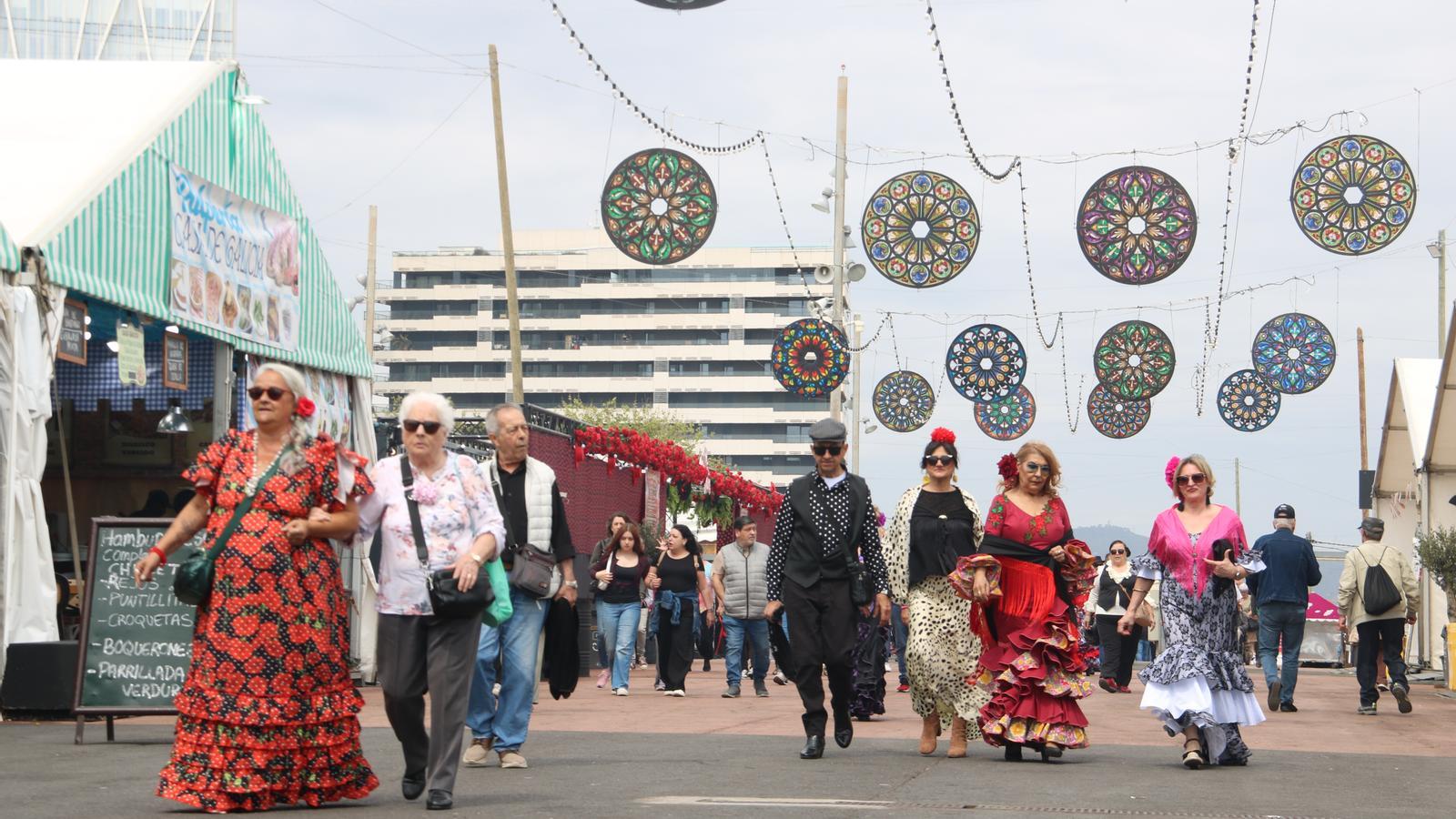

A few days ago, the 53rd Feria de Abril de Catalunya, organized by FECAC (Federació d'Entitats Culturals Andaluses en Catalunya), was inaugurated. And following this celebration, Catalan political scientist Arantxa Tirado was the subject of an online diatribe for having said that she had seen the “real Catalonia” there. She herself clarified the interpretations of her comment, and since I don't know the extent of the dialectical turmoil, I won't go down that path. I only cite it to do justice to the origin of the idea of writing the lines that follow.
In any case, indeed, present-day Catalonia, rather than a homogeneous nation, is increasingly resembling a kaleidoscope in which, with every little turn of the optical cylinder, the figure observed changes again. It is an image that this year's poster for the Feria de Abril also conveys, transforming a Gaudinian trencadís into an Andalusian peineta, playing with the idea of explicit hybridity. A limited hybridity, of course, which doesn't seem solid enough to ensure the FECAC website has a Catalan version. And let it be said as a warning – there are matters in this country where, even treading carefully, you cannot avoid stepping on mines – I do not intend to delve into the murky topic of the Feria itself. Neither its dusty history, nor who participates in it – unfortunately, on their website the list of stalls is still “in construction” – nor how it is financed.
However, I am interested in the dialectic between what is “real” and what is “ideal”. Or, if you prefer, between what things are and how we would like them to be. Because it is true that among the people we can find at the Feria de Abril – I insist on the official name, untranslated, as the organizers call it – there are all sorts. And we would still be understating it. Because yes: real Catalonia is also that of what remains of the CUP and all that will come from Aliança Catalana.It is that of those who dance reggaeton and those who do not miss any concert by the Cor de Cambra del Palau de la Música. It is that of those who like barbecues, those who are vegetarian, and those who are vegan. That of animal rights activists and those who are tired of seeing so many dogs (off-leash) in the street. It is that of people with light or dark skin, those with tattooed skin, and even those with thin skin and thick skin. Behold the trencadís of “real” Catalonia.
Well, getting bogged down in the diversity of factual reality is a great deal of reductionism, not to say reactionary conservatism in its consequences. And it is so because people, and peoples, also have ideals, dreams, hopes, ambitions. And this is a not negligible part of their reality. Especially because it is what transforms – or hardens – factual reality. Appealing to diversity, as is common in Catalonia, has become a way of paralyzing the political changes that would break the current statu quo. It is about repressing the processes of change, which certain movements aspire to, with the excuse that one must be “the government for everyone”. Yes, if with the slogan one means that one governs for everyone, understood, of course. But if it means that a minority government, by virtue of being so, already represents everyone, then absolutely not.
A people like that of Catalonia – I wish I could say of the Catalan Countries without feeling like I was forcing the factual “reality” too much (it's meant to be ironic) – is, certainly, a motley collection of individuals. But I don't know of any small town, any medium-sized city, any national capital, any nation in the world reasonably proud of being so that, however much it is the result of a melting pot of origins, renounces being recognized also as a collective with a future and wanting to lead a common horizon. I don't know of any nation worthy of being so that abdicates having what the sociologist Manuel Castells would call a “project identity”.
I see it so clearly, that the question that really needs to be asked is why this that everyone aspires to, to go beyond what is “real”, cannot also be characteristic of the Catalan nation and of Catalans. Why should the democratically legitimate aspiration to want to be a politically independent nation be denied with the argument that there exists a heterogeneous “reality” among which, yes, there are other ideals of country, such as the collective that considers itself Spanish or the one that doesn't even know what all this is about. To be clear: if there can be independentist stalls at the Feria de Abril – this mystified Andalusia turned into a fair of nostalgias –, there would be no harm in a Feria de Abril in an independent Catalonia either. Who is interested, then, in making “real” Catalonia an obstacle to a certain ideal of common well-being and prosperity? That is the question.
