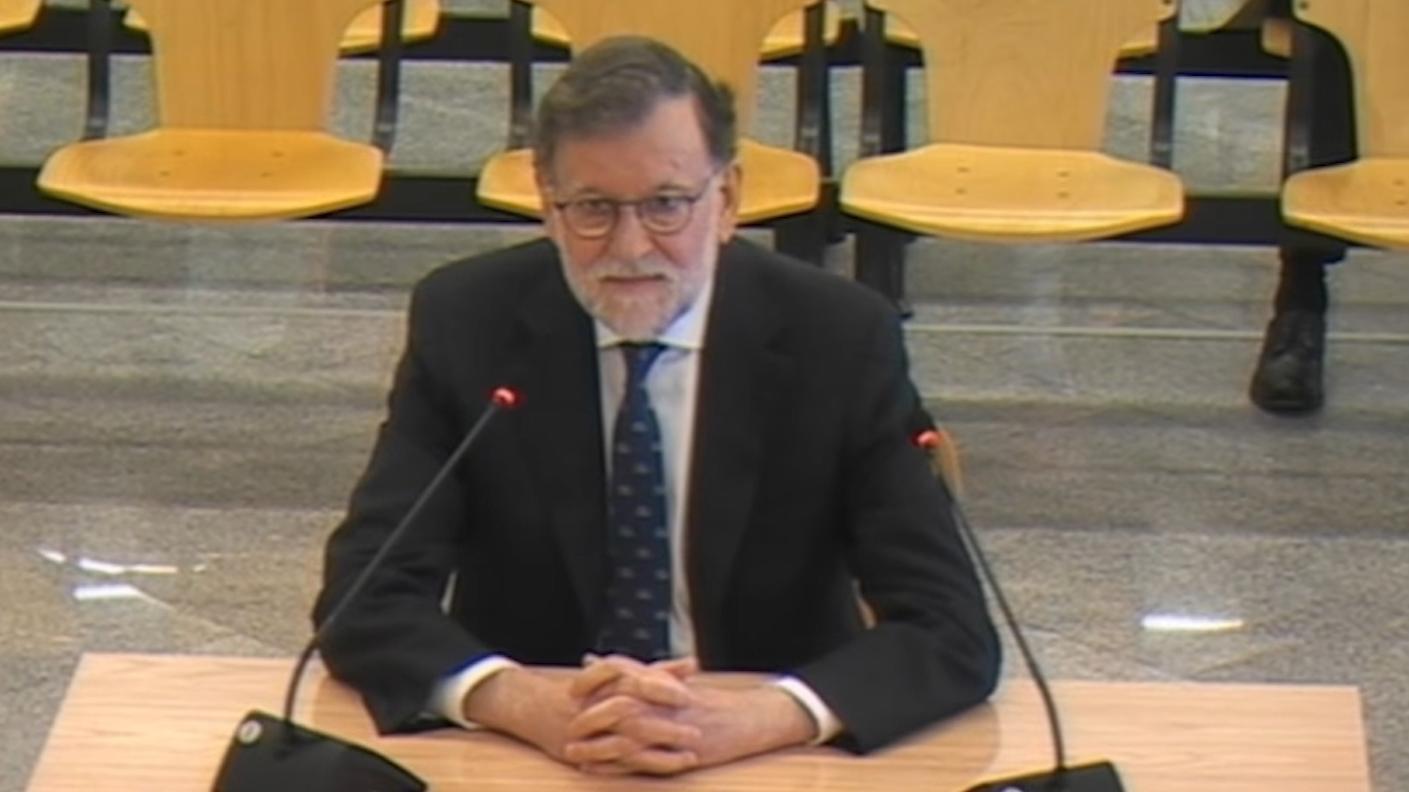

Mariano Rajoy has always managed to get extraordinary performance out of his public persona. Some time ago, he managed to create, even among his detractors, a kind image, for many even endearing, of a absent-minded man, a little slow, with somewhat bizarre but funny remarks, more interested in football than in politics (sadly, both in Spain and Catalonia, football works as a perfect social whitewash for any scoundrel), old-fashioned, fundamentally a good fellow.All of this, needless to say, is false. It is a facade, half-casual and half-studied, which, as we said, has given him very good results. Rajoy always maintains a clearly visible distance between what happens around him and his person, as if things never concerned him, as if there were no causal relationship between the positions he has held in the Popular Party and in the government of Spain and the crimes that were committed within the party or within the executives he presided over. It doesn't matter if it's the Kitchen plot, the patriotic police, the police charges of October 1st, or any other scandal. He wasn't there, he didn't know anything about it, he was alien to it, his ignorance was absolute. Rajoy also possesses a notable cold-bloodedness, which allows him to lie before a court and remain impassive. Even more so if the president of the court helps him, as Magistrate Teresa Palacios did last Thursday during the declarations of Rajoy and Cospedal at the National High Court, precisely for the Kitchen case.Rajoy, however, is like bad actors, who eventually get tired of playing the same role and then overact. On this occasion, he even denied knowing the aliases by which he was known within the criminal circles organized within the leadership of his party: he claimed to be unaware of the nicknames of el Asturiano, el Barbas, etc. "My name is Mariano Rajoy, as everyone knows." Another of Rajoy's favorite recursos are obvious statements and tautologies, with which he often manages to provoke the audience's smile and facilitate jokes from monologists and impersonators.The reality is that Rajoy's time as president was one of the darkest in Spanish democracy, and that's saying something. These are years of blatant patrimonialization of institutions, of denial of any dialogue with the opposition, of impulse to the ultra ideology that has finally become hegemonic within the Spanish right (now we exclaim, but Rajoy already had ministers who sang "El novio de la muerte" at the processions of Holy Week in Malaga), of constant belligerence against any form of diversity (especially against linguistic diversity, especially against Catalan) and, of course, of organized and institutionalized corruption at all levels of public administration. Perhaps it would be necessary that the next times Rajoy sits before a court it is not to mock justice and citizens again, and to leave as happy as ever.
