Overflow
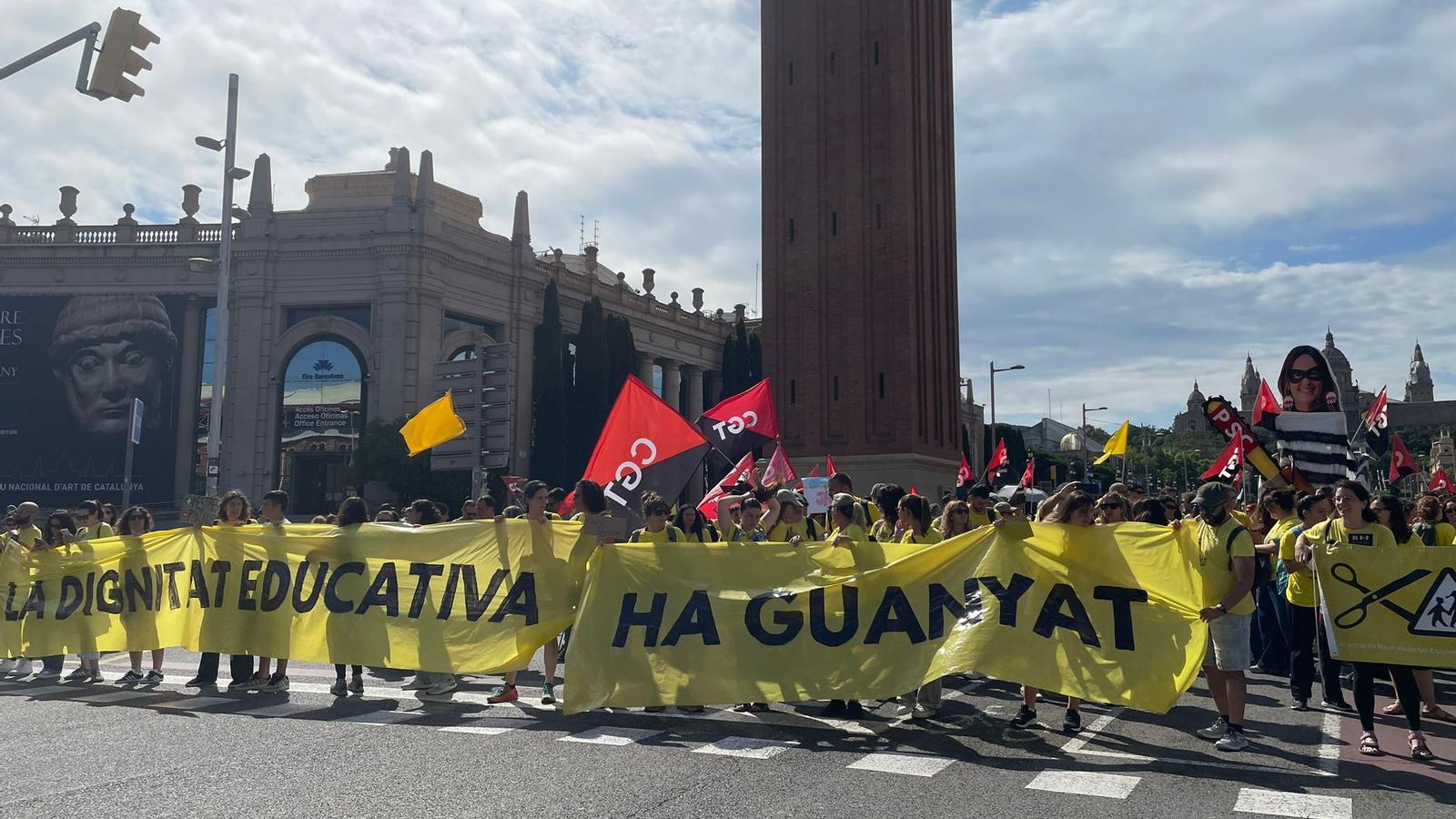

The Generalitat signs a pre-agreement with the unions representing the majority of the sector and, on the other hand, a very broad majority of teachers who participated in the consultation reject it. It is not the first time something similar has happened. In December 2023, the Department of Health reached an agreement with the majority unions, also in nursing, and on the other hand there was an indefinite strike that lasted more than 40 days, led by organizations that until then were very minority. The major farmers' mobilizations in February 2024 were not led by the majority union Unió de Pagesos nor any other agricultural union, but by a new organization called Revolta Pagesa which operated outside the established representation.
The underlying problem that these cases express is not just about unionism: they are symptoms of a deeper crisis affecting our societies, which will have uncertain effects: the crisis of political and social intermediation. All organizations whose mission is to articulate interests and worldviews and to mediate between citizens and public or private institutions are in a profound crisis. The Spanish political scientist Ignacio Sánchez Cuenca pointed this out very lucidly in his book El desorden político (Catarata, 2022), in which he argued that this crisis of intermediation "disrupts" democracies.
The most obvious case is that of political parties, which are the key mechanism of intermediation in representative democracy and have been going through a very profound crisis for a long time. The symptoms are abundant and evident: parties have fewer members than ever, they are the institution that arouses the lowest levels of confidence in opinion polls, and they have fewer and fewer loyal voters: there are more and more people who change their vote from one election to the next. This causes parties to live in a kind of permanent Dragon Khan, and new ones constantly appear, often with dazzling irruptions and ephemeral lives.
Media outlets are suffering the same crisis. If traditionally people had "flagship" newspapers (or media) that, in some way, articulated their worldview, today audiences are much more promiscuous. Newsrooms are no longer the filter that structures and organizes the information that reaches citizens: they emit bits of information in a space that only the algorithms of networks and the behavior of the crowd organize in that way. In fact, the same happens with teachers and professors, who no longer have anything resembling a monopoly on intermediation with knowledge: our students have many channels and tools to access content on their own. Even doctors are increasingly finding patients "empowered" by the information they have gathered online.
The causes of this crisis are multiple. The first is technological change, which makes direct information sources and coordination mechanisms available to citizens that they did not have a few years ago. On the other hand, people are increasingly capable of processing this information and articulating their own positions and demands. And, above all, there is a change in values. Mainly in relation to authority and hierarchies: many of these intermediary institutions were sustained on the principle of authority, which is in crisis.
It's logical that it happens: when intermediation is no longer essential, people are no longer willing to bear its costs. Because intermediation is not free. Intermediaries almost always end up defending interests that are not exactly those of the intermediated, but their own.
However, what is not obvious is that the alternatives to classic intermediation are better or more democratic. Direct and assembly democracy can operate in specific spaces and times, but it has feasibility problems to act as a structural alternative in complex societies like ours. And it often ends up generating strong informal inequalities of power and influence. And the other alternatives are less benign, such as charismatic and authoritarian leaderships, which we already know where they end up.
Perhaps in a few years technology will solve this problem and we will all have an artificial intelligence agent on our phones trained with our preferences, and which will be able to interact, negotiate and reach collective decisions with other artificial intelligences. Then intermediation might not be necessary. But this utopia —or dystopia?— is still a bit far off. Meanwhile, and if we don't want to travel this path, perhaps we will have to think of a practicable alternative. Because it is in the void where monsters grow.
