Operation Ruffian: a takeover bid for Comuns
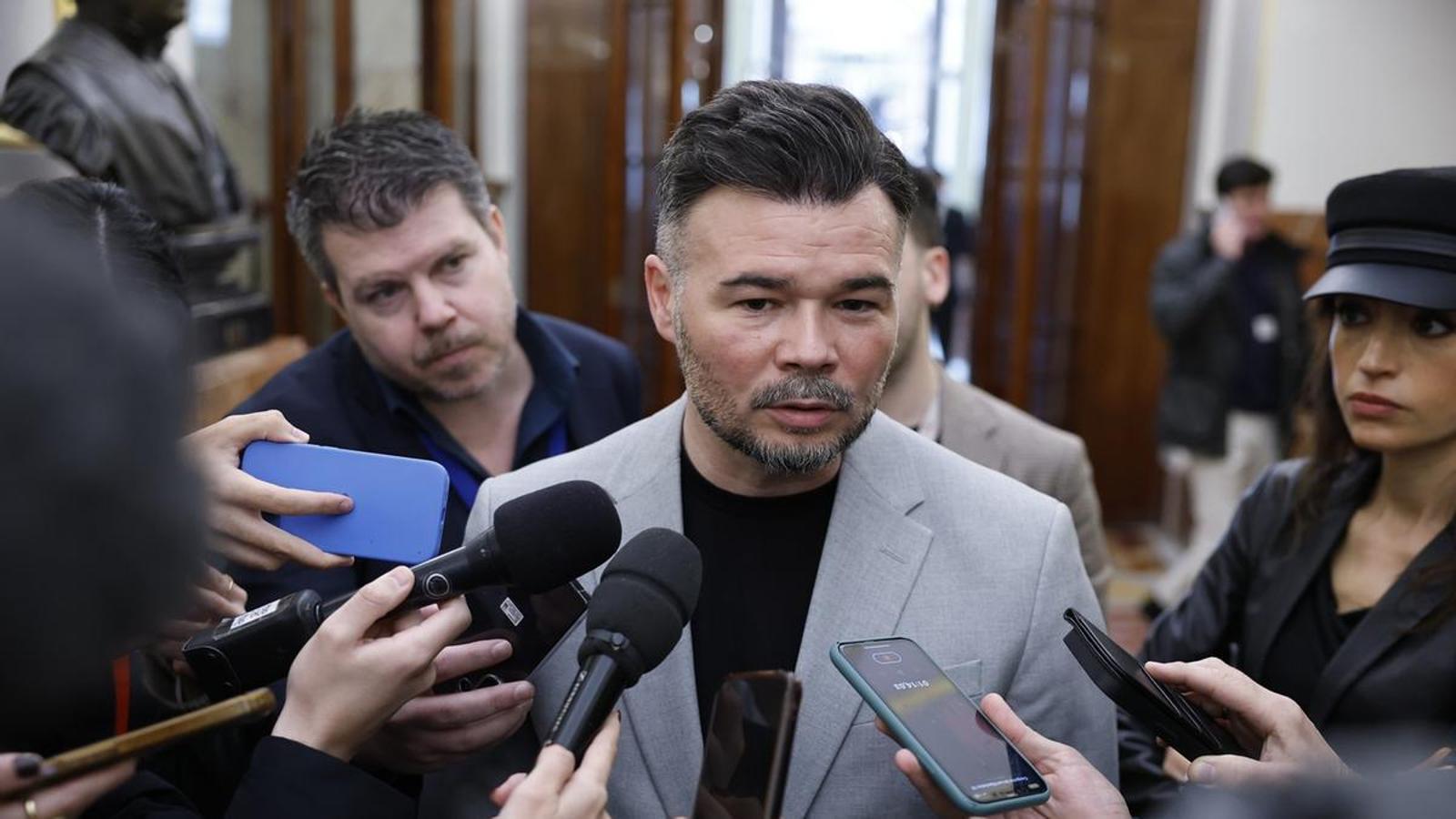

Spanish media —much more Madrid-based than Catalan— have given unprecedented prominence to the possible formation of a new unity action by the left beyond the PSOE, yet another of those unifying processes that always end in fragmentation, but this time attributing political leadership to Gabriel Rufián. The paradoxical fact that a Catalan independentist linked to ERC activated the operation has generated much intrigue in the capital, where, apparently, they have discovered great political and communicative appeal in the Catalan deputy, who has allowed himself to be courted in this new role; a new role that, because it is assumed, is not very credible. Although in the current parliamentary and political dynamics, extreme "performances" and gestures may predominate, there are many more things to consider. If it is about stunts, it is quite certain that the ERC spokesperson has a prominent place in the spotlight. Fortunately, other virtues, dimensions, and depths are still needed.Gabriel Rufián has always seemed to me like a character from Juan Marsé's novels who has learned to move very well among people who do not consider him socially one of their own. In his early days as a politician, he was a bit pathetic; he took advantage of the uniqueness of being a Spanish-speaking independentist during the Procés era, and he displayed abrupt manners and uninhibited limitations. From exotic and extemporaneous parliamentary appearances, he has moved on to more elaborate communicative performances, all while maintaining the appeal of simplicity. The Madrid media have bought into some rudeness and inappropriate remarks that have become attractive to the more or less allied left, but also to a right that finds the character amusing and, in fact, considers him a charming remnant of an already irrelevant or non-threatening independentism. He is an example of a fairly current politician: little training, scant background, has managed nothing, does not draft any bills, and in fact, does not engage in much parliamentary life beyond his prepared weekly interventions in plenary sessions and his daily tweets. A politician of post-politics, in which everything has been reduced to "media frames and shareable social media phrases. From arrogant independentism, he has moved on to cultivating a more social and left-wing discourse to increasingly please the politicians and voters of the left to the left of the PSOE and, especially, the world of Podem, a space with which he has always flirted. Let's not deceive ourselves, however. Rufián is an image, a communicative dimension, but not a leader of ERC. He has no sector behind him beyond Joan Tardà, and his dependence on and connection with Junqueras has always been absolute.No one can seriously consider an agreement of the entire non-socialist Spanish left articulated by ERC and led by Rufián. Neither Junqueras nor Rufián himself believes it, even if at some point it may have seemed that he had mimicked this role. Esquerra voters would not understand it, nor would postmodern Spanish left-wing voters. It has served to shake the tree, and if it has gone too far —as it now seems—, Junqueras can burn his acolyte as if he were a fuse, accusing him of having embarked on a personal adventure. From the beginning, this has been a major operation designed to capture the Comuns' space, to be able to accuse them of not having lived up to the unity the country required. The operation, moreover, requires that this left-wing space commit hara-kiri by boosting ERC, despite it being obvious that we are talking about electorates that have little in common in terms of political culture, especially when we move from the city of Barcelona to the interior of the country. In Esquerra, they have intended to expand their scope towards "the left," knowing that they will lose a part of the independentist voter base, whom, with their contradictions, they have driven to deposit their frustration in Silvia Orriols' party. The attempt to appropriate a progressive space that was alien to them would be completed with an image maneuver aimed at boosting Podemos in Catalonia, a minority group that still disputes territory with Comuns, hand in hand with a political figure who usually creates more aversion than sympathy, Irene Montero. In a procedure of occupying and dividing the opponent, the figure of the "defector" always plays a role, a role that seems to have been assigned to former leader Xavier Domènech, who was the most voted candidate in general elections and who cannot be assumed to lack political naivety, but who seems to want to contribute to drawing the path towards an Esquerra converted into the "big house" of the non-socialist left. Seen from the outside, it is quite surprising that some elements of Comuns seem to be playing along with this operation, thinking about the municipal elections. Perhaps I am looking at it very wrongly, but although politics can make strange bedfellows, I do not see how to reconcile the political culture of ERC with that of the alternative left, the esbarts dansaires, and the occupy movement. There are sums that do not add up.
