Lamine Yamal: the change of era will have to wait
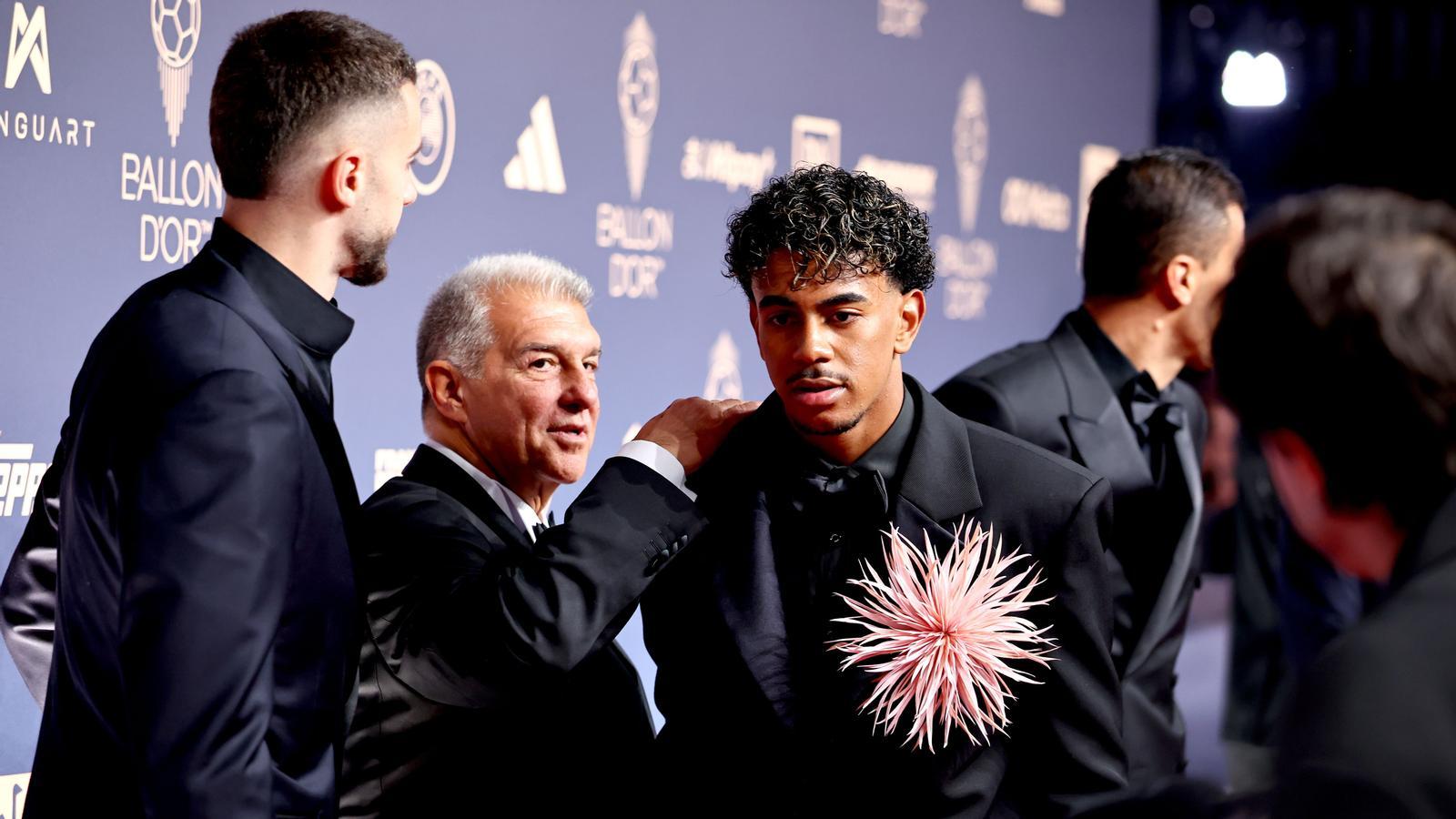

The fact that Lamine Yamal has not won the Ballon d'Or gives the feeling that it simply postpones the inevitable. We know that the award granted by France Football is always both sporting and extra-sporting at the same time, that footballing criteria are rewarded and at the same time there is room for a certain 'je ne sais quoi'. But the charm of Lamine is that when it comes to him, that 'je ne sais quoi' is the core of the matter. After a few years in which the ups and downs could be read in a prosaic key depending on whether the ball went in or not, Lamine embodies one of those cases in which an individual ceases to be just that and becomes a metaphor. The Ballon d'Or merely delays what sooner or later will end up happening.
And everything about Lamine Yamal is read through the metaphor of generational change: he is the player who best represents with the ball at his feet what his generation is doing in other areas of life. It is, above all, the feeling that something that had been slowly decaying is finally being broken. After decades in which the material conditions and future expectations of young people have become progressively leaner, yet still visible by closing one's eyes and kicking the ball forward, Lamine's generation seems to be the first to have said enough and that it will no longer try to repeat the manual of the previous one. That pass with the outside of the boot that we see when we close our eyes and think of him, so extravagant and contrary to the prudent recommendations of using the non-dominant foot, is the kind of lack of respect towards the world of yesterday that millennials never dared to stage.
The trap is that Lamine Yamal's outside-of-the-boot pass works, but perhaps the 0.01% success formula becomes a deception for the remaining 99.99%. Because the paradox of the new generation is proudly defined as harsher and more disillusioned than the previous one. In a way that contradicts everything we had taken for granted about progress, the young people who adore Lamine are championing the first anti-romantic revolution, a sort of perfect reverse of the characteristics we have associated with youth since May '68. Where there was once idealism, confidence in the future, and a will for collective emancipation, there is now pragmatism, suspicion towards promises, and the determination to save oneself without waiting for the world to be saved. In the celebrated lack of inhibition of the boys and girls—undoubtedly the word most repeated to define them—we do not know if they will bring seriousness where it has been lacking or unbridle things that were better left reined in.
As with everything in football, the change in attitude that Lamine represents is insuperably ambivalent. Using excellent Catalan, but reserving a secondary role for it, one can see that the successes of linguistic normalization are perfectly compatible with the increase of a certain banal Spanish nationalism. By saying very calculatedly that he deserves the Ballon d'Or, we see the freedom of someone who no longer asks for permission to have their own voice and the servitude of someone who must turn every word into a self-promotion campaign. With the 304 he makes with his fingers when he scores, there is the absolute certainty that the country can integrate everyone happily and multiplicatively, and the fear that doing so depends on the educational resources of La Masia, which would turn Lamine into an exception that says nothing about the norm.
We welcome the postponement of Lamine Yamal's Ballon d'Or, equally convinced that the generational change is relentless and we do not know whether to feel fear or hope.
