End of the month

"Stories make history"
Vicent Andrés Estellés
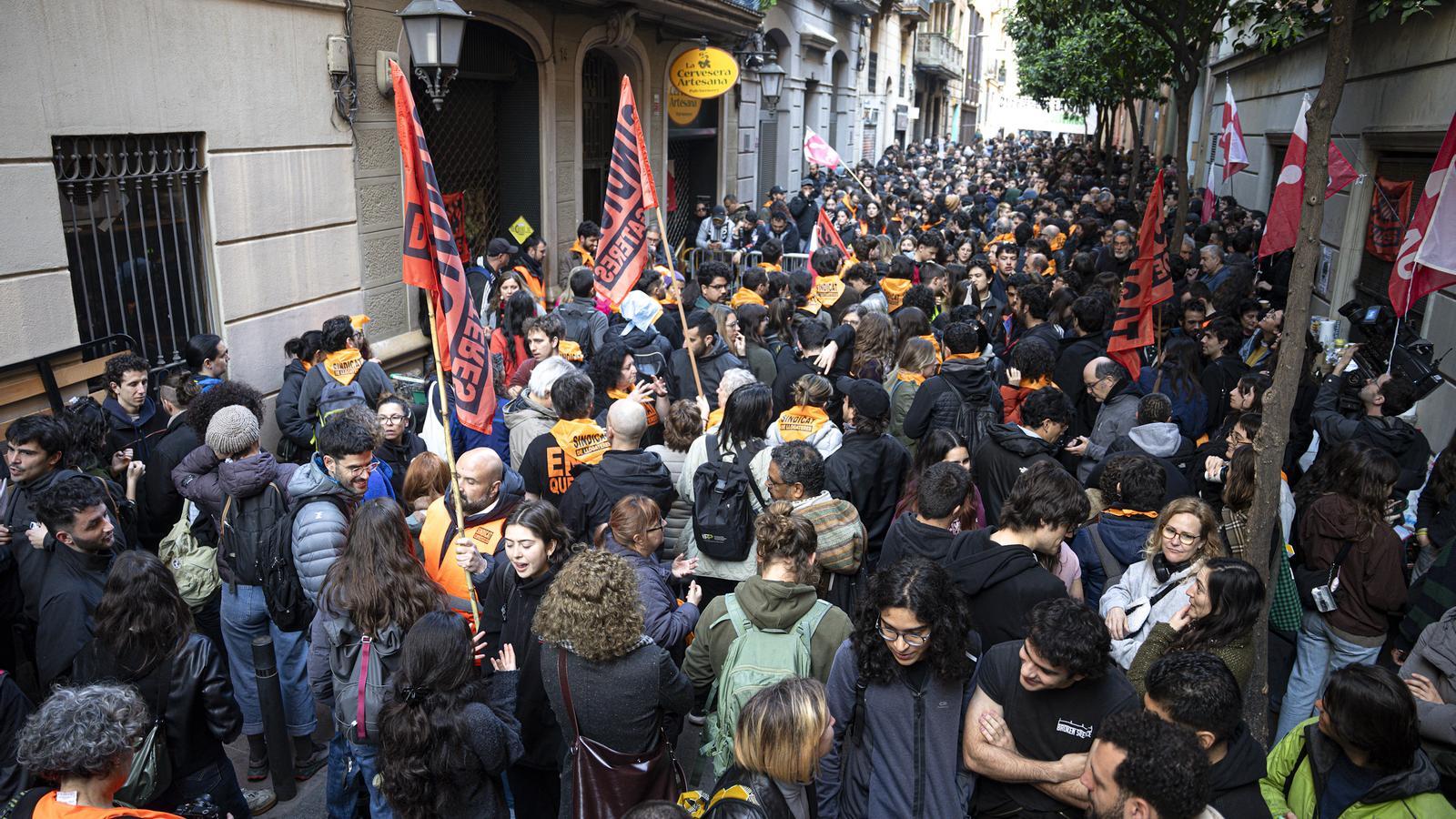
Since last Wednesday, if Txema Escorsa, 34 years old and a struggling secondary school teacher, is still in his home, at Sant Agustí street in Vila de Gràcia, it is because that day, very early, an anonymous crowd, shoulder to shoulder, prevented the judicial procession and judicial device from carrying out the task of kicking him out of his home. Everything stopped at street level and via a human wall, and this is called social unionism, civil disobedience, and community defense. The undeniable evidence clarifies, with lights and shorthand, that the eviction was only blocked by the massive mobilization of the people. That is to say, Txema was saved by the popular initiative of the Tenants Union and not by any calm and severe political, judicial, or police decision. And that the president of the Generalitat even sent a tweet of support – although it will take more than a tweet. The battle against the global market is always local and the image showed hundreds of neighbors against a foreign vulture fund located in New York, which violates and breaks current legislation and which is impudently making prohibited colivings for room rentals, to which it already charges per room much more than Txema pays for an entire apartment. Paradoxically, the main representatives of the speculators were, last Wednesday, the judge and the police – that is, the institutional system – who came to accelerate the expulsion of residents. And from here the creature cries. The judicial procession has left in writing that it will try again on April 15th. The people, undoubtedly, will too. The same day that Txema was resisting at his home thanks to active neighborhood solidarity, Barcelona City Council decided to take advantage of it to evict 130 impoverished people from a vacant lot in La Sagrera. Without any prior notice and without offering them any alternative other than to get out and disperse them throughout the city. Everything happened –words and deeds of urban eloquence, in which the name never makes the thing– under the protection of the alleged Pla Endreça and next to, wouldn't you know it, the Pont del Treball Digne, which the expelled do not have in the open. However, the Quart Món entity was there supporting them. These days a municipal campaign supposedly denounces the uncivil "scoundrels". But what is "shameful" is that the shantytown returns to the city –53 settlements with 299 people as of December 2025– and that so "little" is done to reverse it. Or that the little that is done is to drive them away to an even worse place. Scoundrels, indeed. After all, here in Barcelona as in Badalona, we should insist much more that the different management and narratives –the packaging and propaganda– in no case alter the final product: the abandonment of the kick in the backside. The effect ends up being the same, whether with Albiol's aporophobic shouting, or with Collboni's apparently sanitizing neutrality. One and the other confuse the fight against extreme poverty with the fight against the poor. And that's how we are. Thanks to all the entities involved for years in the fight for the eradication of homelessness, from the Fundació Arrels to the Hospital de Campanya of the parish of Santa Anna. A civil network that has been crying out for years for a law of transitional and urgent measures, still in infinite process and pending approval.
Also on the same day –weeks when everything comes together–, 60 associations from Badalona raised their voices demanding public policies against poverty and at the height of the contemporary challenges of the society of weariness, of the tyranny of exclusion, and of the unstoppable wheel of vital insecurity, after the death of five homeless people in the third city of the country. Stripping Albiol bare, the choice of the place where they presented a manifesto that refuses to look the other way could be neither less innocent nor more just: the parish of Our Lady of Montserrat in the Sant Crist neighborhood. Where in December it was prevented, in a brutal expression of the inhumane brutality of the moment, that the evictees from B9 could stay. Probably, on the same day –or rather, any day, any–, news, pains, and data slipped away and vanished about how the violated right to housing continues to shake the possibilities of democracy, the options for a dignified life, and the generational probabilities of calling a handful of square meters a home. The data of the bloodshed are pandemic and enormous: since the small fry of the 2009 crisis, more than 400,000 evictions have occurred in the Catalan Countries.Looking at it, feeling desperate and hopeful, the three previous paragraphs unequivocally contain an antagonistic duality amidst the times we are living in. First (a basic democratic equation to hold onto), that where there is more organized democratic community –from the Tenants' Union to the Arrels Foundation and the civic fabric of Badalona– far-right outbursts plummet. Second (totally evident), that in none of the previous calls will you ever find any far-right formations. Nor any racist discourse or classist gaze. In one nests the desire to live together in a world in crisis; in the other, the bile to kill someone, a scapegoat, as the culprit for everything. I was thinking about this last Saturday when, one among many and fortunately universally, I attended the 30th anniversary of Hamsa, one of the icons of the criminalized okupay movement in Barcelona and Catalonia in the 90s, until it was evicted in the early morning of August 4, 2004. It was an exceptional reunion, of faces and traces of decades of mutual support, of lives that have not stopped working a single day so that the mercantile inertia does not devour us. It is no coincidence that the event started with a procession from Can Vies –which still resists– to Can Batlló, a lot deserted for years now converted into an impressive community space after a long neighborhood struggle in Sants. Thirty years later, that lucid okupay anticipation that denounced the violence of real estate speculation on our lives directly connects with the latest CIS survey: it places the fear of not being able to pay rent above the fear of dying.Overview, then, of the end of March: evictions, displacements, and homeless people dead in the open. Counter-overview of each month that begins: without the Tenants' Union, without the Arrels Foundation, without social centers like l’Hamsa, it would be impossible to redo the monthly calendar, to continue being a neighborhood and to perform miracles in the besieged city. For Saint's day, then, last week: the plot of life against the trap of the market. In the uninterrupted procession of Holy Solidarity which perhaps does not make history, but by resisting it, writes another. Much more human.
