Catalonia: country of immigration, and of segregation
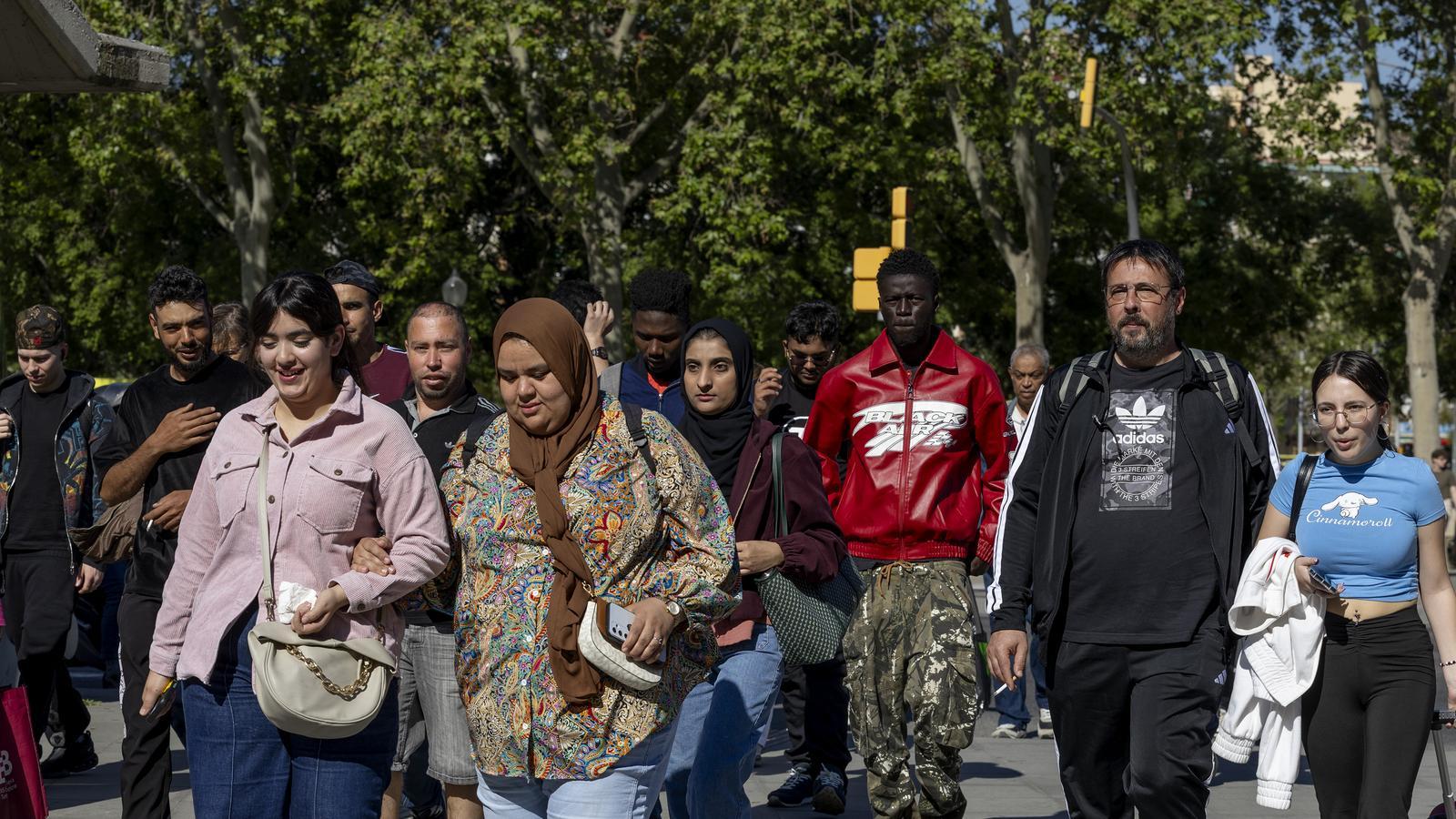

Mapping immigration in Catalonia says a lot about who we are. In the interactive published by ARA this week, the blue that colors the entire territory, in different intensities, leaves no room for doubt: we are a country of immigration. Currently, 24% of Catalans were born abroad. This percentage is comparable to that of countries like Canada and New Zealand.But we are not only a country of immigration, but we have become one very quickly. At two points: between 2000 and 2007 and, once the effects of the economic crisis had passed, from 2014 onwards. In recent years, driven by economic growth, the figures have been increasing significantly. If before the pandemic immigration contributed about 70,000 new residents annually, in recent years this figure has reached 110,000-120,000.The interactive also shows that we are a country of diverse immigration. Diverse in origin: almost half come from Latin America (44.8%) and, to a lesser extent, from Europe (22.1%), Africa (20.8%), and Asia (11.3%). The list of nationalities extends to 170, painting an exceptionally pluralistic picture. But immigration is also diverse in socioeconomic terms: in addition to people seeking a better life, Catalonia attracts many citizens from the European Union and other high-income countries, from digital nomads to multinational employees and retirees.Although it is not visible in the interactive, we are a country of young immigration. One of the differentiating features of immigrant people in Catalonia is their youth: while 88% of foreigners are between 15 and 64 years old, the percentage of nationals in the same age group is 66%. It has a double explanation: they arrive young, but, as Andreu Domingo recalls, the youngest are included in the so-called "empty generations" (like the millennials), that is, generations marked by a considerable drop in birth rates. Being a country of young immigration in a context of an aging population implies that our future is linked to theirs.We are also a country of immigration in its entirety: both in large cities and in rural areas. Unlike many European countries, the population remains diverse as we move away from large urban centers. The interactive is also very clear in this regard: Barcelona and most of the surrounding municipalities have less immigration than those in Alt Empordà, La Segarra, and other points in the regions of Girona and Lleida. The reason is basically economic: the immigrant population concentrates in places where the economic sectors in which they are overrepresented dominate, such as agriculture and the meat industry, construction, and tourism. Although immigration is distributed throughout the territory, we are a country of immigration that segregates. As the interactive shows, the foreign population concentrates in certain municipalities or neighborhoods. For example, we go from 39% in Barcelona to 7% in Matadepera, and from 87.5% in the Gothic Quarter to 24% in Sarrià-Sant Gervasi. More residential segregation, more school segregation. Therefore, although we are a country of immigration, the reality is that populations with diverse origins and socioeconomic positions do not always cross paths, neither in the streets nor in schools.As a segregating country of immigration, the immigrant population not only concentrates in certain territories but also distributes unevenly based on origin. While those born in America are represented throughout the territory, those born in Africa are the majority in Lleida and along the Transversal Axis, and those from the rest of Europe are overrepresented in municipalities like Sant Just Desvern and Esplugues de Llobregat. We have, therefore, a country where diversity manifests in different ways. While this would not necessarily be a problem in itself, it becomes one when this distribution reflects inequalities based on income.We are, therefore, undoubtedly, a country of immigration. But we run the risk of also being a fractured country if the poor are predominantly those we perceive as the “others”, if inequality (worryingly growing) coincides with origin and territory, if the place of birth determines the place we occupy in the labor market, if the origin of parents decisively conditions the school results of their children or if the concentration in certain municipalities and neighborhoods, without accompaniment and resizing of public services, makes the neighbors who have not left feel abandoned.Being a country of immigration, like the United States, Canada, Australia or New Zealand, has always been mentioned as positive. However, when the benefits are concentrated (especially in the economic sectors that depend on these workers) and the costs are socialized (especially in certain territories and social sectors), being a country of immigration in these circumstances can be a real ticking time bomb.
