Yes, go down or by the Segre river
At the Segre Gold Interpretation Centre, in Balaguer, gold is sought – and found – as it was done centuries ago.

-
CAT -
CAST
I suppose the miller's mill, in Balaguer, was called that because the person who operated it was left-handed. And I suppose that when he went to school, as a child – if he went at all – the teachers must have wanted to correct his "anomaly", without success.
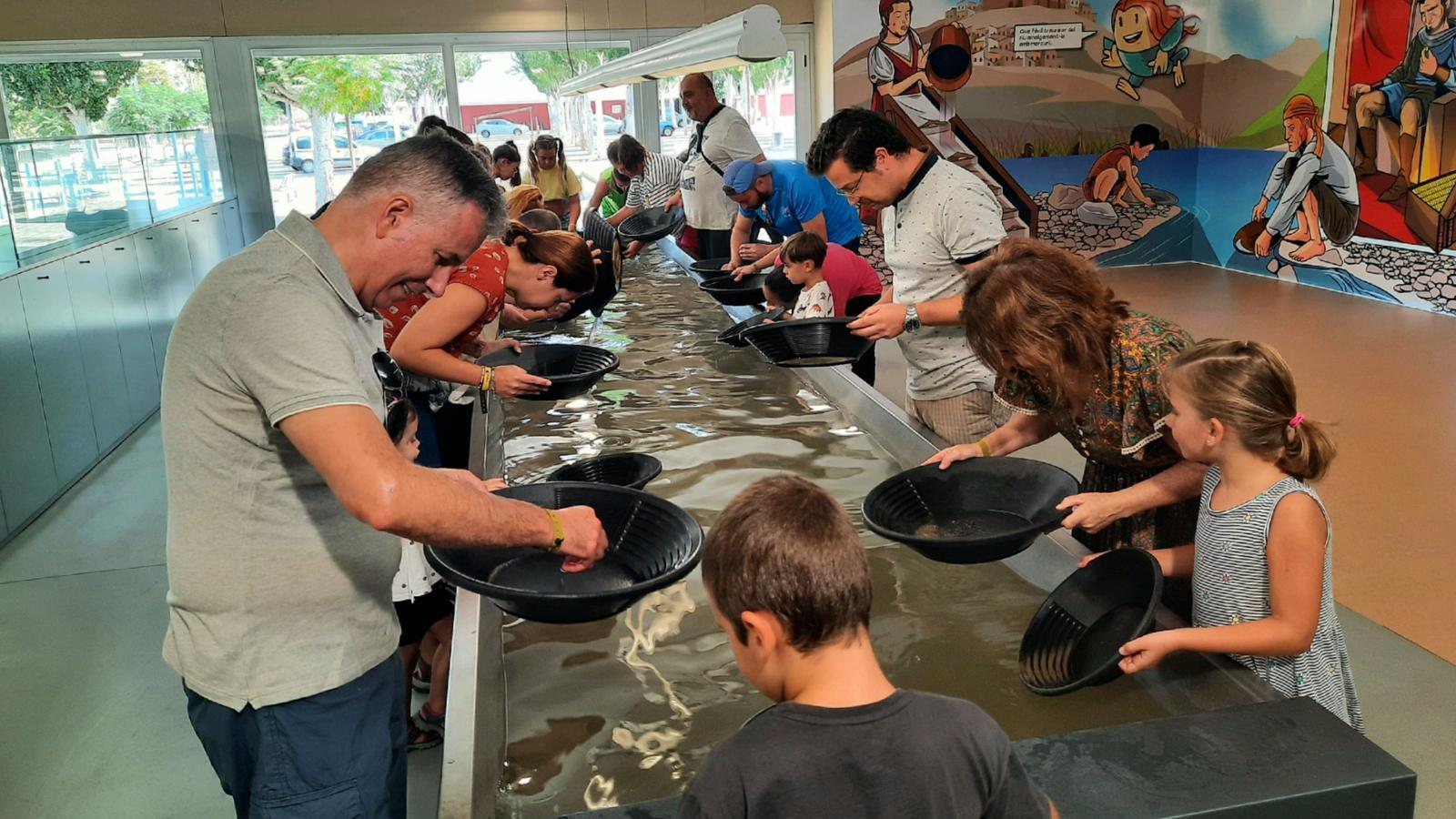
This flour mill in Balaguer, renovated in the 19th century, used the force of the water from the Segre river to move the wheel that operated the mechanism for grinding grain. It was abandoned for a few years and recently has a new use: it is the entrance to the Centre d’Interpretació de l’Or del Segre (Segre Gold Interpretation Centre). However, this centre is located in an annex building built later.Today I travel back a few centuries. Back then, Balaguer was a small and eminently rural town. The river was very important: it was the main communication route to go from the Pyrenees to the plain. Yes, it was navigable. And it wasn't easy to cross! Much more water flowed than now and floods caused by severe storms were greatly feared. The oldest bridge in Balaguer is located precisely next to the l'esquerrà mill. It is the Sant Miquel bridge, which although it has the date 1944 – it was bombed during the Civil War and rebuilt –, it is a very early infrastructure in the city. It seems that it already existed in the Andalusian era (8th-11th centuries).The Segre is a gold-bearing river: throughout its course it carries small particles of gold resulting from the erosion of the Pyrenean mountains. In calm places, these particles are deposited at the bottom of the river. As they lose speed, they go to the bottom. It is true that the reservoirs have slowed down the gold coming from the Pyrenees, but some still flows down. Mireia Subirada, head of the Centre d’Interpretació de l’Or del Segre, explains it to me, as I slowly empty a pan that I have filled with water and sand from a washbasin. The plastic pan has ribbed parts (small steps), so that the heavy minerals – black sands, they are called – are trapped there, including gold, while the sand and water return to the washbasin. I need patience: I am adding sand and water, and slowly emptying them. And finally, yes! Some gold flakes – they are called flakes, these tiny particles – remain on the ribbed side of the pan.Then I place my index finger on each particle and they stick to it. Mireia has given me a small plastic tube, where I put them. I'll take it home, with a dozen gold particles inside. This playful practice of gold panning in Balaguer, both at the interpretation center and by the river, transports me to the golden ages of gold exploitation in the Segre river. It is the star activity of the center. Indeed! Gold was sought in Catalonia. We've seen it mostly in North American films, but here it hasn't been talked about much, if at all. The search for gold in the Segre River is documented from Roman times in Cerdanya. It experienced a special intensity in the Andalusian era (8th-12th centuries), especially in the lower part of the Segre. Later, in the 16th and 17th centuries, there was another period of notable activity thanks to mercury, which is an effective amalgamator of gold. But the mercury inhalations to which the searchers were subjected caused them health problems. In parallel, large quantities of gold arrived in Spain from America – especially from Brazil – and the gold from Balaguer was no longer worth it.The activity of extracting gold from the Segre River was carried out until well into the 18th century. Practically no written or oral memory of it remains. Nevertheless, the Segre Gold Interpretation Centre has gathered a lot of information. In addition to the activity, it has created a permanent mini-exhibition.Two last curiosities. It is said that to extract 1 gram of gold, 500 tons of sand are needed. And the majority of all the gold extracted throughout all of history is still in circulation in one form or another. Perhaps the wedding ring I have before was a gold tooth, and the gold tooth before was a button on a luxury uniform, and the button on the luxury uniform was a set of coins.The numerous uses of goldThe system used to extract gold from the Segre River is not the only one in the world. For example, in Central Europe, sheepskins were submerged in water, which were then hung up to shed excess material, and the skins were left with gold flakes trapped in the wool.Gold has many "qualities". It is a good conductor of electricity, of heat, it does not oxidize (that is why it is used for astronaut helmets), it is malleable – like chewing gum, which stretches –. It is resistant, shiny, incorruptible... It is logical, then, that gold has so many uses. Since the end of the 20th century, gold has been needed in computing, telecommunications, and aviation. It is also used in medicine, gastronomy, and cosmetics, and of course, in goldsmithing and coins. "Since always" is a symbol of power and a safe haven for many investors. And in the past in works of art, in the form of gold leaf.

