What worries young people? We talk about it in the first edition of Tal Qual
Addictions at increasingly younger ages, generational exhaustion of the Tinder model and the growing lack of interest in information are the focus of the first "Tal Qual: what interests young people," a debate forum designed and organized by students from Blanquerna-URL and ARA.
-
CAT -
CAST
Designed for young people and brought to life by young people themselves, "Tal Qual: what interests young people" completely filled the Josep Rom auditorium at Blanquerna-URL, in Barcelona. This first debate forum, connected with the interests and concerns of students, brought together content creators, experts, and journalists to discuss gambling addiction, the consumption of journalistic content, and dating apps.
“At 13 or 14 years old you are the perfect target to get hooked on the game”
“At 13 or 14 years old you are the perfect target to get hooked on the game”“It is difficult for us to pay for what forces us to think”

Peer pressure and the influence of content creators promoting betting houses were central to part of the debate between Navarro and González, who appealed to the responsibility of young people themselves and their friends, but especially influencers. “They can offer you a lot of money and it’s very easy to accept it, because it’s quick money, but the problem is everything it causes afterwards”, according to Navarro.
“It costs us to pay for what forces us to think”In the panel dedicated to the cost of truth, Seró recalled that, while more than 70% of young people have subscriptions to entertainment platforms, less than 15% pay to read a newspaper. According to Jaume Radigales, music critic and collaborator of ARA, “the platform sells stimuli; information sells demands and critical capacity”. “It costs us to pay for what forces us to think, but we don’t mind spending money on constant entertainment”, he added.
The humorist and communicator Guillem Estadella championed the well-done work of professionals and wittily advised students to leave home as well-fed as informed. He also pointed out that, while informing is expensive, misinforming is almost free, “and that is a huge problem, because ‘fake news’ spreads much faster, with practically no cost or effort.” Estadella and Radigales agreed on the need to pay to access quality information and be able to discern between reality and fiction, since on networks like TikTok “a political analyst coexists with someone who says they have been abducted by aliens. All on the same level”.
To add a touch of vindictive optimism, Estadella ended up defending that, “in this world of madness that is social media, of disasters and of ‘fake news’, there is also an oasis that we must reclaim. Always scolding young people is a mistake, because there are many who see the world as it should be, critically and with reason”.
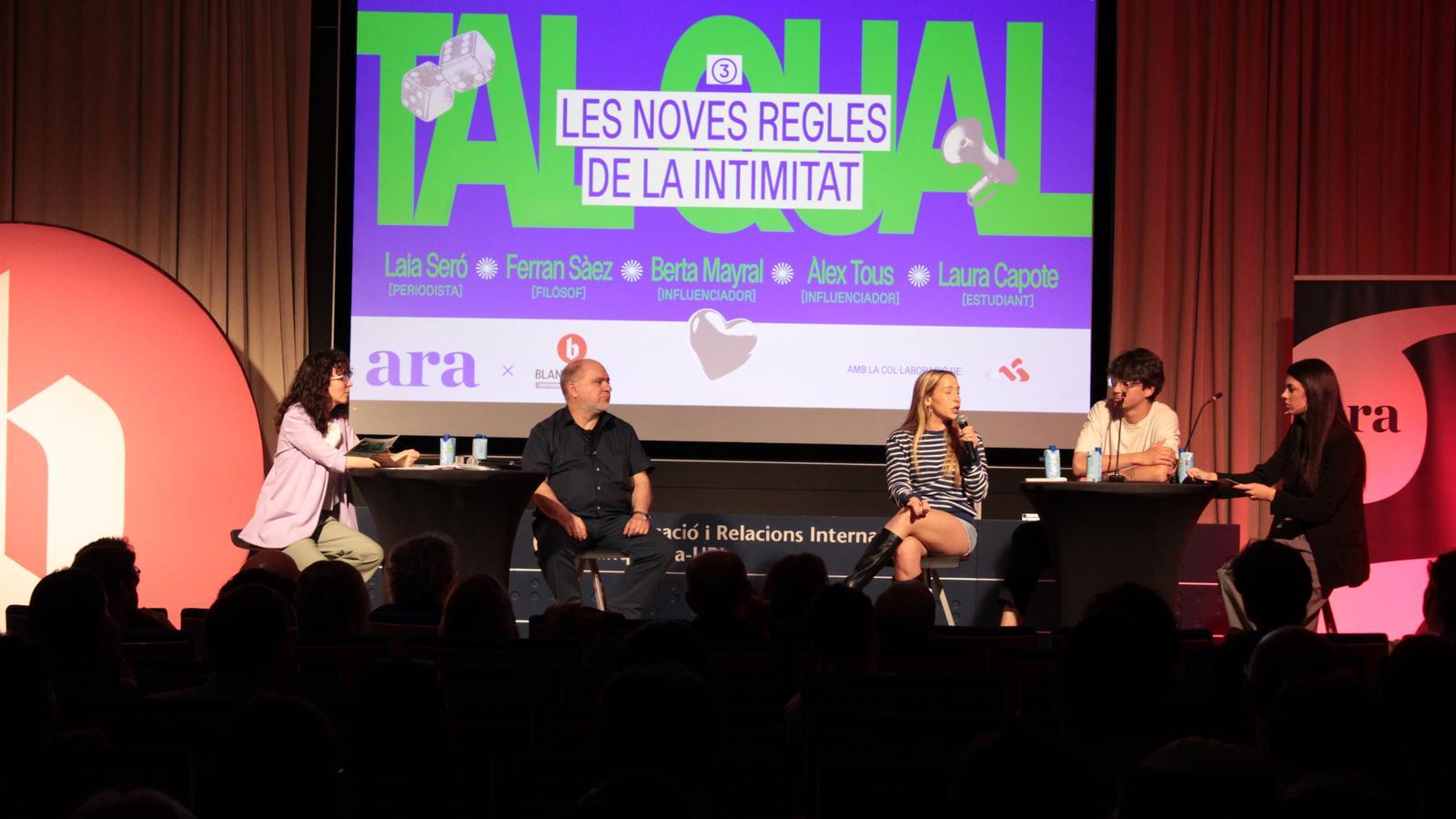
“In relationships, you always have the feeling that you can keep scrolling”The end of the party was probably the most anticipated moment for the audience. The students had prepared an original conversation between the philosopher Ferran Sáez, born in '64, and the influencers Àlex Tous and Berta Mayral, born this century. The title of the table, ‘The new rules of intimacy’, and the fact that 40% of romantic relationships start through apps were the starting point.
Mayral and Tous advocated for a return to face-to-face interaction and relationships. “If social networks disappeared, we would recover many things we are losing,” Mayral began. “People are made to connect face-to-face, body to body. Networks can bring us closer, but they are also making us lose many essential things of human relationships,” Tous pointed out. “Our grandparents bought things thinking they would last a lifetime; we constantly live with the idea that there will always be something better,” Mayral added. “You can meet a person who lives anywhere in the world and talk to them at all hours. And at the same time, you feel like you can always keep scrolling,” Tous added.
Ferran Sáez, using irony, anecdotes, and the classics, and boasting about still using a mobile phone from the 90s, not having WhatsApp, and being “out of the affective-sexual market,” assured that “the human comedy is always the same”: the forms and social spaces change, but “even if the hormone dresses in silk, it remains hormone”.
Tal Qual, the format of ARA designed for young people and created with their collaboration, allowed this seminar group from the Faculty of Communication and International Relations at Blanquerna-URL to have a first approach to the professional world and to participate from the outset in the conceptualization of the event, as well as in the choice of speakers, the graphic image development process, the creation of promotional content, scriptwriting, and the coordination of the event's development and protocol.
