The little house of the astronomer that my great-grandfather made
We visit Vil·la Urània, where Josep Comas i Solà, founder of the Fabra Observatory, lived

-
CAT -
CAST
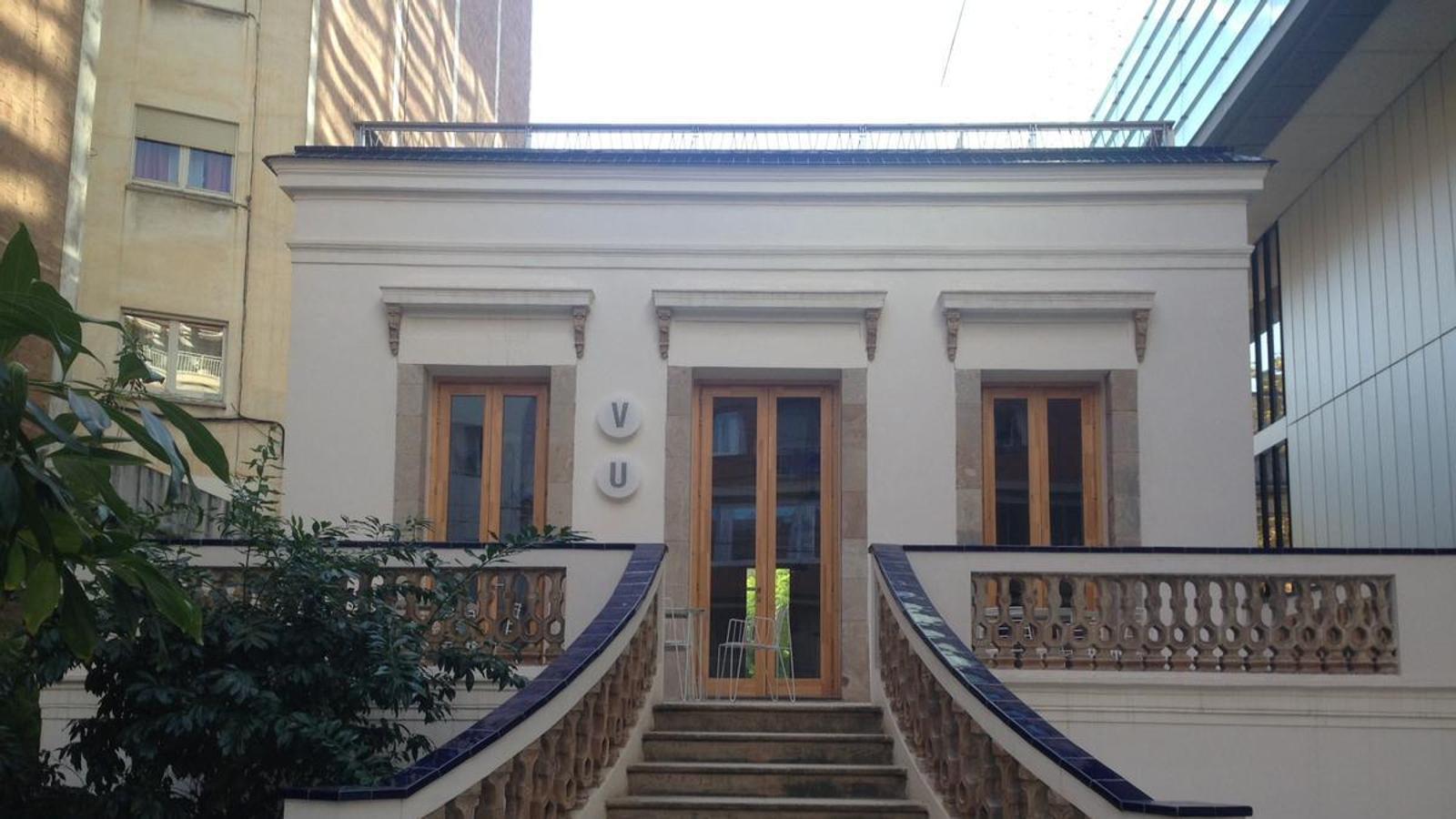
A good way to grieve is to gather memories. When, a few months ago, my father, an architect, died, rummaging through documents, I learned that the lineage of architects who preceded him was much more extensive – and notable – than was said at home.The lineage has ended (for now). None of the seven siblings have dedicated themselves to architecture. The industrial engineers lineage on my mother's side (Cornet) has also become extinct, one of whom directed the Maquinista Terrestre i Marítima.Among the buildings preserved from the lineage of architects of my father, Vil·la Urània stands out, the work of my great-grandfather Magí Rius (grandfather of my grandfather, Magí Romaní Rius). Magí Rius Mulet built it when he was thirty years old. He had not yet reached his professional peak.Vil·la Urània is one of the oldest and most beautiful houses in the Barcelona neighborhood of Farró. It is single-story and slightly elevated (to access it, you have to climb eight steps), which gives it a temple-like air. It has a few ornamental details in the neoclassical style. It was built in 1868 – the year of the Glorious Revolution–, precisely the date on which Josep Comas i Solà was born: I will tell you about it now. The house was commissioned to Magí Rius, Comas i Solà's father, but he lived there for a short time because he died young. His son, the astronomer, inherited it and named it Vil·la Urània, in honor of the muse of astronomy. He lived there until his death, in 1937.I visit Vil·la Urània accompanied by Ricard Martínez, a great astronomy enthusiast, who presided over Aster, Barcelona Astronomical Association, for a few years. "As a child, Comas i Solà already looked at the sky. His hobby became his profession. He did good work on the planets Jupiter, Saturn, and Mars (he thought he had observed a volcanic eruption on Mars; we now know it was a dust storm). He had an enormous capacity for work. He took many photographs, and where photography couldn't reach, he made drawings," says Ricard. And he adds, with a smile: "There are astronomers who have been terrible drawers"."He was very keen on looking through the telescope from the roof of this house, where he spent hours and hours. He made several discoveries: eleven asteroids – including Hispània – two comets...", details Ricard, while we have a coffee at Vil·la Urània. It is now a café-restaurant. "He had a great capacity for communication. He gave many lectures and often appeared on the radio. Before graduating in physical-mathematical sciences, he was already collaborating with La Vanguardia –l’ARA did not exist yet–. He wrote for the Godó newspaper regularly throughout his life. He also published articles in numerous foreign magazines. And he promoted the so-called Festes del Sol (Sun Festivals), which have been revived at Vil·la Urània."

Comas i Solà was hired at the newly built Catalan Observatory, which Rafael Patxot had in Sant Feliu de Guíxols. There he fell in love with his sister, Teresa Patxot, whom he married and settled here, in Vil·la Urània. But their life together was not heavenly at all. The legalization of divorce during the Second Spanish Republic allowed him to formalize his relationship with his second wife, Amèlia Sala, after the breakdown of his first marriage. When the war broke out, he was appointed director of the Generalitat's Astronomy Service.Previously, Comas i Solà founded and was the first director of the Fabra Observatory – not only astronomical, but also meteorological and seismic. He opened the observatory's doors to everyone: associations of all kinds, authorities... and also to the working classes. He had a great connection with the working world. Indeed, he joined the CNT.We say goodbye on the entrance staircase to the house, flanked by lions (smaller than those of the Congress of Deputies in Madrid). How lucky that the building has been preserved! No, the stars did not conspire to save it from demolition: it was popular mobilization. And it is also commendable that a little garden has been maintained on both sides of the house, on Via Augusta and Saragossa street (although there used to be much more). Another reason to go there: next door there is an active civic center – which organizes a lot of astronomy activities – where you will find an exhibition that reviews the impressive career of Comas i Solà.He had no descendants, our protagonist, and he left it written that Vil·la Urània should pass to the City Council when his wife and his wife's sister, who also lived with him, died – how easy it was to spread the rumor that Comas i Solà "was involved" with both of them.But when the sisters died – months apart – the house was left locked. It was a very tempting place for squatters: they felt quite at home there. It also housed a cultural institution and a nursery school. A large part of the astronomer's documentation and material that was at Vil·la Urània was disseminated and lost. Fortunately, its most valuable object, the telescope, has been preserved, and it is now located at the Fabra Observatory."I didn't want Spain to hit rock bottom in science"
"After the loss of the colonies, at the end of the 19th century, Spain fell into a depression. Comas i Solà did not want Spain to hit rock bottom in the scientific field. This is what Santiago Ramón y Cajal also thought. The research and dissemination work of the astronomer and the doctor must be understood in this context and in this shared concern," assures Ricard Martínez.

