The Carraixali: the singular Carnival of Alghero
A celebration between childish revelry and the ancient rhythms of the island of Sardinia
GironaFar from the Principality of Catalonia, there is an island territory where the Catalan language and the feeling of belonging make it feel surprisingly close: l'Alguer. This city, incorporated into the Crown of Aragon in the 14th century, still preserves a living variant of Catalan today. There, identity beats strongly, sustained by words, traditions, and celebrations that are passed down from generation to generation. Festivals, like languages, are mirrors in which people rediscover that version of themselves that endures over time.
With the arrival of Carnival, a dual soul –between past and present– becomes especially visible and takes shape in Lo Carraixali, the Algueresos Carnival. It is a colorful and uninhibited celebration that unfolds a complex tapestry of traditions, influences, and cultural continuities that explain the richness of this territory and the need to display it.
In l'Alguer, with Lo Carraixali, the city adorns itself. Schools are filled with colorful fabrics, and children go out to have a good time. But within this luminous festival, dedicated to the youngest members of the household, everything can be turned upside down in an instant: the moment when the carnival of ancient Sardinia makes its presence felt with all its might.
A primeval voice from ancient Sardinia
The traditional Sardinian Carnival is a celebration with agropastoral roots that begins in mid-January, with the bonfires of Sant Antoni, when fire lights up the squares and crossroads of the inland villages. The flame purifies, illuminates the winter night, and announces a new cycle. Unlike other versions of this festival, the Sardinian Carnival retains an almost primeval ritual dimension, closely linked to fertility cults, the connection with nature, and the symbolic struggle between good and evil.
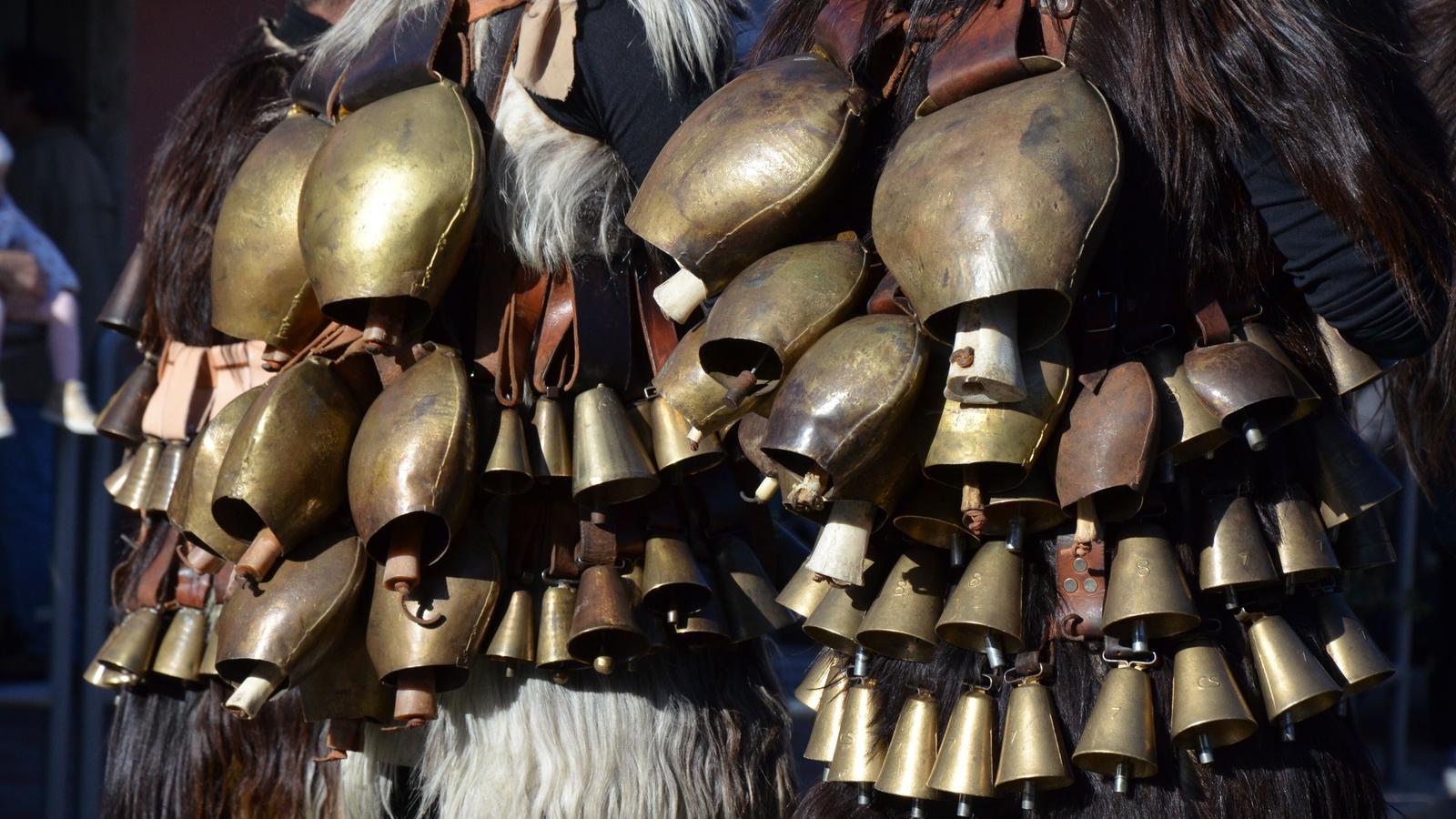
In the heart of the island, figures that seem to emerge from a mythical time survive: Mamuthones, Tintinnatos, Colonganos, s'Urtzu, or even Tumbarinos. Bodies covered in skins, heavy horns and bells; faces hidden behind black wooden masks or dyed with dark pigments. As they advance, the metallic sound resonates like an approaching storm, marking the deep rhythm of the drums. They are authentic emblems of a symbolic universe in which chaos and order, the freezing winter and the rebirth of spring intertwine.
This telluric and dense world reaches the locality through the Carnevale delle Borgate. The festival opens, every year, the streets of the neighboring urban centers of L'Alguer to traditional groups from the interior. The celebration keeps intact the most hidden meaning of the Sardinian Carnival and, at the same time, puts it in dialogue with the modernity of more dazzling costumes.

The children's heart of the carnival
If the Carnevale delle Borgate provides depth and genesis, the radiant heart of Lo Carraixali continues to be the children's carnival. Alghero has justly earned the title of the city of Children's Carnival: here childhood is the vital center of the festival. For weeks, schools transform into workshops of imagination, in which costumes, parades, and choreographies are born from the complicity between teachers and families. When the streets fill up, they become a stage where thousands of children celebrate fantasy with disarming naturalness.
The culmination of Carnival arrives with the pentolaccia, the playful farewell ritual. The square fills with music and laughter: children and their families sing, dance, and wait for the piñata suspended in the air to burst in a sweet rain of sweets. The protagonist is the old Cià Nica Manca – the queen of Carnival –, who humorously recounts a local version of the play "La giara", by Luigi Pirandello, turning the show into a completely Algherese tale. Some hands still tremble with impatience, and when the piñata gives way, shouts of joy spread through the streets like the last explosion of winter. It is a simple gesture and, at the same time, full of meaning: the children's revelry before the Lenten silence, a unique way to say goodbye to Carnival.
Between Sardinian roots and Catalan echoes
Lo Carraixali of l’Alguer is a living heartbeat that brings together ancestral roots and modern impulses. On the one hand, there is the oldest Sardinia, with masks and rhythms that evoke the relationship with the land and primitive rites; on the other, the city celebrates the festival through children, with laughter, colors, and imagination that project the spirit of Carnival.
This double pole, ancestral and contemporary, takes on its full meaning within the broader framework of Catalan culture: extensive and diverse, with territories that bring unique nuances that enrich the whole. L’Alguer is an eloquent example: a city with a Catalan soul on Sardinian land, where traditions evolve without losing the spark of their origin.
Perhaps the strength of this culture lies precisely here: in the ability to preserve essential memory while dialoguing with other worlds, without dissolving. In L’Alguer, between the echo of the cowbells and the laughter of the children, Carnival reminds us of this every year with a naturalness that needs no proclamation.

