Mar Reguant: "People are discovering that going to school by bike is faster than by car"
Energy economist
-
CAT -
CAST
Bellaterra / Sant Cugat del VallèsEight months pregnant, Mar Reguant (Súria, Bages, 1984) took her bicycle to buy her first electric car. She already had a daughter, lived on the outskirts of Chicago, and got around by pedaling alone, but she was soon to be a mother for the second time, and a big snowfall was predicted. “The car was very small and had a maximum range of 100 kilometers,” she recalls. When she returned from the United States after the pandemic, she moved to a development in Bellaterra with her two young children. And unlike her neighbors, for a year and a half she also lived without a car. “Now I think about it and I don't know how we did it – she explains, laughing –. The children were very young and it shows that it can be done, but sometimes activism weighs us down a bit.”
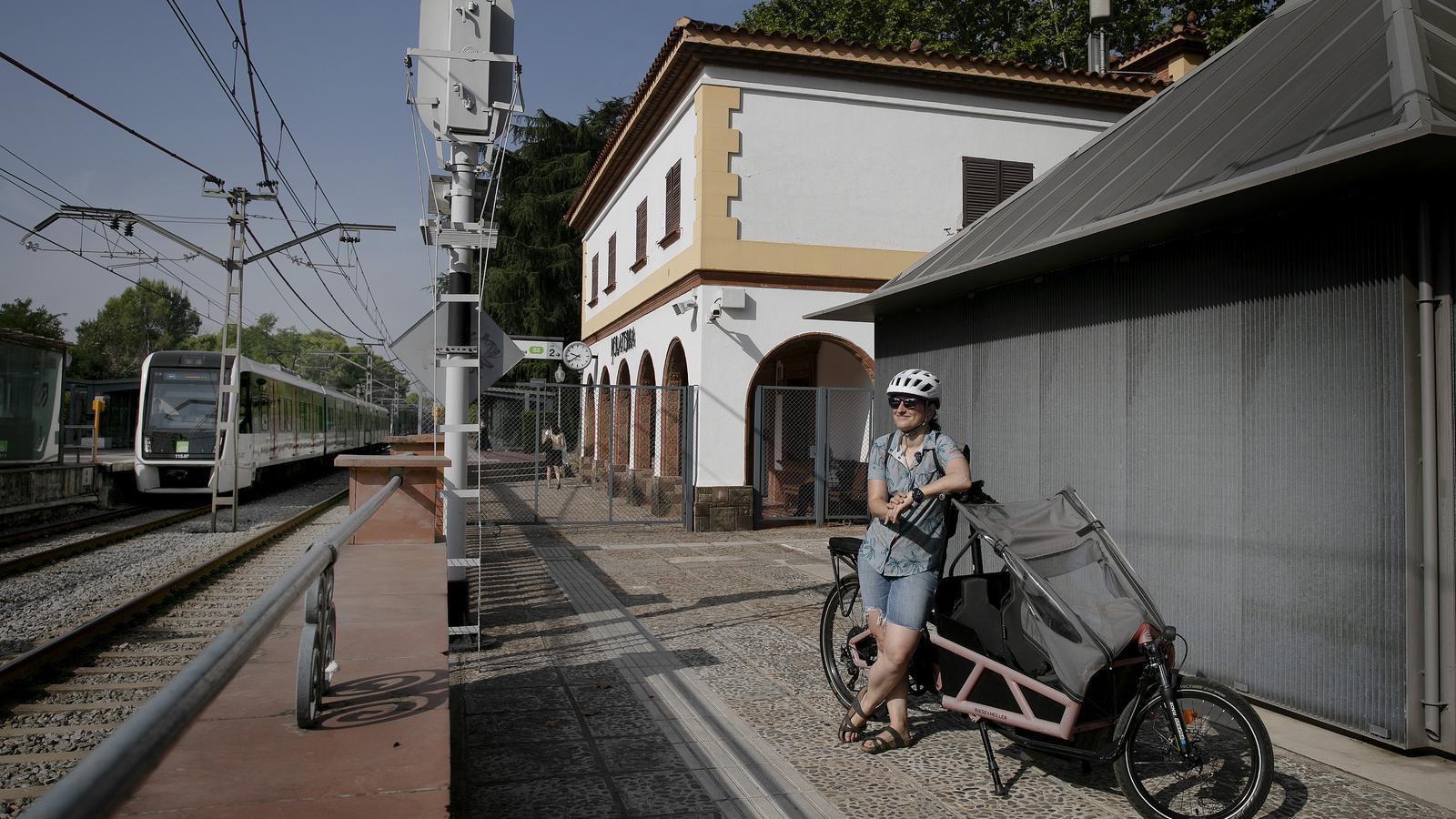
Her garage is a collection of all sorts of bicycles, most of them electric to tackle the ups and downs of where she lives. She has a cargo bike with a basket in the front, another longtail where people can also sit in the back, and two individual models. “If you recommend cycling but don't know what it costs, the difficulties, or the shortcomings, you lack credibility,” she says. In fact, the bicycles are just one more ingredient in a home that has become a laboratory for the way of life she has advocated since she was very young: “I try to experiment [...] because then I have direct experience of the things I recommend and a bit of credibility.”
Reguant, a scientific researcher at Icrea (Catalan Institution for Research and Advanced Studies), is an energy economist. When she obtained her doctorate fifteen years ago at the Massachusetts Institute of Technology (MIT), she recalls that climate change activists were called tree-huggers and that she was a “stressed person.” Now, after the accumulation of natural disasters, she acknowledges that her job consists of making others “less stressed,” by highlighting small changes such as making sustainable energy cheaper and more accessible. “I research renewable energies and climate change policies,” she says. At home, she puts it into practice by having an autonomous home: with solar panels, batteries, and an electric car. “We keep experimenting, partly because we can afford it,” she justifies.
In her daily life, the bicycle has become a way of living life in a “more relaxed” manner while still being able to get everywhere in less time. “People are discovering that cycling to school is faster than going by car,” she argues about the increase in sustainable mobility in her school environment. Today we met at half past eight in the morning to cycle and chat during a morning of family errands. She takes her children on a cargo bike to two different summer camps, one in Bellaterra and another in Sant Cugat del Vallès, and then we ride a good part of the way to the bike parking at the Bellaterra station of Ferrocarrils de la Generalitat de Catalunya (FGC) to catch the train to Barcelona when she has meetings.

The bicitancat is a spacious parking area, with an electric entrance door and another for exit, where you can park your large bicycle well. Reguant vehemently defends this secure parking model that accepts all types of bicycles and scooters. "It works very well for me. For a while, I used a foldable electric bike that I took on the train. But the truth is that bikes take up a lot of space on the train and you can't fit them on Ferrocarrils anymore. And now what I do is park at the bicitancat and then take the Bicing in Barcelona. So, I do three different types of mobility: bike, train, and bike again, but a public bike. And it works quite well for me. It's often the fastest way I can do it.
A tool for empowerment
For Reguant, the bicycle is much more than an alternative to the car. “It is a revolutionary decarbonization tool” in a context where there are still “an absolutely economically inefficient amount of travel”. In his opinion, the electric bicycle has also expanded the possibilities of those who can pedal, becoming “a new empowerment tool”. That is why he believes that betting on it from public policies is also a way to reduce inequalities.
It is a view that he also applies to his children. Reguant started cycling alone through Súria in primary school, with his sister, to be able to go to extracurricular activities without depending on his parents. Now he believes that this same independence should be able to reach adolescents. He advocates for building safe bike lanes to cycle independently, without parents.
- From your first memories on a bike? In primary school, as my sister and I liked to do many extracurricular activities and our parents couldn't take us to all of them, we said: we'll take ourselves there!
- How would you define cycling? It's the most efficient means of transport.
- What has it taught you? To live a more relaxed life. Because you can do many things, but you can do them differently. Living with limitations, but with great potential.
- And professionally? I experiment with what I preach to have credibility.

