In Vilalba dels Arcs are found the first parchments in Hebrew of the Terres de l'Ebre
The parchments had been reused to bind study books from the 16th and 17th centuries and were in a medieval house
-
CAT -
CAST
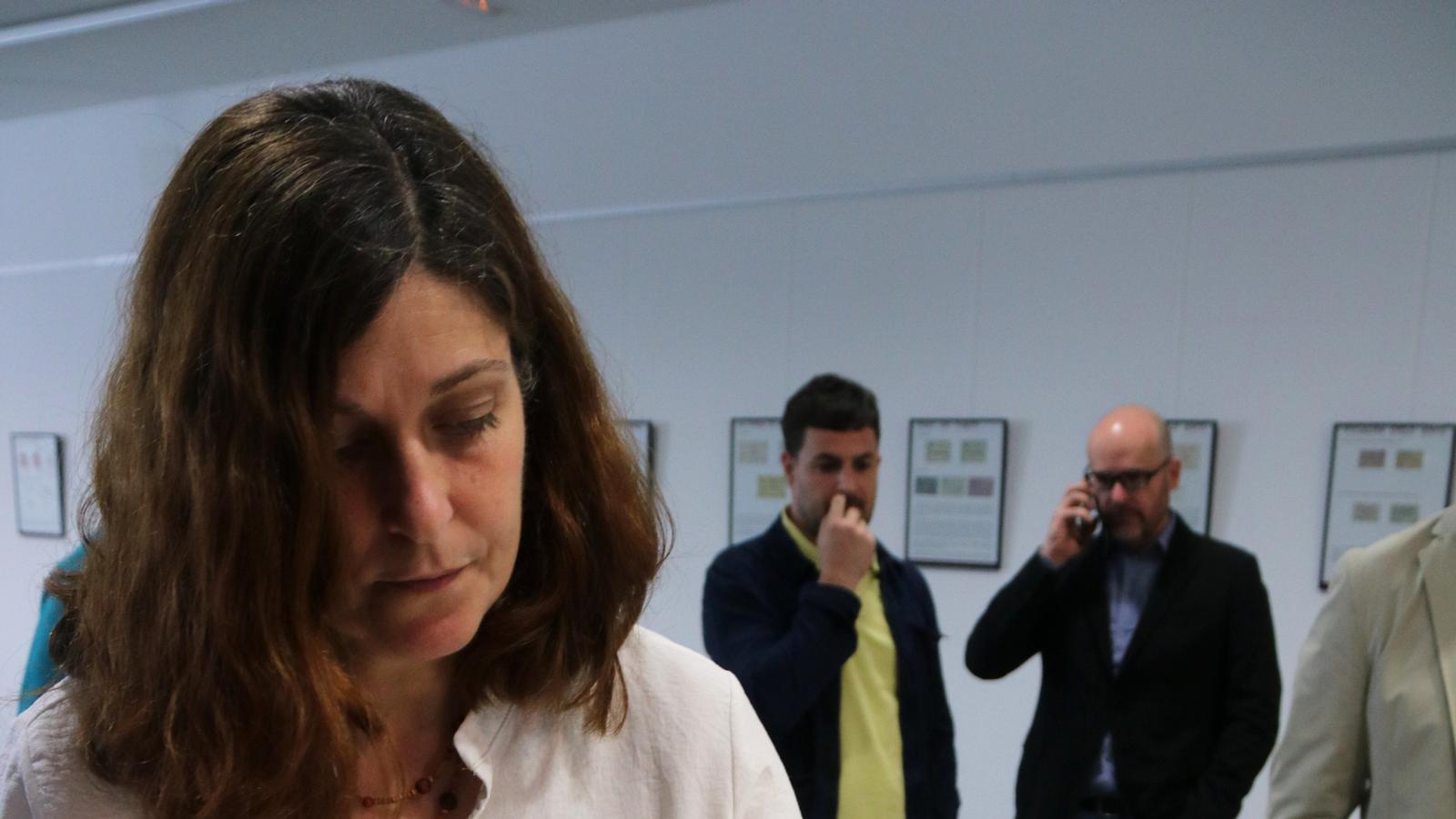
Barcelona"Discovering these Hebrew fragments has been one of those wonderful coincidences," says Laura Tienda, director of the Terra Alta Regional Archive. They are the first parchments in the Hebrew language found in the Terres de l'Ebre and were in Casa Coll, an imposing building of medieval origin located in the historic center of Vilalba dels Arcs, on the corner between Carrer Major and Carrer del Call. The house belonged to the same family until recently and has a very long history: it served as headquarters for the Carlist general Ramon Cabrera during the 19th century and suffered severe damage during the Civil War.
Last year, the council bought it, and it was the restorer and conservator Llum Cubells and Albert Julià, from the Center for Ebro Battle Studies, who noticed some books on one of the shelves while restoring some costumes. As there was a risk that they would be lost forever due to humidity and lack of preservation, Tienda initiated the procedures with the owner of the documentation, Joaquim Ferrer de Ucelay, to manage their accession. Thanks to the mediation of the Gandesa City Council, on May 30, 2024, the donation of 33 volumes, named the Casa Coll fund, was formalized.
It was during the review at the archive that the surprise occurred. When analyzing the covers of two study books from the 16th and 17th centuries, they saw that the binding hid an unusual script. "There was a volume with writing in a strange script. We immediately saw that it was not Latin and we began to find many similarities with Hebrew characters. Quickly, we contacted experts like Professor José Ramón Ayaso from the University of Granada to confirm it, and he told us that the fragments needed to be extracted for analysis," details Tienda.
Fragments from the Book of Leviticus
Once recovered, the parchments turned out to be consecutive fragments of a Torah scroll from the late 14th or early 15th century, specifically from the book of Leviticus (from 18:26 to 26:14). "The fragments contain passages about the orders God gave Moses regarding holiness, sexual morality, and the purity of priests. In addition, they preserve a small mark indicating the beginning of the parashah, the weekly portion read every Sabbath in the synagogue," says Irene Llop, medievalist, professor at UVic-UCC, and a graduate in Hebrew philology. Among other things, God details to Moses how the senior priests must educate the young priests and lists the calendar of sacred festivals and the laws of the sabbatical and jubilee years.
Reusing old parchments was a common practice among bookbinders of that era, and according to experts, the Torah parchment was a material of excellent quality, making it a coveted object of plunder. There is no clear answer as to how the Torah scrolls ended up in the covers of De anima, de generatione, de caelo by friar Antoni Linaris (1569) and Totius dialectica explicatio (a treatise on logic and dialectics from 1628 used for university study in Tortosa). Both books have a Latin inscription on the first page indicating they belonged to Petri Bernard Coll.
, and the parchments have been deposited at the Archive of Gandesa.The route of the Jewish exile
The medievalist emphasizes that, although similar fragments have been preserved in Girona, Vic, Barcelona, or Montserrat, in the Terres de l'Ebre the physical evidence was almost non-existent. Furthermore, there are no other copies anywhere of this specific fragment of the Torah. In fact, regarding the presence of the Jewish community in the Terres de l'Ebre, there are only some Christian documents relating, as Llop explains, to the permits requested by the Jewish community to build synagogues in Tortosa and Móra d’Ebre. In Tortosa, the only physical evidence consists of two funerary tombstones that can be seen in the cathedral and in the Torre del Rastre.
Unlike other places, however, there is no physical trace of these synagogues. They were scrolls and, therefore, could only belong to a synagogue or an oratory in a nearby town or in Vilalba dels Arcs itself. Llop also does not rule out that they were scrolls that a converted Jew might have hidden after the expulsion of the Jews. "The Terres de l'Ebre have a very interesting Jewish history and, on the other hand, it is very little exploited. Discoveries like this must undoubtedly help to promote the knowledge of Judaism in this territory, where there are still many unknowns to be resolved," he assures.
The Alhambra Decree, signed by the Catholic Monarchs on March 31, 1492, gave an irreversible deadline: by July 31, all Jews had to have left the kingdom or converted to baptism. A significant part of the Jews decided to stay in exchange for converting to Christianity. Those who remained faithful to their faith left, and Tortosa became a monumental bottleneck. As land transport was expensive and dangerous, thousands of Jews from the Crown of Aragon chartered barges to go downriver. The river journey ended in Tortosa, where they had to pay transit taxes to the local authorities and stay temporarily in the Call (Remolins). Afterwards, they had to embark at the port of l'Ampolla. In mid-July 1492, an immense human caravan walked the route from Tortosa to l'Ampolla. There, large ships (many of which were Genoese) awaited them to begin the journey of exile. The Hebrew fragments that have been located and restored can be consulted openly through the Online Archives website, and the parchments have been deposited at the Archive of Gandesa.
