The useless survey of La Sexta "for Book Day"
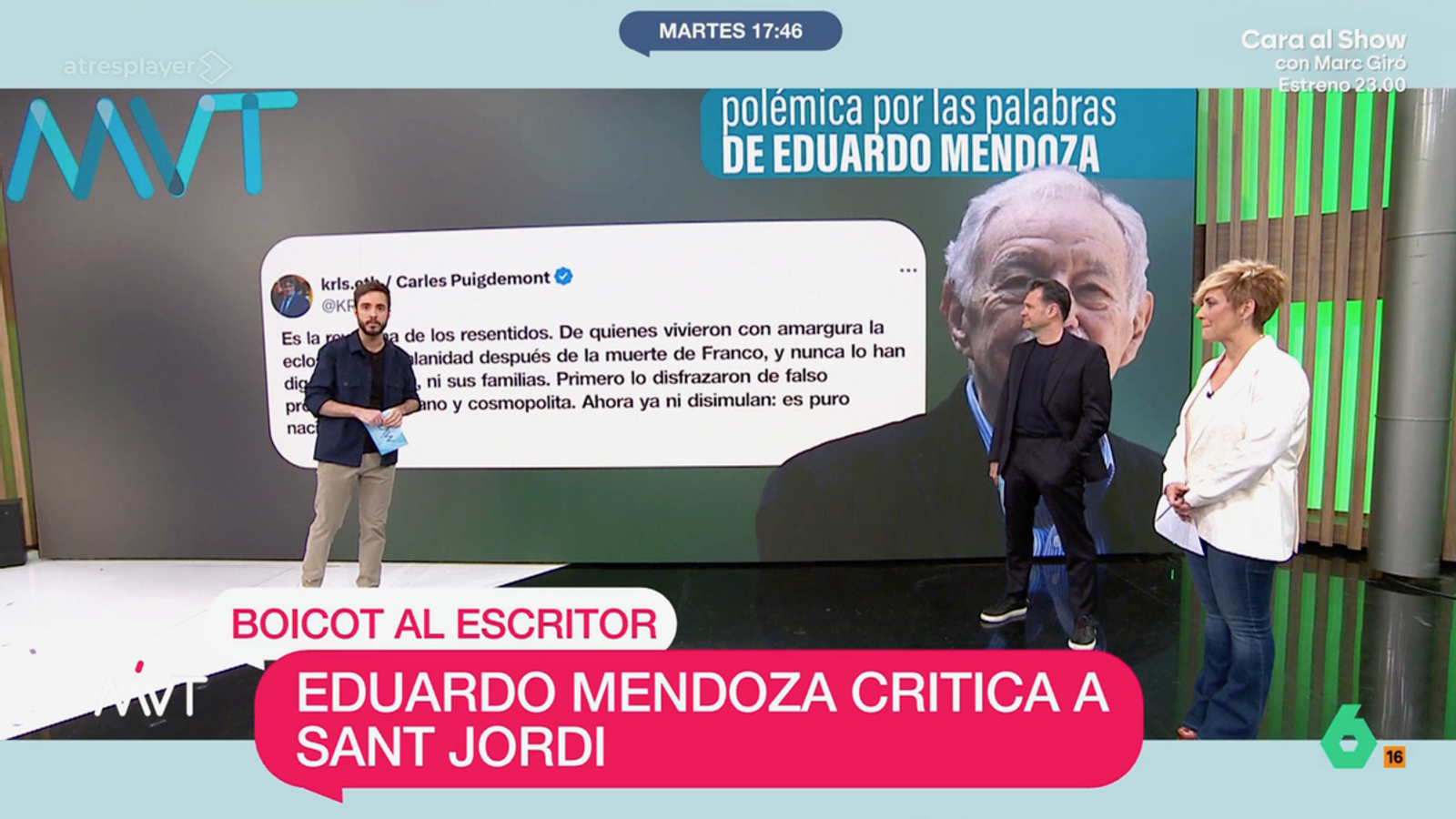

This Tuesday, the program Más vale tarde on La Sexta lived up to the program's title. Suspiciously, they collected, a week late, the statements by Eduardo Mendoza disowning Sant Jordi and calling for 'Dia del Llibre' as the name for the day. Two days before the celebration, they thought it more opportune to revive the controversy. They haven't been the only ones. Other Spanish media outlets waited until the eve of Sant Jordi to turn it into news that had ruined the celebration. Saying it “makes Sant Jordi rare”, or it “stirs up” Sant Jordi, as if in Catalonia we were throwing plates at each other in the middle of the celebration.A Better late than never, after commenting on the health status of the bullfighter Morante de la Puebla, who was gored, Iñaki López made a simile with the writer: “A very hard tumble too, but much less bloody, is the one Eduardo Mendoza has taken...”. They turned Mendoza into the victim of the Catalans' anger. “Things got complicated”, “You don't know what a mess it's become”, “He must have really had it coming”, the presenters pointed out before continuing to explain the news. The program's editor explained how the writer had tried to rectify by tweeting on social media that it was a joke, a comment that the editor interpreted and defined as “an apology”. The program regretted that, even so, the writer had received criticism, and focused on a tweet by Carles Puigdemont. They turned the events into a political issue. To demonstrate it, they conducted the classic useless street survey to show that in Catalonia there are opinions for everything when it comes to choosing between Saint George's Day and Book Day: “¿What do they think in Barcelona?”. They interviewed four people. Three ladies and one gentleman. The man declared himself against Mendoza's statements and the first woman dismissed it by arguing that it was the writer's typical sense of humor. The second suspected if the author's comment hid an interest in selling more books and the last one claimed Saint George's Day and Book Day from a perfect equidistance. To collect the survey, the presenter Cristina Pardo added with a certain tone of arrogance: “¡And it is that free opinions, always, yes!”There are four aspects of this television treatment that should be highlighted. The first, postponing the controversy for a week to move it to the eve of Saint George's Day. The second, turning Eduardo Mendoza into a victim. The third, showing four responses from people on the street, very varied, as representatives of a very undefined and disparate popular positioning. The fourth is very subtle: the presenter, with a certain arrogance, claimed free opinions as if at some point someone had lost their freedom to opine. Mendoza had it to express himself and whoever wanted it had it to react. It is curious this use of the word freedom as if it only belonged to a few. And, above all, to reproach the popular or identity-based outcry as an example of coercion to freedom.
