Silvia Omedes: “The photo of the starving African child, with the snot and the flies no longer works”
Cultural manager and director of Photographic Social Vision
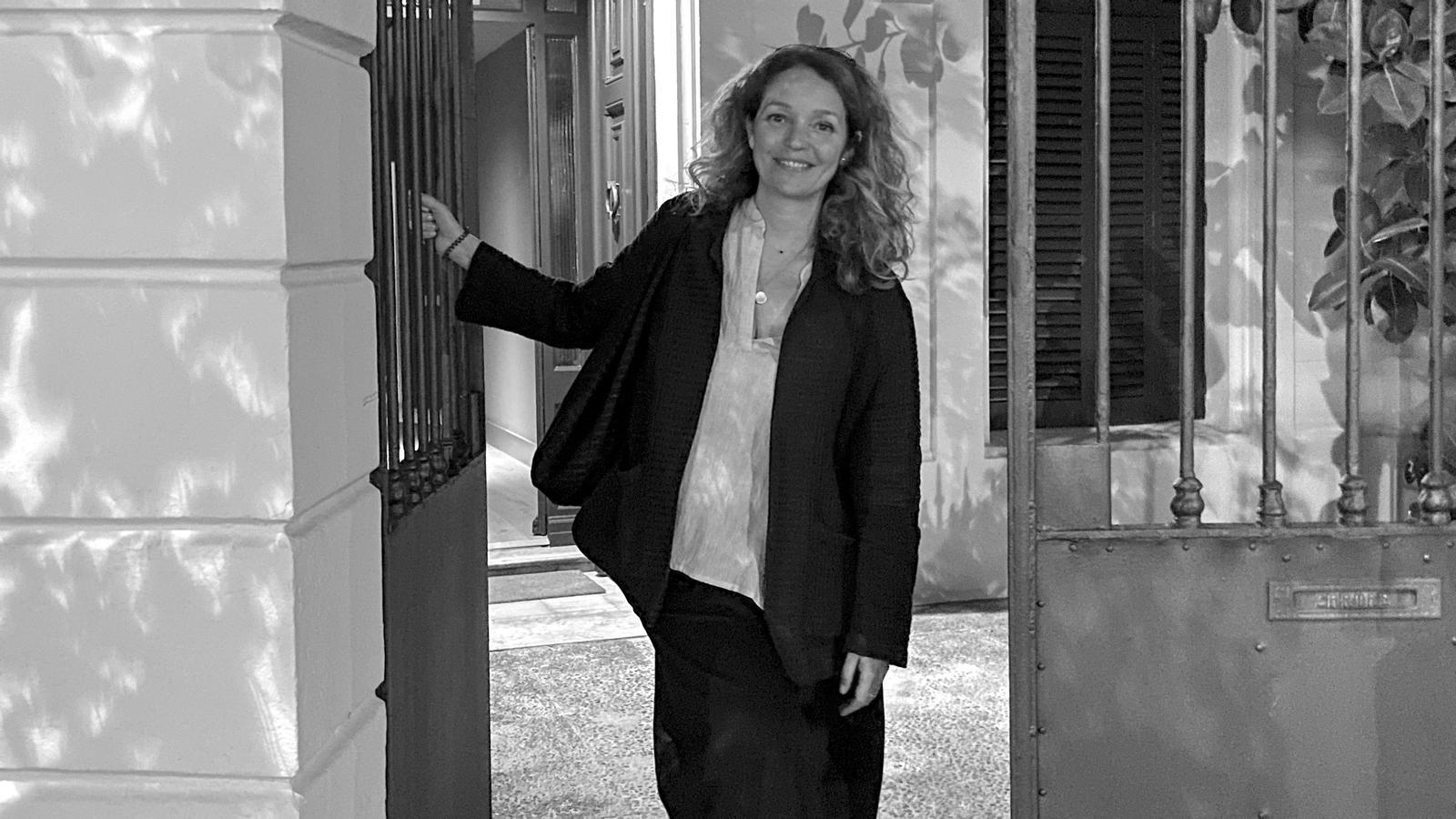


Like a Gallic village in the middle of a residential neighborhood, on Via Augusta, the Photographic Social Vision Foundation is a beautiful little house with a charming garden. Inside, around fifteen professionals work to promote photojournalism and the social dimension of photography. On WhatsApp, the director of the Foundation, Silvia Omedes, who is also the architect of the World Press Photo exhibition in Barcelona, looks at the interlocutor, in the black and white captured by her friend Imma Cortés, from this garden, which is ideal for reflection.
Daughter of a photographer. Was the vocation born at home?
— My mother worked as a semi-professional for a few years. And I especially remember the day she sat me on her lap, hung her camera around my neck, and taught me how to hold it: the shutter speed, the aperture, the light, the composition... I was eight years old and I felt that she was sharing her power with me.
A superpower!
— I was impressed by how my mother could capture life: our life. Years later, she gave me her first camera... which was stolen from me on Carrer Sant Pau a month later. I went out like a rocket to take photographs around Barcelona and, distracted in a bar, it was taken from me.
Which is the photograph taken by her that you like the most?
— Oh, I have never asked myself that question...! Mother was a very good portraitist. She captured people when they were present, as if she had a scanner capable of truly seeing them. Photography brings us closer to people's souls, and that captivates me deeply.
And what if we have killed this mystical power in today's children, by saturating them with images?
— Ah, here you touch upon a topic that concerns us a lot at the Foundation: the time we dedicate to understanding things. We know from the figures that reading comprehension of texts is at a minimum, but visual comprehension is as well.
Why?
— We have evaluated the level of comprehension of students who visited the World Press Photo and only 2% of those surveyed knew how to find different levels of language within an image. One of the main problems is the little reading time that is dedicated because we do not stop scrolling. scrolling. We receive millions of images, but we do not dedicate enough time to analyze them.
To read them?
— To read them, yes: an image has as much narrative power as a text. Historically, the image had been used to illustrate texts. But we know that is not the case, that it has many capabilities and possible readings. And we want students to know how to read them, because they are just as prone to being manipulated by text as they are by images.
How should we face a photo for the first time?
— It is always good to be well accompanied the first time. All the information you can provide is good. If you place a child in front of an image, a sculpture, a movie, and you give them time to think and then express doubts, emotions... they will never forget it, you have activated something in them. But today's society wants us passive and distracted.
You have been a jury member for the World Press Photo. What must an image have to win?
— Visual power and a key ingredient: the ability to challenge you, to question you, to put you to work intellectually.
The need to draw attention can foster the spectacularization of pain.
— Twentieth-century photojournalism has been guilty of an excess of photo-spectacle, usually of conflict: images with a wide-angle lens, at the barrel of a gun, with soldiers flying through the air. Or let's think about the NGOs of the eighties: when they wanted to raise awareness, they did the same thing. The wide-angle lens, the high-angle shot that deformed the starving African child, with the snot and the flies... that no longer works. Photo-spectacle has made us live in a state of visual anesthesia.
At the same time, we do not want to turn our backs on pain.
— It is not that I am in favor of showing blood and guts, but it is necessary to have photographers documenting. Afterwards, a graphic editor will decide what to show, but the material must be recorded. Because if we no longer send photographers, or do not give them time, we impoverish our understanding of reality.
Are many AI-manipulated photos arriving?
— We arrived in Amsterdam to form the global jury and on the first day they told me: I am sorry, but 60% of the entries you chose in Europe as potential winners have been manipulated, according to our forensics experts. My heart sank, because there were some spectacular entries.
Photographs are retouched for light, color... should AI also be accepted?
— An organization like this, which bases all its value on trust, cannot accept that a photographer deletes a pigeon because it made the photo look strange. World Press Photo is one of the few contests that verifies: we are not painting images, we are recording.
Painting images is very tempting.
— Or decorate them to make them impactful. There are cameras that are already integrating artificial intelligence at the moment of capturing. They fill in missing information for you, add texture, light... If we open the door to this, in three years we won't have documentary photography.
The winning image is called “Separated by the ICE”. Guide me and explain why it is the best.
— Carol Guzy stood for a thousand hours at the New York courthouse, one of the few where the press had access. ICE takes advantage of the fact that they come with their papers to regularize their situation and arrests them in a corridor, with their faces covered. The photographer captures a man, Luis, at the moment they are taking him away. But we do not see his face: only the desperate daughters pulling at his t-shirt to hold him back. The jury valued the tensions on a visual and compositional level, which are very powerful.
Agreed. But now I want your assessment.
— I was absolutely against this photo winning. I was one of the people who opposed it the most. Three of us were against this photo winning, but four voted in favor, so it was a democratic decision.
What were your objections?
— To this day we still do not know the names of these girls, who are being revictimized all over again, without anyone telling us who they are. And I can understand it: if I were the mother of these children I would hide them because I do not want all the media to come and rub salt in the wound by asking me what happened and how I feel.
Will you tell me the photo you are going to defend?
— Yes, it is a very powerful portrait of Doña Paulina, an Achí Maya woman who last year won the first trial in Guatemala, in which 36 women denounced their rapists during the armed conflict of the eighties under the government of Ríos Montt. Doña Paulina pierces us with her gaze: that which we said about the power of great portraits.
Do you remember the first photograph you took with intention?
— Indeed... I took a portrait of my father, who passed away recently, and I still keep it. In the photo, he was inside a car, angry. I was walking with my mother and my father was coming from Barcelona: one of those summers when parents work all week and arrive on Fridays. He must have been burnt out, or tired: I perceived a mood, an “something is going on here”. To portray is just that.
