The 20 years of '.cat' in anecdotes: "And what do you want a domain for cats?"
Digital diary with curiosities, statistics and impossible stories of 20 years of making Catalonia exist as an entity on the internet

-
CAT -
CAST
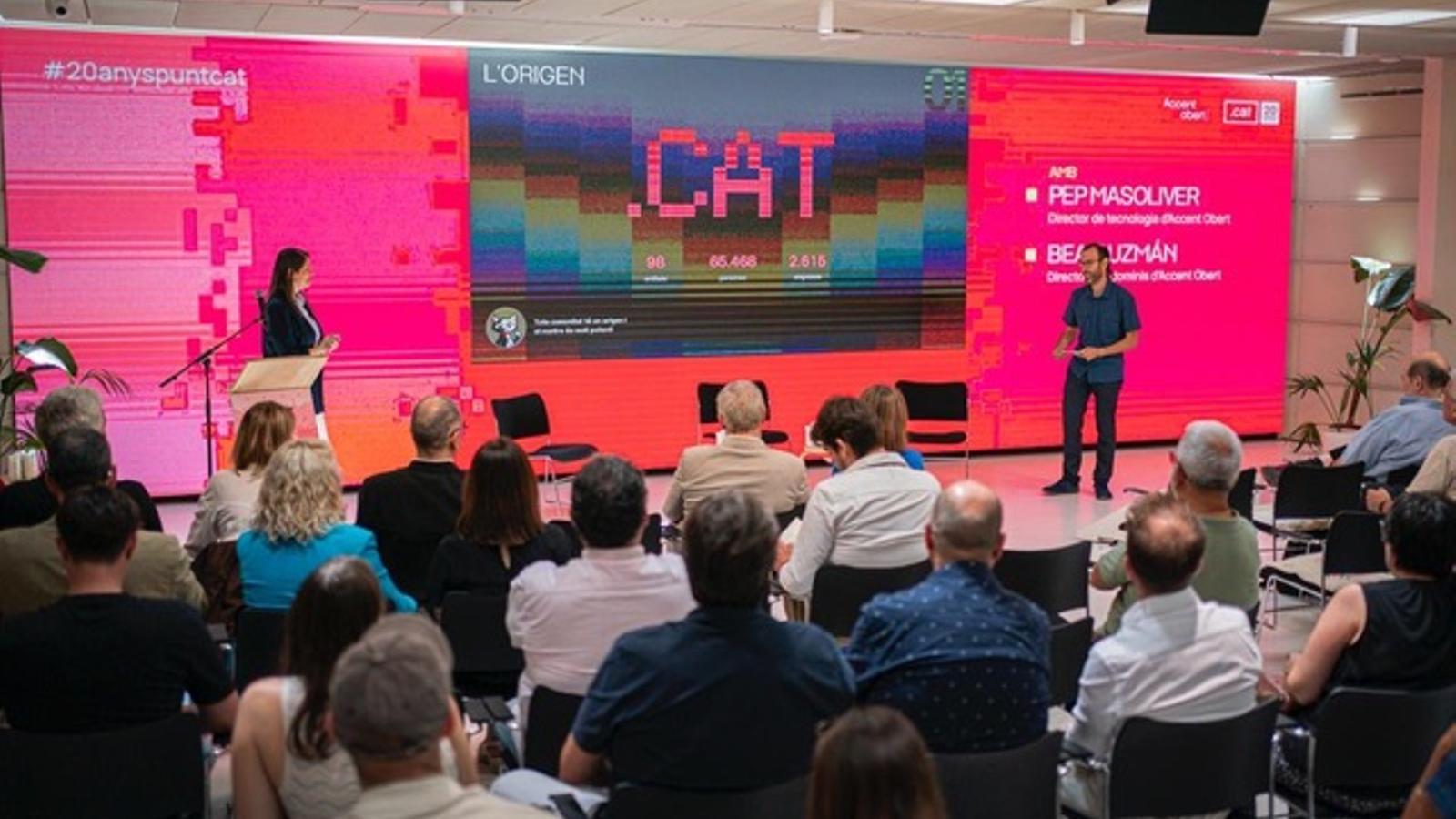
BarcelonaMore than two decades ago, representatives of a very active Catalan-speaking internet community suggested to ICANN, the organization that regulates internet domains, the possibility of creating a top-level domain not linked to any state (.fr, .uk, .es) or any type of activity (.com, .edu, .org), but to a language and a culture. The response was one of skepticism. "'What do you want a domain for cats for?', they asked us," recalled Amadeu Abril, one of the three original promoters of the .cat, a few days ago, at an event commemorating the domain's 20th anniversary.
Ironically, today, among the more than 118,000 active .cat domains (4.5% more than a year ago), there are over 350 that do refer to cats and other felines, from the classic Gat.cat to the viral Nyan.cat. But the tone of the original question made it clear that, in 2003, requesting a domain for a stateless language was a technical and political anomaly. The first .cat domain to exist, in fact, was an internal joke by the engineers at the puntCAT Foundation: on December 21, 2005, they registered Tan.cat, which still works today.
Three Catalans before ICANN
Behind that response were Abril, Manel Sanromà, and Jordi Alvinyà, the three promoters who on March 16, 2004, presented a formal candidacy to ICANN with an argument that no other has ever been able to wield: the explicit support of 98 entities and associations, 2,615 companies, and 65,468 citizens from all Catalan-speaking territories. This was precisely what decisively helped to open negotiations between ICANN and puntCat, the entity born as an association and later transformed into a foundation.
Along the way there were obstacles, including the formal protest of a Spanish ambassador to ICANN. But the political context also played in their favor, as Sanromà himself explained at the event: "In part, we got the .cat thanks to the 11-M attacks in Atocha, which led to a change in the government of the State, and the then Minister of Telecommunications, the Catalan José Montilla, did not oppose it as a member of the PP would have." ICANN finally approved the .cat domain on September 16, 2005, and on April 23, 2006, Sant Jordi's Day, registration was opened to everyone.
In the first year, 19,693 .cat domains were registered. Today there are more than 118,000
, with a curve that has never been linear. There have been moments of euphoria, such as the early years or the wave of the "Procés" in 2017, and also of containment, typical of an already mature market. The .cat, moreover, has a higher renewal rate than .com: nine out of ten holders renew the domain each year, a figure that denotes, above all, usefulness. It is no coincidence: .cat better positions Catalan content. Currently, in the first million most visited websites, there are 391 (79% more than in 2010) under the .cat domain, led by Gencat.cat.
The first two years the trend words were sant, for new municipal websites, and hotel, for tourism interest. It could be said that registrations function as a seismograph of the country. In 2010, the year of the Constitutional Court's ruling on the Statute, the most repeated word in new domains was Catalonia. 2017 and 2018 were the years of republic and junts. And in 2020, with the confinement of March 14, an avalanche of domains with covid was triggered, although 73% were abandoned before two years: the impulsive registration of an emergency that passed quickly. "When you trace twenty years of .cat data, you realize that the domain is, in reality, a diary of the country," summarizes Beatriz Guzmán, director of the domain area at Accent Obert (AO), the entity that inherits the Foundation and currently manages the .cat.
The domain has left home
. And in 2020, with the lockdown on March 14, an avalanche of domains with Beyond the territory, .cat has also made its fortune. After the rest of the State (7,384 domains), the United States (1,764) and France (984) have a significant presence, followed by China (803) and Germany (587): Catalans in the diaspora, but also companies looking to sell to Catalan speakers. The furthest point on the map is, literally, on the other side of the world: in New Zealand there are two .cat domains registered, a travel agency and an independent developer.
.cat allows up to 63 characters, and someone has taken it seriously: the longest active domain –Arxiudelabasilicadelssantsmartirsjustipastor.cat– has 44. The shortest, on the other hand, is content with a single accented character: Ò.cat, from Òmnium Cultural. This takes advantage of the domain's ability to accommodate the eleven characters unique to the language
through so-called IDNs, which now account for 1.1% of the total .cat domains.
The language also leaves its mark every year. Since 2014, the neologism of the year consecrated by Termcat usually passes through the street and .cat domain registrations first (drones, estelades, cassolades), although words without direct commercial appeal tend to generate fewer registrations: in general, what can be sold is registered. There are domains that do not resign themselves to dying: one out of ten of those that have been cancelled, generally for violating rules on content or intellectual property, have been reborn. Messi.cat has lived six lives; Spotify.cat, eight; 404.cat, ten. The record, however, belongs to a strange trio: Realestate.cat, Sexy.cat, and Pepsi.cat have each had eleven lives.
Small holders
Behind all this are mainly ordinary people: according to Pep Masoliver, AO's director of innovation, almost half of the domains, 47.6%, are from a single domain, and 25.5% have between two and five. The first citizen to register one for personal use was Xavier Vernetta: Xaviervernetta.cat, which still works today. One in ten .cat domains contains a person's name, with "Montserrat, Montse i Blanca" and "Albert, Carles i Xavier" among the most repeated. Traditional culture has a weight: three out of four casteller groups with a website have chosen .cat, a figure that rises to 85% among traditional groups from Catalonia, the Balearic Islands, and Northern Catalonia.
Vint anys després, el domini que va néixer entre el dubte i la incredulitat s'ha convertit en una referència per a altres comunitats lingüístiques i culturals que, des de llavors, han seguit el mateix camí davant l'ICANN. En la mateixa jornada commemorativa, Ronald Schwärzler, de geoTLD, l'associació que representa els dominis de primer nivell d'àmbit geogràfic, va agrair explícitament el suport que el .cat els ha donat en les seves pròpies gestions amb l'ICANN. El domini dels gats, deia la broma de fa vint anys, ha acabat sent la porta perquè una llengua i una cultura, sense necessitat de tenir un estat al darrere, puguin tenir casa pròpia a internet.
