Llorenç Corbella i Llorenç Corbella: "The set designers can multiply the grandeur of a show"
Set designers
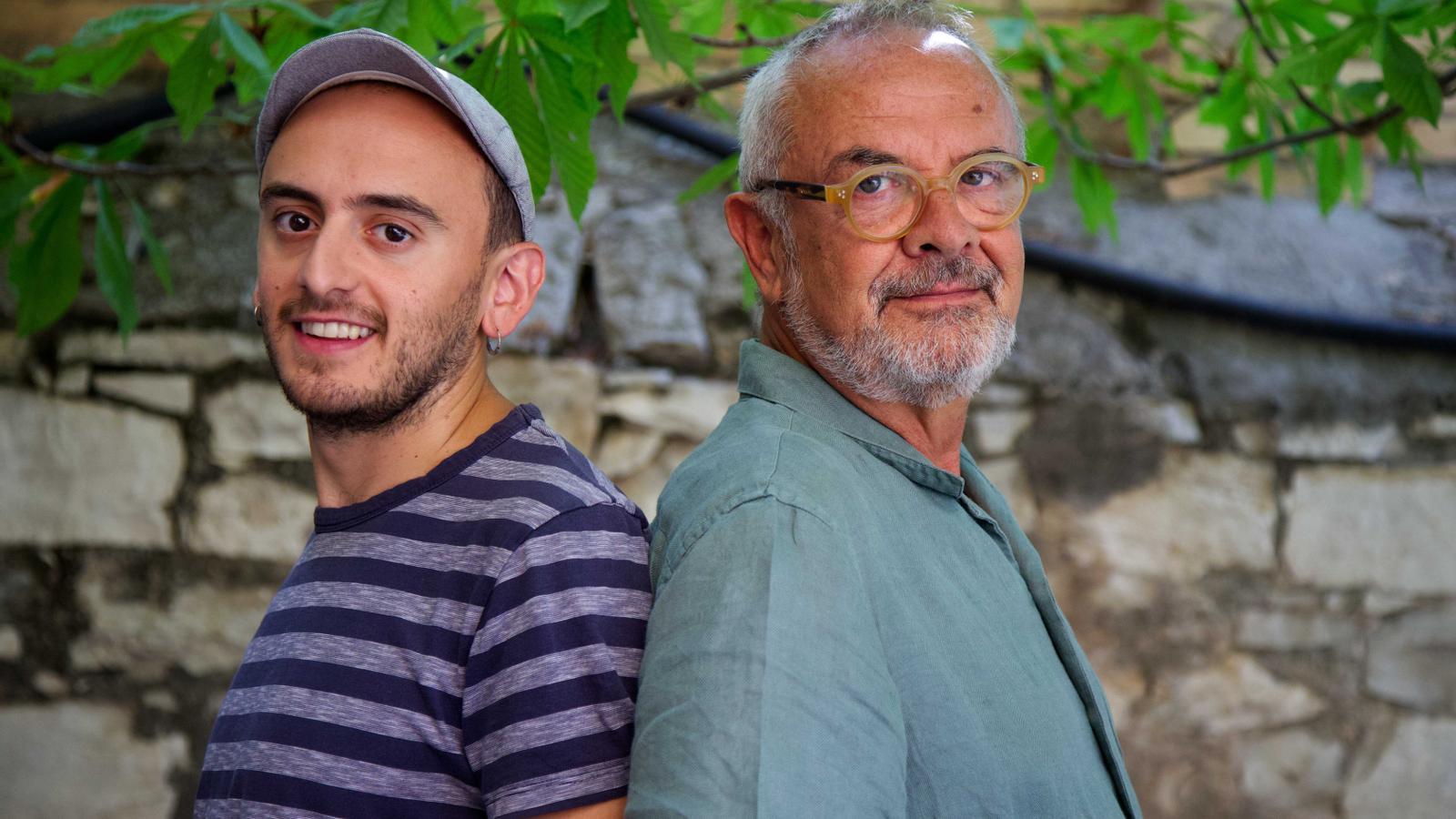

TàrregaSet design has a first and last name, twofold. Llorenç Corbella i Burgués (1997), aka Passerell, and his father Llorenç Corbella i Sambola (1958) are separated by a generation, but united by a vocation, some projects, and even the same studio in Tàrrega. We are talking about the art of set design, about circuits, and obviously, about the Street Theatre Fair.
Let's start with the origins. Passerell, how would you describe your father?
— PASSERELL: She is a very curious and observant person of everything around her. An artist of constant and persistent work. She dedicates many hours to it and perhaps I not so many…
— LLORENÇ CORBELLA: This reminds me that, once, after leaving a meeting together, you told me: “We have an hour left!” [laughs].
Are new generations more straightforward?
— LLC: We come from different experiences. I have dedicated my career to theater, dance, opera... I see that he is more open to everything, with a very different vision.
But you ended up doing the same art.
— Q: Without having foreseen it.
— LLC: It's not that I handed over the baton to him. We found ourselves in it.
— Q: I started with music, ephemeral arts, and installations to avoid theater and not do the same as my father. But in the end, I ended up doing it.
Is the set designer a technician or an artist?
— LLC: We are not technicians, because we get involved in projects that we don't even know how they will end. We always start with our own artistic idea, very conceptual. The technical part always comes after our idea.
— Q: Is it true that we often arrive through a commission, a project already preconceived. We have to accompany it and I think a lot of pedagogy is needed within the sector so that they don't just see us as technicians. We are in projects to make proposals, not just to execute those of others.
— LLC: If a director has definitively decided how they want the set design, they had better go to a construction workshop and not call us.
— Q: Leading a project is an act of trust in an entire team, open to other visions.
— LLC: Sometimes we have gone as far as to radically change the initial project or directors or producers have even come to me with nothing more than the title of the work to stage it from the set design.
— Q: Unforeseenly, set designers can multiply the grandeur of a project.
— LLC: Set designers are part of the grandeur of the show. This shows that a good play is the result of teamwork. It often happens to me that, at the time of staging, I don't know if the ideas that emerge were mine or someone else's. Everything merges during the creative process.
Does success always depend on a good budget?
— LLC: This is an excuse. We cannot say that a work would be better if we had had more money. Creativity is adapting to limitations.
— Q: Money alone can improve the way a work is presented.
The space, the light, the set design, the costumes… should they accompany the script or go off on a tangent?
— Q: A performance is a set of many layers of information that the spectator has to unravel. It is a whole that sparks the imagination. We have the example in the latest version of The Marriage of Figaro at the Liceu, where everything takes place on an immense wedding cake that occupies the stage.
— LLC: Sometimes I've been reproached by saying: "Why didn't you do something more realistic?". To begin with, when actors speak in verse or sing, it's no longer realistic! A set designer also has to make abstractions.

And what is your creative process like? Is it still one of sketches and small-scale mock-ups, or are we moving to version 2.0 and AI?
— Q: It all depends on where the commission comes from. Each project is a world. But it works well for both of us to always start with sketches on paper and pencil. We see that it is the best way to convey our idea. However, increasingly they ask us for the definitive conception, and this is where we move on to volumetric mock-ups (my father is more used to that) and digital designs in my case.
Are you afraid of being replaced by AI?
— LLC: I don't know where we'll end up, but I just see this as another work tool, like another brush that serves to show our idea to the artistic team. Afterwards, there's the whole stage setup where AI is incapable of acting. For now...
— Q: In the end, the goal is for the team to understand our idea. It doesn't matter what tool we use. Afterwards, the plans with all the finishes will come.
— LLC: A sketch, a work of art, a photo, or an AI-generated image are different starting points for working on the set design.
And from idea to execution. Is the performing arts circuit still narrow in our country? Is more public aid needed?
— I would like there to be no subsidies.
Really?
— LLC: If companies had many performances, it would mean they would have jobs and enough income. Depending too much on subsidies is not good. And this, lately, happens a lot in our country.
— Q: We are working based on subsidies, their requirements, the amount of money they grant... If they didn't exist, we would work differently.
— LLC: Years ago, there were no subsidies, but there was spectacle. We had the need to do theater. With the subsidy, even though it helps us, they are buying us.
And how can it be reversed?
— LLC: That the administration focuses on facilitating circuit. From governments to city councils. That at the main festivals there be dancing, but also visual arts!
The Fira del Teatre al Carrer of Tàrrega assumes this role of circuit dynamizer, doesn't it?
— LLC: Cert. For many years it has been like this.
— Q: The Fair is a good tool, but beware! It also receives subsidies and programs according to them.
In any case, you two live off this profession. That means there's a future, right?
— LLC: If in 1981 I had imagined doing everything I have done, I would have believed it impossible. It has not been an easy path, with times of all kinds and many concessions, but looking back I think I can say that it has not been bad at all.
— Q: I'm now pressing many buttons, the ones that have come my way, and I've never stopped to think about what I really want to be. Sometimes I think I need more experiences and to suffer a little more before taking on certain projects.
— LLC: Well, I have taken on projects that, looking back now, I confess I didn't have the knowledge to do them.
Were you reckless?
— LLC: Totally. I think you have to be aware of where you are getting yourself into, but if we rationalized everything too much, we would stop doing many things. We have to get out of our comfort zone more.
— Q: For now I'm avoiding stomach aches... and thus having my space.
Passerell is a way to escape a name and surname that weigh too much?
— I have never felt pressured. I want to sign as Passerell because it identifies me, it's a kind term that denotes naivety, learning, and restlessness, as well as being the name of a bird species very typical of here. This way I create my own brand, to avoid confusion with my father.
Is over 65 years old. When does a stage designer retire?
— LLC: I've never considered it. My instinct tells me that if they propose interesting projects, I'll keep accepting them. It's the work I've done all my life and I like it. But it must be said that now, facing the new generations coming up, I try to keep quiet as much as possible and contribute something only when asked.
