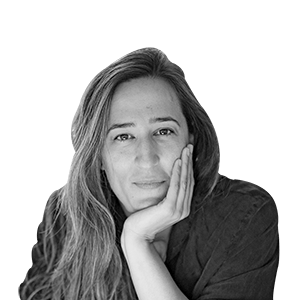
Yaya Buschraft: "I want to die in the cabin made by me "
Hut builder. Publishes 'Live without asking permission'
-
CAT -
CAST
Yaya Buschraft asks us not to say her real name, nor where she lives. She is in the mountains, that's for sure. Anyone who follows her on social media knows this, where she has thousands of followers, to whom she explains her day-to-day life building cabins. She decided this would be her life project when she was nearing 70, and now she tells her story in the book Living without asking permission (Penguin).
Who are you?
— A person who loves to build forts.
Why cabins?
— I fell in love when I was 8 years old. With huts and with wood. Wood... is alive.
Why do you like them?
— It's a constant challenge. I had no idea how they were made, I grabbed a YouTube tutorial and photographed it, frame by frame, piece by piece, to understand what the hell it was.
And the result?
— The first cabin fell down on me, the second is at the very top of the mountain peak, the third is bioconstruction, a wall has also fallen off it, and the fourth is this one you see here. Which also has some errors. When I started I said: five cabins. The fifth will be the definitive one to live and die in a cabin made by me.
In the book, Bukowski is quoted: "Only the mad and the lonely can afford to be themselves, because the lonely don't need to please anyone and the mad don't care about being understood." Are you crazy?
— Totally. I don't reach Bukowski's level, but I am a perfect iconoclast, a bohemian, and I break molds without meaning to. It's not deliberate, it's my way of being. Easy things bore me, difficult things are a challenge.
Crazy... and also lonely?
— Yes, I am very open, but also closed. Heraclitus' law of opposites.
You have started sleeping in the cabin. What is a night like here?
— Magical. There is a silence... and I have Pitxi and Mitxi here. They are mountain mice.
Are people missed?
— No, in fact, with the book presentation, what unsettles me is so many people next to me.
Why Yaya?
— Because grandmothers are people who have lived, they are wise. And for me they are sweetness. And Buschcraft is the forcefulness, not to be a wilting flower. The forcefulness and the challenge of building a cabin.
Grandmothers are great.
— I am 71 years old, darling. I am old.
And do you feel great?
— I have always felt old. When I was young, I hung out with old people, and now that I'm old, I hang out with young people.
And isn't what you're doing typical of someone younger?
— Don't be ageist, you will receive it.
But there are things you don't do in your 70s, supposedly.
— So many things are assumed… Look at the book title.
To live without asking permission. How do you live without asking permission?
— Without believing the “it is supposed to”.
But what did your environment say when you said: I'm going to make huts?
— I didn't say it. I did it.
And how is the decision made? Is there a click moment?
— It's a process. It started when I went to Meeting Camper, it continued with YouTube videos, I loved it and I said: I have a dream that overcomes me. Because I didn't have the knowledge, nor the physical strength, nor anything... but I had one thing that characterizes me: passion.
And why?
— What? To shit on it? No.
What does it teach you to make huts?
— To believe in myself. To discover how strong, how magical, how stubborn I am, because I am very much so. It is also a therapeutic value. It has given me a lot of strength.
If you don't live there, why do you make them?
— To learn, does it seem like little objective to you? I believe that today this society has everything so easy that they will get sick of disgust. Because in what is easy there is no learning and learning is life.
You're very popular on social media, many people follow you. Some say nice things, and others don't...
— The haters. Or the digital psychopaths.
What do you think?
— Poor people. I tell you honestly, eh. At first it surprised me, but I am very clear that when one is happy and comfortable with oneself, one does not waste time telling the other what to do or what not to do, not even giving advice. When you are happy, you live. And I suppose when you are not happy, seeing someone who is happy must really get on your nerves.
They criticize me for being posh.
— Yes. But pija is for the nouveau riche. I am bourgeois, with great honor. I am what the bourgeois call bobo, a bourgeois bohemian.
But you have lived through complicated situations, you explain it in the book
— And those that I haven't explained.
Do you know what it is to lose your home, you have been evicted.
— Yes, I was evicted. I was rebellious, I saw things in my family and my surroundings that I didn't like. I lived abroad, I went to India, and upon returning I dismantled the persona and ended up making peace with my origins. Some time ago you called me bourgeois and it was an insult. And now, with my mouth full, I say: my father's surname, yes.
Speaking of surnames, what does your daughter say to you?
— My daughter is an actress. We respect each other a lot. I have never looked in her bag to see what she carries and what she doesn't. Those of us who are parents know that raising a child is not easy. That we make the same mistakes our parents made with us. If you realize it, it's not that you can fix it, but it can be a learning experience.
Like huts, right? The fifth is not the same as the first. But with children... you can't go back.
— I have always told my daughter that I cannot fix the past. I didn't know how. They didn't teach me. But the present, yes. If it helps you, go ahead. And yes, it helps her.
What are you proud of?
— Of myself. Of these huts and what they represent. Because even though I've always pushed forward, I've also doubted. I won't show it to you, but inside I can be doubting. And before I attacked, and now I don't need to. I don't have to prove anything to anyone. As a science journalist, because I was the second woman in this country to write about science and technology, when I returned from India I threw it all to the wind. And I found myself cleaning and the wall told me nothing, neither good nor bad. It stayed there, clean. Or I ironed the clothes, and it told me neither good nor bad. It was there, clean. And the hut, I feel it has a similar point. I give it five, it gives me back five. I give it ten, it gives me back ten. And if I give it nothing, it gives me nothing. It's a marvel. And it's also feeling that I have a place for myself.
In the end you say you want to die there.
— Yes, in the fifth. What I have learned previously I will apply there and it should be enough. Although now I think I will make other mistakes.
Why die in the cabin?
— Because I don't like houses, I don't like cement. If it's not wood, I don't like it.
In fact, at the beginning of the book you say: "One day I was in the mountains".
— I remember that in the houses I have lived in, when there has been a garden, I had a tent and slept in the garden in the summer. My mother always said "Damn it, girl". Nature, for me, is a healing element, it is a vivifying element and it is my projection. I am sorry that people mistreat it, that people take it for their trash can. That they leave their shit there. That the pissing people don't respect the mountain paths. This lack of respect for nature, when we are nature, says a lot about the disconnection that a person has with themselves.
